


Best Waterproof Fabrics for Bags: Features & How to Choose the Right One
Jun 12, 2026
Leave a message
The best waterproof fabric for bags depends on what the bag must survive.
A daily commuter backpack does not need the same material as a kayak dry bag. A promotional waterproof pouch should not be built like a motorcycle roll bag. A cooler bag needs waterproofing, but it also needs easy cleaning and insulation compatibility. For a dry bag, the fabric must work with welding. For a backpack, the fabric also has to bend, carry weight, and feel comfortable against the body.
For most waterproof bags, the common choices are PVC tarpaulin, TPU-coated or TPU-laminated fabric, PU-coated nylon or polyester, coated Oxford fabric, and recycled options such as RPET-based fabrics.
The real decision is not only "which fabric is waterproof."
It is which fabric, coating, seam method, closure, and cost structure fit the bag project.
How Waterproof Bag Fabrics Work: Base Fabric + Coating + Construction
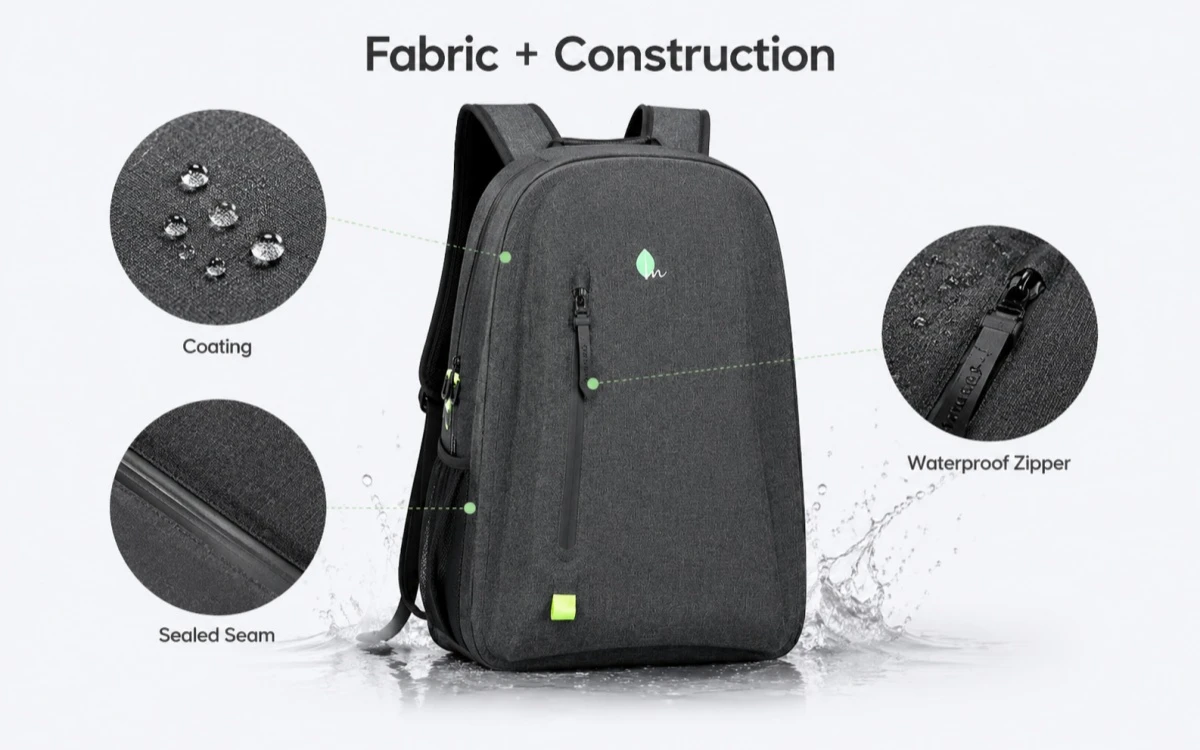
A waterproof bag fabric is usually not a single material. It is often a composite structure made from a woven base fabric and a waterproof coating or film.
The base fabric gives strength, shape, tear resistance, and texture. The coating or lamination blocks water. The construction method decides whether the finished bag actually keeps water out.
A waterproof fabric alone does not make a waterproof bag.
If a fabric is fully waterproof but the seams are stitched with needle holes, water can still enter. If the opening uses a normal zipper, water can pass through. If the material cannot be welded properly, the bag may fail in production or during use.
Base Fabrics: Polyester, Nylon, Oxford, and RPET
Polyester is widely used because it is stable, cost-friendly, and easy to coat. It is common in daily bags, promotional waterproof bags, cooler bags, and PVC-coated tarpaulin structures.
Nylon is usually stronger and more abrasion-resistant than polyester at a similar weight. It is often used for waterproof backpacks, duffel bags, travel bags, and outdoor gear bags that need better tear strength.
Oxford fabric refers to a basket-weave fabric structure, usually made from polyester or nylon. In bag production, buyers often see specifications such as 300D Oxford, 600D Oxford, or 900D Oxford. A higher denier often means a thicker and heavier yarn, but it does not automatically guarantee better waterproofing. Coating quality matters.
RPET fabric is made from recycled PET materials, commonly plastic bottles. It is mainly used when a brand wants a sustainability story. RPET still needs a waterproof coating or lamination if the final product must resist water.
Base fabrics create the body of the material. They are not enough by themselves for strong waterproof bags.
Waterproof Layers: PVC, TPU, PU, and Membranes
PVC coating creates a tough waterproof barrier. It is common in heavy-duty dry bags, marine bags, motorcycle waterproof bags, and industrial waterproof gear. PVC is cost-effective and welds well, but it can feel heavier and stiffer.
TPU coating or lamination uses thermoplastic polyurethane to form a flexible waterproof layer. TPU is often softer, more cold-resistant, and better suited to premium outdoor products. It usually costs more than PVC.
PU coating is often used on nylon or polyester for lighter waterproof or water-resistant bags. It keeps a more textile-like hand feel, which is why it works well for commuter backpacks, rain covers, school bags, and lightweight travel bags.
Waterproof breathable membranes, such as ePTFE-based membranes used in technical outdoor gear, are designed to block liquid water while allowing water vapor to pass through. They are common in apparel and some technical gear. For most dry bags and welded waterproof bags, PVC and TPU structures are more practical.
Construction: Welding, Seam Sealing, and Closures
The finished waterproof level depends heavily on production method.
Common waterproof bag construction methods include:
- High-frequency welding: often used for PVC and some TPU materials
- Heat sealing: used for compatible coated or laminated fabrics
- Seam taping: used on sewn bags to reduce leakage through stitch holes
- Roll-top closure: common on dry bags and marine bags
- Waterproof zipper: used when roll-top closure is not suitable
- Leak testing: used to check finished product performance before shipment
For strong waterproof products, especially dry bags, kayak bags, and motorcycle bags, welded seams are usually more reliable than ordinary stitching.
The fabric is only the starting point. The bag becomes waterproof when material and construction work together.
Waterproof vs. Water-Resistant: What Buyers Should Know
Water-resistant fabric can resist light rain or splashes for a limited time. It may use a DWR surface treatment, PU coating, or tight weave.
Waterproof fabric is designed to block water penetration under pressure, usually through coating, lamination, or membrane technology.
Fully waterproof or submersible bag construction means the entire bag system is designed to resist water entry, including fabric, seams, closure, zipper, welding, and structure.
These terms are often used loosely in marketing. That creates problems for buyers.
A backpack with DWR-treated fabric may shed rain at first, but the surface treatment can wear off after abrasion. A PU-coated fabric may handle short rain well, but if the seams are not taped, water can enter through stitch holes. A dry bag made from PVC tarpaulin may be highly waterproof, but only if the welding and roll-top closure are done correctly.
For fabric testing, buyers may see hydrostatic head ratings such as 3,000 mm, 5,000 mm, or 10,000 mm. This rating measures water pressure resistance under lab conditions. It is useful, but it does not replace finished bag testing.
A practical way to think about it:
| Waterproof Need | Typical Use Case | Material Direction | Construction Requirement |
|---|---|---|---|
| Light rain protection | Commuter bags, school bags | PU-coated polyester, coated Oxford | Sewn seams may be acceptable, seam taping preferred |
| Heavy rain protection | Outdoor backpacks, travel bags | PU/TPU-coated nylon, PVC-coated fabric | Taped or sealed seams, protected zippers |
| Strong waterproofing | Dry bags, kayak bags, marine bags | PVC tarpaulin, TPU-laminated fabric | Welded seams, roll-top closure |
| Short-term water exposure | Boating, fishing, motorcycle use | Heavy-duty PVC or TPU | Welding, waterproof zipper or roll-top, leakage testing |
For B2B buyers, the safer question is not "Is the fabric waterproof?"
Ask: What waterproof level does the finished bag need to pass?
Learn more about the differences between waterproof, water-resistant, and moisture-proof.
Common Waterproof Fabrics for Bags: Features, Pros, and Limitations
Different waterproof bag materials solve different problems. The wrong fabric may still look good on a spec sheet, but fail in weight, stiffness, cost, welding, or user experience.
PVC Tarpaulin
PVC tarpaulin is a polyester or nylon base fabric coated with PVC. It is one of the most common materials for waterproof dry bags and heavy-duty outdoor bags.
PVC tarpaulin is popular because it is tough, waterproof, easy to clean, and compatible with high-frequency welding. In real bag production, this matters. A welded PVC dry bag can avoid stitch holes completely, which is why PVC is widely used for roll-top dry bags, waterproof duffel bags, motorcycle bags, kayak bags, and marine gear.
Typical PVC tarpaulin materials may range from around 250D to 1000D base fabric, with different coating thicknesses depending on product grade. Heavier tarpaulin gives better structure and abrasion resistance, but also adds weight.
Best for:
- Dry bags
- Kayak bags
- Marine gear bags
- Motorcycle waterproof bags
- Heavy-duty waterproof duffel bags
- Industrial waterproof storage bags
Limitations:
PVC can feel stiff, especially in colder environments. It is usually heavier than PU-coated nylon or polyester. Some brands also avoid PVC because of sustainability positioning or market compliance concerns.
PVC is not a "cheap material" by default. Good PVC tarpaulin still needs stable coating, good adhesion, clean welding behavior, low odor, and consistent thickness. Low-grade PVC can crack, smell strong, delaminate, or show poor print quality.
TPU-Laminated or TPU-Coated Fabric
TPU fabric uses thermoplastic polyurethane as a waterproof layer. It can be laminated or coated onto nylon, polyester, or other base fabrics.
TPU is often selected for premium waterproof bags because it is softer, more flexible, and better suited to cold conditions than many PVC options. It also has a better sustainability image, especially when a brand wants to reduce PVC usage.
TPU works well for high-end dry bags, outdoor backpacks, cycling bags, compact waterproof pouches, and tech bags. It is also used where touch and flexibility matter. A TPU-coated nylon backpack can feel less bulky than a heavy PVC tarpaulin bag.
Best for:
- Premium dry bags
- Waterproof backpacks
- Outdoor travel bags
- Lightweight waterproof pouches
- Tech protection bags
- Cold-weather outdoor products
Limitations:
TPU costs more than PVC in many projects. Material thickness also matters. A thin TPU fabric may feel excellent, but it may not be suitable for large-capacity bags or heavy water pressure. If the buyer increases thickness to improve performance, the cost rises quickly.
TPU is a strong choice, but it is not automatically better for every bag.
PU-Coated Nylon or Polyester
PU-coated fabric is made by applying polyurethane coating to a nylon or polyester base. It is common in backpacks, school bags, rain covers, lightweight outdoor bags, and travel accessories.
PU-coated nylon keeps a textile feel while adding water resistance or waterproof performance, depending on coating quality. For everyday bags, this is often the best balance. The bag still looks and feels like a normal fabric bag, not a rubberized dry bag.
Nylon with PU coating is often used when weight and tear strength matter. Polyester with PU coating is more cost-friendly and stable for larger-volume production.
Best for:
- Commuter backpacks
- School bags
- Rain covers
- Lightweight travel bags
- Outdoor daypacks
- Promotional waterproof bags
Limitations:
PU-coated fabric is not usually the first choice for heavy-duty dry bags. It may require seam taping if the bag is sewn. The coating can also degrade over time if the material is low quality or exposed to heat, humidity, and abrasion for long periods.
PU-coated fabric is excellent for controlled rain protection. It should not be treated as a direct substitute for welded PVC or TPU dry bag materials.
Coated Oxford Fabric
Coated Oxford fabric is common in daily bags and cost-sensitive outdoor products. It is often made from polyester and finished with PU, PVC, or other waterproof coatings.
Specifications such as 300D Oxford and 600D Oxford are often used in sourcing discussions. For daily backpacks, 300D or 600D coated Oxford can offer a practical balance of price, strength, and water resistance.
A 300D PU-coated Oxford fabric may be suitable for city bags and light outdoor use. A 600D PVC-coated Oxford fabric may be used for stronger utility bags, tool bags, or promotional outdoor bags.
Best for:
- Daily backpacks
- Tool bags
- Outdoor leisure bags
- Promotional bags
- Cost-effective waterproof products
Limitations:
Oxford fabric quality varies widely. The denier number alone does not tell the full story. A poorly coated 600D fabric can perform worse than a well-coated 300D fabric. Buyers should check coating type, adhesion, abrasion performance, color fastness, and waterproof test data.
Coated Oxford is useful when the project needs cost control and basic weather protection. It is not the first choice for submersible or marine-grade dry bags.
RPET and Recycled Waterproof Fabrics
RPET waterproof fabric uses recycled PET as the base fabric, then adds a waterproof coating or lamination. It is common for brands that want recycled content in their product line.
RPET is attractive for sustainability-focused markets. It can be used in backpacks, cooler bags, shopping bags, outdoor pouches, and promotional waterproof bags. When paired with PU, TPU, or PVC coating, it can reach practical waterproof performance for many applications.
Best for:
- Eco-positioned bag collections
- Promotional waterproof bags
- Outdoor lifestyle bags
- Cooler bags
- Brand projects requiring recycled material claims
Limitations:
RPET can cost more than standard polyester. It may also have different strength, dyeing, and coating behavior depending on the supplier. For B2B projects, recycled content claims should be supported by supplier documents or certification when required by the market.
RPET is a good option when sustainability is part of the product value. It still needs the right coating and testing.
PVC vs. TPU vs. PU-Coated Fabrics: Which One Should You Choose?
Most waterproof bag projects eventually come down to three material directions: PVC, TPU, or PU-coated fabric.
Each has a clear place.
| Material Type | Waterproof Level | Weight | Flexibility | Cost Level | Manufacturing Fit | Best For |
|---|---|---|---|---|---|---|
| PVC tarpaulin | High | Medium to heavy | Medium | Low to medium | Excellent for high-frequency welding | Dry bags, marine bags, motorcycle bags |
| TPU-coated or laminated fabric | High | Light to medium | High | Medium to high | Good for premium welded or sealed products | Premium dry bags, outdoor backpacks, tech bags |
| PU-coated nylon/polyester | Medium to high, depending on coating | Light | High | Low to medium | Better for sewn and taped construction | Backpacks, rain covers, commuter bags |
| Coated Oxford fabric | Low to medium-high | Medium | Medium | Low to medium | Good for sewn bags and cost-focused products | Daily bags, tool bags, promotional bags |
| RPET-coated fabric | Depends on coating | Light to medium | Medium | Medium to high | Similar to polyester-based coated fabrics | Eco-focused bag lines |
Waterproof Performance and Seam Compatibility
PVC and TPU are usually better choices for bags that need welded seams. This includes dry bags, marine bags, kayak bags, and some motorcycle bags.
PU-coated nylon or polyester is better for bags that need a softer fabric feel, more sewing details, more compartments, or lower weight. It can be used for waterproof backpacks, but the seam treatment must match the waterproof claim.
A sewn PU-coated backpack with a normal zipper is not the same product as a welded roll-top dry bag. Both can be called waterproof in some marketing contexts, but their performance levels are different.
Weight, Flexibility, and Cold Resistance
TPU usually wins when flexibility and cold-weather hand feel matter. It is suitable for bags that need to fold, bend, or carry comfortably.
PVC gives strong waterproofing and abrasion resistance, but it can be heavier and stiffer. This is acceptable for dry bags and motorcycle bags. It may be less suitable for a lightweight hiking backpack.
PU-coated nylon or polyester is often the best answer for daily carry because the material feels like fabric and keeps the bag lighter.
Cost, Sustainability, and Brand Positioning
PVC is often the most practical choice for cost-controlled heavy-duty waterproof bags.
TPU fits premium outdoor brands better, especially when the product needs a softer hand feel, better cold performance, or a PVC-free positioning.
PU-coated fabrics suit mid-range and everyday bags where full dry-bag construction is not required.
The right choice depends on the buyer's product promise. If the sales page says "submersible dry bag," the material and closure must support that claim. If the product is a commuter backpack for rain protection, a lighter coated fabric may be the better commercial choice.
Best Waterproof Fabrics by Bag Type
Choosing by bag type is usually faster than choosing by material name. A buyer developing a dry bag, backpack, or cooler bag has different priorities from the start.
Dry Bags and Marine Bags
Dry bags need strong waterproof fabric and a construction method that avoids leakage through seams.
For this category, PVC tarpaulin and TPU-laminated fabric are the main choices. PVC is often selected for cost-effective production and strong welding. TPU is selected for premium feel, flexibility, and better brand positioning.
The usual structure is simple: welded body, roll-top closure, reinforced stress points, and buckle closure. The fewer stitched areas, the better.
For marine use, material thickness should be selected carefully. A lightweight dry bag for camping does not need the same fabric as a 60L boating gear bag dragged across a wet deck.
Waterproof Backpacks and Outdoor Travel Bags
Waterproof backpacks are more complex than dry bags. They may need shoulder straps, back padding, compartments, laptop sleeves, mesh pockets, and zippers. Every added feature creates a possible water entry point.
Common material choices include:
- TPU-coated nylon for premium outdoor backpacks
- PU-coated nylon for lightweight travel and hiking bags
- PVC tarpaulin for roll-top waterproof backpacks
- Coated Oxford fabric for cost-controlled daily waterproof backpacks
For a backpack, the back panel and shoulder straps also matter. A fully waterproof body fabric can still feel uncomfortable if the back structure is too stiff or non-breathable.
The best material here is the one that matches the bag's real use: commuting, hiking, cycling, boating, or travel.
Cooler Bags and Insulated Waterproof Bags
Cooler bags need waterproofing, but they also need insulation compatibility, easy cleaning, and safe lining options.
Common structures include outer coated polyester or Oxford fabric, inner PEVA or TPU lining, foam insulation, and welded or sewn construction depending on grade. For premium leakproof cooler bags, the inner lining and seam sealing become very important.
PVC or TPU materials can be used when the product needs strong water resistance and easy cleaning. PEVA is common as an inner lining because it is lightweight and suitable for many cooler bag designs.
For cooler bags, buyers should not select fabric only by exterior appearance. The inner lining, foam thickness, seam method, and zipper structure often decide user satisfaction.
Motorcycle, Kayak, and Fishing Bags
These bags face rain, abrasion, mud, UV exposure, and rough handling. A motorcycle waterproof bag may rub against racks or frames. A fishing bag may sit on wet ground. A kayak bag may be splashed repeatedly.
Heavy-duty PVC tarpaulin is widely used here because it handles welding, cleaning, and abrasion well. TPU-coated fabric can also work, especially for premium or lighter products.
For this category, fabric strength and seam strength are both needed. Reinforced panels may be needed at stress points, especially where straps, buckles, or mounting systems attach.
A good-looking lightweight fabric can fail quickly if the bag is dragged, strapped tightly, or exposed to repeated outdoor abuse.
Promotional and Daily Waterproof Bags
Promotional waterproof bags usually have a different goal: acceptable protection, good logo display, stable cost, and mass production efficiency.
PU-coated polyester, coated Oxford fabric, and PVC-coated polyester are common choices. These materials support printing, color customization, and lower unit costs.
The waterproof requirement should be clear from the start. A promotional pouch for beach use does not need the same material as a dry bag for paddling. Overbuilding the product wastes cost. Underbuilding it creates complaints.
For daily and promotional bags, the smart choice is often a balanced fabric, not the strongest fabric.
How to Choose the Right Waterproof Fabric for Your Bag Project
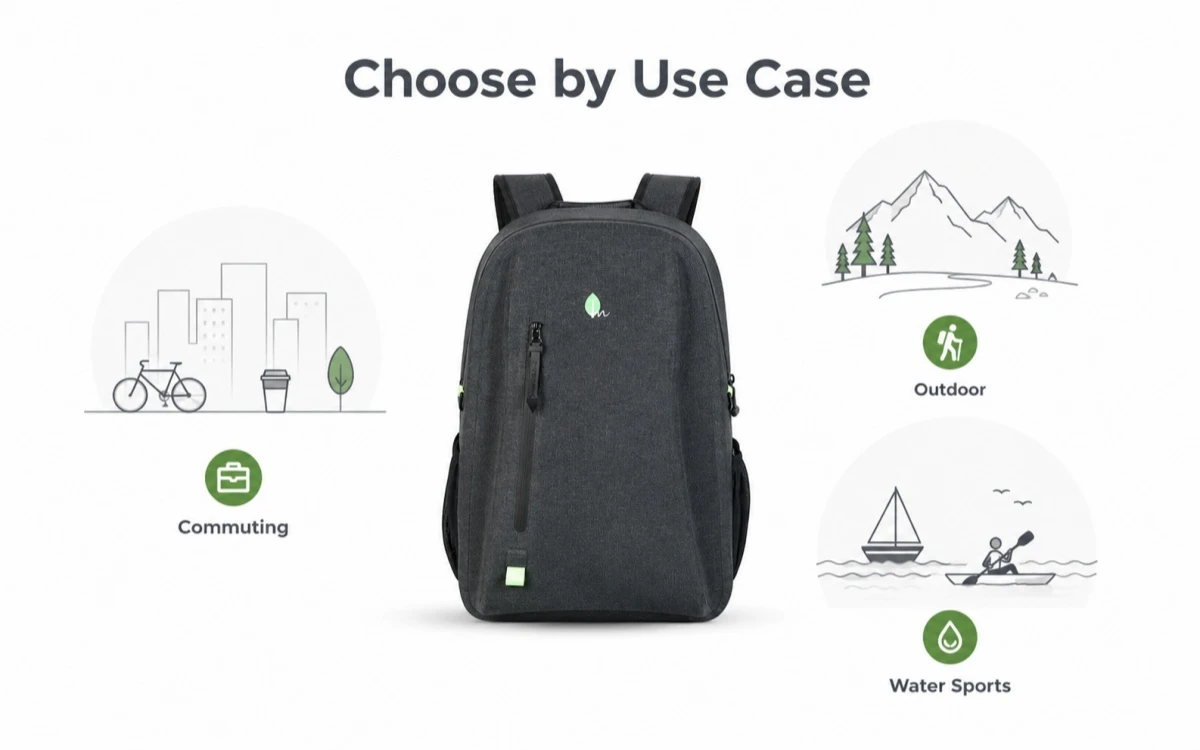
A fabric decision should start with the use case, not the material catalog.
Define the Waterproof Level
Start with the environment.
Will the bag face light rain during commuting? Heavy rain during hiking? Splashes on a boat? Short-term immersion? Long-term wet storage?
Each condition leads to a different material and construction choice.
For light rain, PU-coated polyester or nylon may be enough. For heavy rain, the buyer should consider stronger coating, seam taping, and protected zippers. For dry bags and marine products, PVC or TPU with welded seams is usually the safer route.
If the product claim is strong, the testing plan must be strong as well.
Check Fabric Thickness, Denier, and Durability
Buyers often ask for 300D, 600D, or 1000D fabric. These numbers refer to yarn thickness, not total waterproof performance.
A higher denier can mean stronger fabric, but durability also depends on weave structure, coating adhesion, coating thickness, abrasion resistance, and tear strength.
Useful specifications to discuss with a supplier include:
| Specification | What It Tells You | Why It Matters |
|---|---|---|
| Denier, such as 300D or 600D | Yarn thickness | Helps estimate weight and strength |
| GSM | Fabric weight per square meter | Affects cost, thickness, and product feel |
| Coating type | PU, PVC, TPU, silicone, etc. | Decides waterproof behavior and process fit |
| Hydrostatic head | Water pressure resistance | Helps compare waterproof level |
| Abrasion resistance | Surface wear performance | Useful for backpacks, motorcycle bags, tool bags |
| Tear strength | Resistance to tearing | Useful for load-bearing outdoor bags |
| Welding performance | Compatibility with welding equipment | Needed for dry bags and welded waterproof products |
Do not approve material based only on a name. "PVC tarpaulin" or "TPU fabric" can mean many different quality levels.
Match Fabric with Manufacturing Process
The best material on paper can fail if it does not match the production method.
PVC tarpaulin is usually well suited for high-frequency welding. TPU can also be welded or heat sealed, but the exact fabric structure must be tested. PU-coated fabrics are often sewn and seam-taped rather than fully welded.
The equipment matters. High-frequency welding machines, hot-air seam sealing machines, heat press systems, and waterproof zipper assembly all have different material requirements.
A waterproof bag factory should test how the material behaves during cutting, welding, folding, printing, and assembly. Some materials look fine in small swatches but crease, bubble, shrink, or delaminate during production.
Balance Budget, MOQ, and Market Positioning
Fabric choice affects unit cost, minimum order quantity, lead time, and product positioning.
A simple way to think about it:
- Economy line: PU-coated polyester, coated Oxford, PVC-coated polyester
- Mid-range outdoor line: PVC tarpaulin, PU-coated nylon, stronger coated Oxford
- Premium line: TPU-coated nylon, TPU-laminated fabric, RPET-based waterproof fabrics
- Heavy-duty line: thick PVC tarpaulin, reinforced TPU, welded composite fabrics
A premium fabric does not always produce a premium product. The structure, hardware, stitching, welding, printing, and quality control must match the material level.
Ask for Test Reports and Sample Validation
Before mass production, buyers should confirm actual performance.
Useful checks include:
- Material waterproof test report
- Sample leakage test
- Seam welding strength test
- Abrasion and tear test when needed
- Color fastness test for printed or dyed materials
- Odor and coating stability check
- Logo printing compatibility test
- Trial assembly before bulk cutting
This is especially necessary when changing from PVC to TPU, standard polyester to RPET, or a sewn structure to a welded structure.
The safest fabric choice is the one that passes the sample stage under the same conditions the final bag will face.
Common Mistakes When Choosing Waterproof Bag Materials
Material selection mistakes are expensive because they are often discovered after sampling, testing, or customer complaints.
Confusing Water-Repellent with Waterproof
A DWR-treated fabric can make water bead on the surface. That does not mean the bag is waterproof.
DWR can wear down through rubbing, washing, folding, and long-term use. If the base fabric has no waterproof coating and the seams are not sealed, the bag should not be marketed as fully waterproof.
For daily rain protection, water-repellent treatment may be enough. For dry bags, it is not.
Ignoring Seams, Zippers, and Closures
Many failed waterproof bags do not fail through the fabric. They fail through seams, zippers, openings, and attachment points.
Ordinary stitching creates needle holes. Normal zippers allow water entry. Strap attachment points can leak if they are sewn through the waterproof body.
A waterproof construction plan should define:
- Are seams welded, taped, or only stitched?
- Is the zipper waterproof, water-resistant, or standard?
- Is the opening roll-top, zippered, drawstring, or flap-covered?
- Are stress points reinforced without creating leak paths?
- Is the finished bag tested after assembly?
The fabric specification is only one part of the product specification.
Choosing Fabric Based Only on Price
Low-cost waterproof fabric can cause problems that are not obvious in the first sample.
Common issues include strong odor, coating peeling, poor welding strength, unstable color, weak abrasion resistance, stiff hand feel, poor logo printing, and inconsistent thickness.
For B2B buyers, the cheapest fabric may raise the total cost through higher defect rates, slower production, rejected goods, or bad reviews.
Price matters. But price without performance control is not cost control.
Assuming One Fabric Can Do Everything
No fabric is ultra-light, highly abrasion-resistant, fully waterproof, breathable, low-cost, soft, eco-friendly, and easy to weld at the same time.
A material choice is always a trade-off.
For a dry bag, waterproofing and welding may come first. For a commuter backpack, weight and appearance may matter more. For a cooler bag, cleaning and lining compatibility may dominate. For a premium outdoor brand, TPU or RPET may support the product story better than PVC.
The right fabric is the one that protects the product promise.
Work with FENGLINWAN for Custom Waterproof Bag Fabric Selection
FENGLINWAN manufactures custom waterproof bags for outdoor, travel, marine, motorcycle, cooler, and promotional markets. Fabric selection is part of the product development process, not a separate purchasing step.
Based on the bag type, target market, budget, MOQ, logo method, waterproof level, and sustainability requirements, FENGLINWAN can help buyers compare PVC tarpaulin, TPU-coated fabric, PU-coated nylon or polyester, coated Oxford, RPET-based fabrics, and lining options.
Custom waterproof bag projects may include:
- Waterproof dry bags
- Waterproof backpacks
- Cooler bags
- Kayak and fishing bags
- Motorcycle waterproof bags
- Outdoor gear bags
- Promotional waterproof bags
A good waterproof bag starts with the right material, but it is finished by the right construction. That means welding, seam sealing, closure design, sample testing, and production control all need to be planned from the beginning.
FAQ
What is the best waterproof fabric for bags?
There is no single best waterproof fabric for all bags. For dry bags and marine bags, PVC tarpaulin and TPU-laminated fabric are common choices. For backpacks and daily bags, PU-coated nylon, PU-coated polyester, or coated Oxford fabric may be more practical.
The best choice depends on waterproof level, weight, durability, cost, flexibility, and target market.
What material is commonly used for dry bags?
Dry bags are commonly made from PVC tarpaulin or TPU-laminated fabric. These materials work well with welded seams and roll-top closures, which are common in dry bag construction.
PVC is often used for cost-effective and heavy-duty dry bags. TPU is more common in premium or lightweight dry bag designs.
Is TPU better than PVC for waterproof bags?
TPU is usually softer, more flexible, and better suited to premium or cold-weather products. It also has a stronger sustainability image than PVC.
PVC is usually more cost-effective and widely used for heavy-duty waterproof bags. It welds well and performs strongly in dry bags, marine bags, and motorcycle bags.
TPU is not always better. It is better when the project needs its specific advantages.
Is nylon or polyester waterproof?
Nylon and polyester are not fully waterproof by themselves. They are usually water-resistant to some degree, but they need PU, PVC, TPU, silicone, or another waterproof coating or lamination to be used in waterproof bag production.
The final waterproof result also depends on seam sealing, zipper design, and bag structure.
Is Oxford fabric good for waterproof bags?
Coated Oxford fabric is a practical choice for daily waterproof bags, tool bags, outdoor leisure bags, and promotional bags. 300D and 600D Oxford fabrics are common in bag manufacturing.
For strong waterproof products such as dry bags or marine bags, PVC tarpaulin or TPU-laminated fabric is usually a better fit.
What should B2B buyers check before mass production?
Buyers should check fabric type, coating type, thickness, GSM, denier, waterproof test data, welding or seam compatibility, logo printing performance, odor, color fastness, and sample leakage results.
For custom waterproof bags, the sample stage should confirm both material performance and finished bag construction.
Final Thoughts: Choose by Application, Not Just Material Name
The best waterproof fabrics for bags are not selected by name alone. PVC, TPU, PU-coated nylon, coated polyester, Oxford fabric, and RPET all have useful roles, but each one fits a different product strategy.
For heavy-duty dry bags, PVC tarpaulin or TPU is usually the right direction. For lightweight backpacks, PU-coated nylon or TPU-coated nylon may make more sense. For cost-controlled daily bags, coated Oxford or coated polyester can work well. For eco-focused collections, RPET-based fabrics are worth testing.
The final waterproof performance comes from fabric, coating, welding, seams, closures, and testing.
If you are developing custom waterproof bags and need help choosing the right fabric structure, FENGLINWAN can support your OEM/ODM project from material selection to sample development and bulk production. Contact FENGLINWAN to discuss the waterproof level, target price, and bag structure for your next project.