

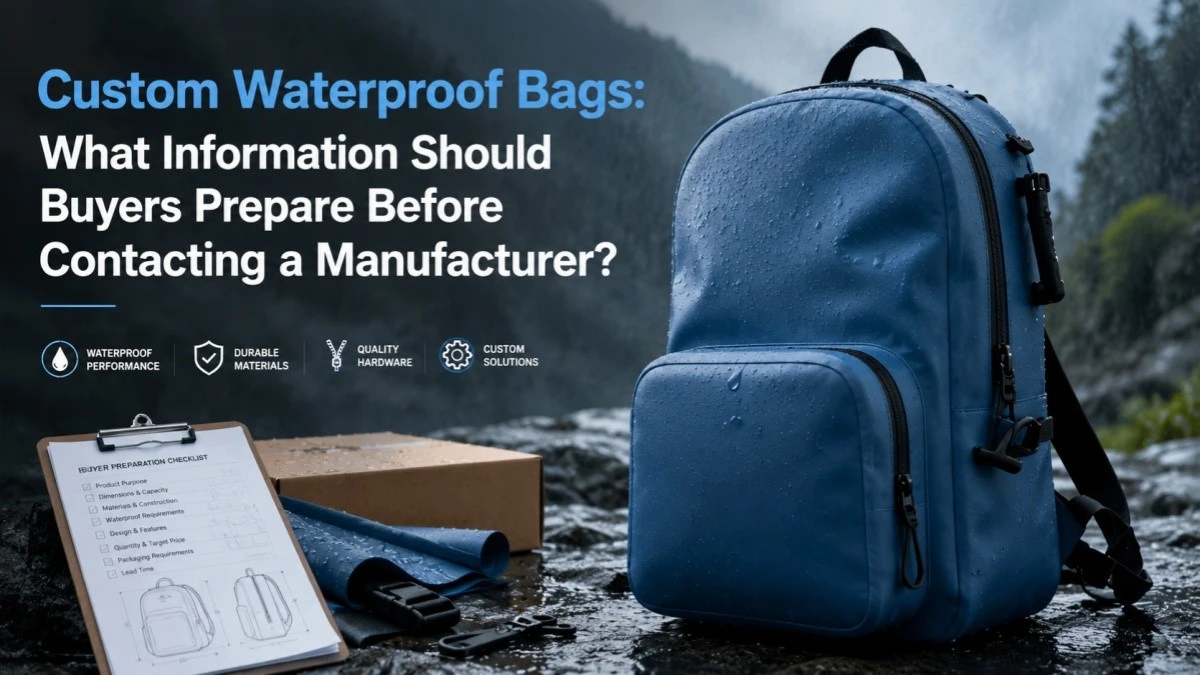
Custom Waterproof Bags: What Information Should Buyers Prepare Before Contacting a Manufacturer?
Jun 12, 2026
Leave a message
Buyers should prepare the bag type, application scenario, size, capacity, waterproof requirement, material preference, load-bearing needs, branding details, order quantity, target budget, packaging requirements, sample expectations, testing needs, and delivery timeline before contacting a custom waterproof bag manufacturer.
That sounds like a long list, but it is not paperwork for its own sake.
A waterproof bag is not defined by fabric alone. The final result depends on material, seam construction, opening design, hardware, reinforcement, printing method, and how the bag will be used. A 20L dry bag for kayaking, a waterproof backpack for commuting, and a waterproof duffel bag for motorcycle travel may all use "waterproof fabric," but the production logic is different.
If the buyer only sends a reference photo and asks, "How much is this bag?", the manufacturer can only make a rough guess. The quotation may change after the real size, material, logo method, waterproof structure, and order quantity are confirmed.
Clear information gives the manufacturer a real starting point.
Why Clear Requirements Matter Before Custom Waterproof Bag Production
Custom waterproof bags are bags designed and produced according to a buyer's specific requirements, including structure, material, waterproof performance, logo, packaging, and order quantity. In B2B manufacturing, this is usually handled through OEM or ODM production.
OEM means the buyer already has clear specifications. The manufacturer produces according to the buyer's size, material, artwork, structure, and packaging requirements.
ODM means the buyer has a concept, reference sample, target market, or product idea, and the manufacturer helps develop the material, structure, sample, and production solution.
Both models can work. The problem starts when the buyer does not know which stage the project is in.
For example, a buyer may send a photo of a waterproof backpack and ask for a quote for 1,000 pieces. But the manufacturer still needs to know whether the backpack uses welded seams or stitched seams, whether the zipper must resist rain or short-term water exposure, whether the fabric is PVC tarpaulin, TPU laminated fabric, or coated nylon, and whether the logo is printed, patched, or heat transferred.
Those details change the cost.
They also change the sample method, MOQ, production time, and quality inspection points. A vague inquiry often leads to three problems: inaccurate quotation, repeated sample revisions, and production expectations that do not match the final product.
A good manufacturer can help buyers improve an idea, but it cannot read the buyer's market positioning from a photo. Before contacting a waterproof bag manufacturer, the buyer should at least define the product use, target user, rough size, waterproof scenario, branding needs, and estimated order quantity.
That is enough to start a serious production discussion.
Define the Bag Type and Real Use Scenario
The first question is not "What material should we use?" The first question is: What is this bag supposed to do?
Bag type and use scenario control almost every later decision. A lightweight promotional waterproof pouch does not need the same fabric, seam structure, or load-bearing design as a waterproof duffel bag used on a boat or motorcycle.
Common Custom Waterproof Bag Types
Common custom waterproof bags include dry bags, waterproof backpacks, waterproof duffel bags, waterproof waist bags, waterproof cooler bags, waterproof phone pouches, waterproof tote bags, and waterproof travel bags.
Each type has a different production focus.
A dry bag usually depends on roll-top closure and welded seams. A waterproof backpack may need shoulder straps, back padding, laptop compartments, side pockets, and a balance between waterproofing and comfort. A waterproof duffel bag often needs larger capacity, stronger handles, reinforced bottom structure, and durable hardware.
A phone pouch is small, but its waterproof sealing and transparent window may be more demanding than its fabric consumption. A cooler bag may require insulation layers, easy-clean lining, leak-resistant structure, and food-contact-related material considerations depending on the market.
So the buyer should not only say "waterproof bag." The bag category must be named first.
Application Scenarios That Affect Design
Use scenario is where many buyers underestimate the project.
A bag used for weekend camping may only need strong rain resistance, abrasion-resistant fabric, and comfortable carrying. A bag used for kayaking or paddleboarding may need roll-top closure, welded construction, and better protection against short-term water exposure. A motorcycle waterproof duffel needs not only rain protection but also stable fixing points, stronger webbing, abrasion resistance, and a structure that does not deform easily under wind and vibration.
Here is a simple way to think about it:
| Use Scenario | Main Design Focus | Typical Risk If Not Clarified |
|---|---|---|
| Hiking / Camping | Weight, abrasion resistance, carrying comfort | Fabric too heavy or structure too weak |
| Kayaking / Paddleboarding | Welded seams, roll-top closure, water exposure protection | Bag leaks around seams or opening |
| Motorcycle / Cycling | Fixing points, abrasion resistance, rain protection | Bag moves, rubs, or fails at stress points |
| Travel / Beach Use | Lightweight, easy cleaning, logo, portability | Overbuilt product with unnecessary cost |
| Promotional Gifts | Cost control, logo visibility, simple structure | Product becomes too expensive for campaign use |
A manufacturer can suggest a better construction only after the use case is clear. Without this information, material selection becomes guesswork.
Prepare Basic Product Specifications
After the bag type and use scenario are clear, the buyer should prepare the basic product specifications. These details help the manufacturer estimate fabric usage, pattern development, sample difficulty, hardware needs, packing size, and production cost.
Size, Capacity, and Shape
For waterproof bags, size can be provided in length, width, and height. Capacity can also be used, especially for dry bags and duffel bags. Common dry bag capacities include 5L, 10L, 20L, 30L, and 40L. Backpacks are often described by capacity and body dimensions together.
If the buyer does not have exact dimensions, a target capacity and reference product can work for the first discussion. But the buyer should still explain what must fit inside the bag.
For example:
- A 10L dry bag for phone, wallet, towel, and light clothing
- A 25L waterproof backpack for laptop, jacket, bottle, and daily gear
- A 60L waterproof duffel for camping equipment or motorcycle travel
Shape also matters. A cylindrical dry bag, rectangular backpack, flat pouch, and wide-mouth duffel require different pattern design and different sealing methods.
A reference photo helps the manufacturer understand the style direction. It does not replace size, capacity, and structure details.
Load-Bearing and Reinforcement Requirements
Waterproof does not mean durable by default.
If a waterproof bag needs to carry 5kg, 10kg, or more than 20kg, the manufacturer must consider fabric thickness, handle strength, webbing width, buckle grade, shoulder strap construction, and stress point reinforcement. The bottom panel may need extra reinforcement. The handle connection may need additional layers or wider welding areas.
For example, a 20L dry bag used for clothing may not need the same reinforcement as a 20L waterproof tool bag carrying metal parts. The size may be similar, but the load is completely different.
Buyers should state the expected load early. It saves time later, especially during sample testing.
Opening, Carrying System, and Inner Structure
Opening design affects both user experience and waterproof performance.
Common options include roll-top closure, waterproof zipper, flap closure, buckle closure, drawstring with cover, or mixed structures. Roll-top closure is widely used on dry bags because it is simple and reliable when designed properly. Waterproof zippers can improve access, but they add cost and require careful structural matching.
Carrying structure also needs early confirmation. Shoulder straps, handles, chest straps, waist belts, detachable straps, D-rings, reflective strips, bottle pockets, laptop sleeves, inner mesh pockets, and padded back panels all affect production.
Each added function changes the pattern, sewing or welding sequence, labor time, and quality inspection points.
Clarify the Waterproof Performance Requirement
"Waterproof" is not a complete production requirement.
In bag manufacturing, waterproof performance depends on the fabric, coating or lamination, seam structure, opening method, zipper choice, bottom construction, and hardware attachment points. A fabric may be waterproof, but the finished bag may still leak if the seams are stitched without sealing or if the opening structure is not suitable for the use case.
Water-Resistant, Waterproof, or Short-Term Water Exposure?
Buyers should describe the real waterproof scenario instead of relying on one general word.
A water-resistant bag may handle light rain or splashes. A waterproof dry bag may protect items during outdoor activities and water sports when the roll-top is closed correctly. Some projects may require protection against short-term water exposure, but that must be discussed carefully through structure and testing.
These are different requirements:
| Requirement Level | Practical Meaning | Typical Product Example |
|---|---|---|
| Water-resistant | Handles light rain or splashes | Commuter backpack, coated tote |
| Rainproof | Handles outdoor rain for a period of time | Hiking backpack, cycling bag |
| Waterproof construction | Uses welded seams or sealed structures | Dry bag, waterproof duffel |
| Short-term water exposure protection | Designed for water sports or accidental drops | Kayak dry bag, paddleboard bag |
Not every waterproof bag should be described as submersible. That claim needs very clear structure, testing, and use conditions. For most B2B projects, the safer and more useful discussion is about the actual environment: rain, spray, boat use, beach use, kayaking, fishing, or motorcycle travel.
Seams, Closures, and Structural Waterproofing
A waterproof bag can fail at the seam, closure, bottom corner, zipper end, handle attachment, or accessory installation point.
That is why structure matters as much as fabric.
High-frequency welding and heat sealing are often used for waterproof bags made from PVC tarpaulin or TPU laminated materials. These methods bond material surfaces without creating needle holes. Stitched seams can work for water-resistant bags, but if the needle holes are not taped or sealed, they are usually not suitable for higher waterproof expectations.
Roll-top closure is practical for many dry bags because it reduces reliance on zippers. Waterproof zippers are useful when quick access is needed, but they are more expensive and must be matched with the right body structure. A poor zipper choice can raise cost without solving the real waterproof problem.
The buyer does not need to know every production method before contacting a manufacturer. But the buyer should explain what level of water exposure the bag must handle. The manufacturer can then recommend welded seams, sealed structures, roll-top closure, waterproof zipper, or a more cost-effective alternative.
Testing Expectations Before Sampling
Testing should be discussed before sampling, not after mass production.
Depending on the product, buyers may request spray testing, water filling checks, short-time water pressure tests, seam inspection, pull testing, drop testing, abrasion testing, or colorfastness checks. For a backpack, strap strength and buckle function may be as important as waterproof performance. For a dry bag, seam sealing and roll-top closure are the first areas to check.
If the buyer has an internal testing method, it should be shared. If there is no formal method, describe the use condition clearly.
A simple sentence such as "This bag is for kayaking and may get splashed or briefly dropped near water" gives the manufacturer more useful direction than just writing "100% waterproof."
Choose Suitable Materials, Hardware, and Accessories
Material choice affects waterproof performance, weight, hand feel, durability, environmental positioning, printing result, and cost. Hardware and accessories affect strength, user experience, and long-term reliability.
Common Materials for Custom Waterproof Bags
PVC tarpaulin is widely used for dry bags, waterproof duffel bags, and outdoor gear bags. It is durable, has strong waterproof potential when welded properly, and is usually more cost-controlled than higher-end laminated materials. It can feel heavier or stiffer, so it is not always the best choice for lightweight products.
TPU laminated fabric is often chosen when buyers want better flexibility, cleaner hand feel, and a more premium or PVC-free direction. It usually costs more, and material availability should be checked early.
PU-coated nylon or polyester is common for lightweight outdoor bags and water-resistant backpacks. It can work well for rain protection, but the full bag structure must match the expected waterproof level.
Coated Oxford fabric is practical for outdoor backpacks, tool bags, travel bags, and utility bags where abrasion resistance and structure matter.
The buyer does not need to decide the final fabric alone. But the manufacturer needs to know the target use, price level, and market expectation before giving a realistic material recommendation.
Hardware and Accessory Choices
Buckles, zippers, webbing, D-rings, hooks, reflective strips, EVA pads, foam back panels, shoulder strap padding, and zipper pullers all influence the final product.
For example, a waterproof backpack for daily commuting may need smooth zippers, padded straps, and a laptop compartment. A waterproof duffel for boating may need heavy-duty buckles, reinforced handles, and wide webbing. A promotional dry bag may only need a simple buckle and printed logo to keep cost under control.
Accessory selection should match the product level. Overbuilding a low-cost promotional item wastes budget. Underbuilding an outdoor performance bag creates customer complaints.
Compliance or Environmental Requirements
If the target market requires PVC-free materials, low-odor materials, REACH-related documentation, OEKO-TEX-related textile requirements, recycled fabric claims, or third-party testing, these requirements should be mentioned before sampling.
Do not add environmental claims at the end of the project.
Material documentation, fabric sourcing, and testing options can affect cost and lead time. If the product will be used for food delivery, baby products, medical supplies, or other regulated applications, the buyer should state that early so the manufacturer can check suitable materials and documents.
Prepare Branding, Color, and Packaging Details
Branding is not just "add our logo."
For custom logo waterproof bags, the manufacturer needs artwork format, logo size, placement, color reference, printing method, label requirements, and packaging details. Missing brand information often causes sample revisions even when the bag structure is already correct.
Logo Files, Colors, and Placement
Buyers should provide vector logo files such as AI, PDF, or SVG. A low-resolution JPG from a website is not enough for clean production artwork.
Pantone color references are also useful, especially when brand color consistency matters. If Pantone is not available, the buyer should provide a clear color reference and accept that fabric, coating, and printing method may affect the final color.
Logo placement should be marked clearly. A logo on the front panel, side panel, shoulder strap, rubber patch, zipper puller, or inner label all require different production handling.
Printing and Label Options
Common branding methods for waterproof bags include screen printing, heat transfer printing, rubber patch, woven label, embroidery, embossed logo, and custom zipper pullers.
Not every method works well on every material. Screen printing may be practical for simple logos and larger batches. Heat transfer can handle more detailed artwork but needs proper material compatibility. Rubber patches or woven labels can improve brand presentation, but they add cost and production steps.
The right method should be selected based on material, artwork complexity, order quantity, target price, and brand positioning.
Retail Packaging and Shipping Labels
Packaging should be confirmed early for retail, e-commerce, wholesale, or promotional projects.
Buyers may need hangtags, care labels, barcode labels, SKU labels, individual polybags, retail boxes, carton marks, color sorting, size sorting, or pallet packing. For Amazon or other e-commerce channels, labeling and SKU separation can be as important as the bag itself.
Packaging mistakes do not always show up during product sampling. They often appear at the shipping or warehouse stage, when corrections are more expensive.
Confirm Quantity, Budget, Sample Needs, and Timeline
MOQ, budget, sampling, and delivery time are not just commercial details. They affect the production plan.
A custom waterproof bag manufacturer needs these details to judge whether the project should use stock materials, custom colors, welded construction, premium hardware, simple logo printing, or a more developed ODM solution.
Order Quantity and MOQ
MOQ depends on bag type, material availability, color customization, logo method, waterproof construction, accessories, packaging, and production schedule.
A simple dry bag using stock material and one-color printing may support a different MOQ from a waterproof backpack with custom lining, multiple compartments, waterproof zipper, rubber logo patch, retail packaging, and color-specific hardware.
Buyers should provide an estimated order quantity, even if it is not final. The number helps the manufacturer suggest practical material and branding options.
Target Budget or Price Range
Some buyers avoid sharing a target price because they worry the manufacturer will quote toward that number. In practice, a realistic budget helps the manufacturer avoid proposing the wrong solution.
The same waterproof bag concept can be built in different ways. One version may use PVC tarpaulin, standard buckle, and simple screen printing. Another may use TPU laminated fabric, waterproof zipper, custom rubber patch, padded back panel, and retail packaging. The appearance may be similar from a distance, but the cost structure is not.
A target price range helps both sides decide where to spend money and where to simplify.
Sample Requirement and Delivery Timeline
Buyers should explain whether they need a fully customized sample, a reference sample from existing styles, or only material and logo testing before full sample development.
They should also state any deadline tied to a trade show, launch date, seasonal promotion, retail delivery window, or repeat order plan.
Custom waterproof bag production includes requirement confirmation, material sourcing, artwork confirmation, pattern development, sample making, sample revision, waterproof testing, mass production, QC, packing, and shipment preparation. Planning only around the mass production days is risky.
Use a Requirement Checklist Before Contacting a Manufacturer
A good inquiry does not need to be perfect. It needs to be clear enough for the manufacturer to respond with a practical direction.
Use this checklist before requesting a quote for custom waterproof bags:
- Product type
- Application scenario
- Target users
- Size or capacity
- Target load
- Material preference
- Waterproof requirement
- Seam construction preference, if known
- Closure type
- Carrying system
- Inner structure
- Accessories
- Logo file
- Branding method
- Color or Pantone reference
- Packaging requirement
- Order quantity
- Target price range
- Target market
- Testing or compliance requirement
- Sample requirement
- Delivery timeline
- Reference photos, drawings, or existing samples
If some details are not confirmed, say so. A good manufacturer can still help, but it needs to know which decisions are open.
What If You Only Have a Concept or Reference Photo?
Many buyers start with only a market idea or a competitor sample. That is normal for ODM waterproof bag development.
In that case, prepare the basics: who will use the bag, where it will be used, what size range you expect, what items it needs to carry, what waterproof scenario it should handle, what price level you are targeting, and what order quantity you expect.
A reference photo can show design direction, but it cannot define production standards. Tell the manufacturer what you like about the reference: the shape, opening, pocket layout, logo position, material texture, or carrying style. Also tell the manufacturer what can be changed.
That gives the factory room to improve the design instead of copying a photo without understanding the product goal.
Review Samples and Lock Production Standards Before Bulk Orders
A sample is not just an appearance check. For custom waterproof bags, the approved sample becomes the physical reference for bulk production.
Buyers should check the sample from both design and manufacturing angles:
- Size and capacity
- Material thickness and hand feel
- Seam welding or stitching quality
- Roll-top or zipper function
- Basic waterproof performance
- Strap, handle, and buckle strength
- Logo position and adhesion
- Color consistency
- Inner structure
- Packaging and labels
For a welded dry bag, seam quality should be checked carefully. For a waterproof backpack, shoulder strap comfort, zipper performance, and pocket layout may need more attention. For a duffel bag, handle strength and bottom reinforcement are often the risk points.
Long-term buyers should also think beyond one sample. Batch consistency matters for brand presentation and repeat sales. Material color, welding line, logo placement, hardware, webbing, labels, and packaging should remain stable across repeat orders.
A perfect sample means little if bulk production cannot follow the same standard.
Prepare Better, Communicate Faster, Produce More Smoothly
Before contacting a custom waterproof bag manufacturer, buyers should prepare the product type, use scenario, size, waterproof requirement, material direction, load-bearing needs, branding details, packaging, quantity, budget, sample needs, testing expectations, and delivery timeline.
This does not mean the buyer must solve every production problem alone. It means the manufacturer can give better advice, more accurate pricing, and a more realistic sample plan.
FENGLINWAN is a China outdoor waterproof bag manufacturer providing OEM and ODM support for custom waterproof bags. If you are developing a waterproof backpack, dry bag, duffel bag, cooler bag, or other outdoor waterproof product, we can help evaluate materials, structure, waterproof performance, sample feasibility, and cost balance before production.