


What Makes a Waterproof Backpack Suitable for Hiking?
Oct 31, 2026
Leave a message
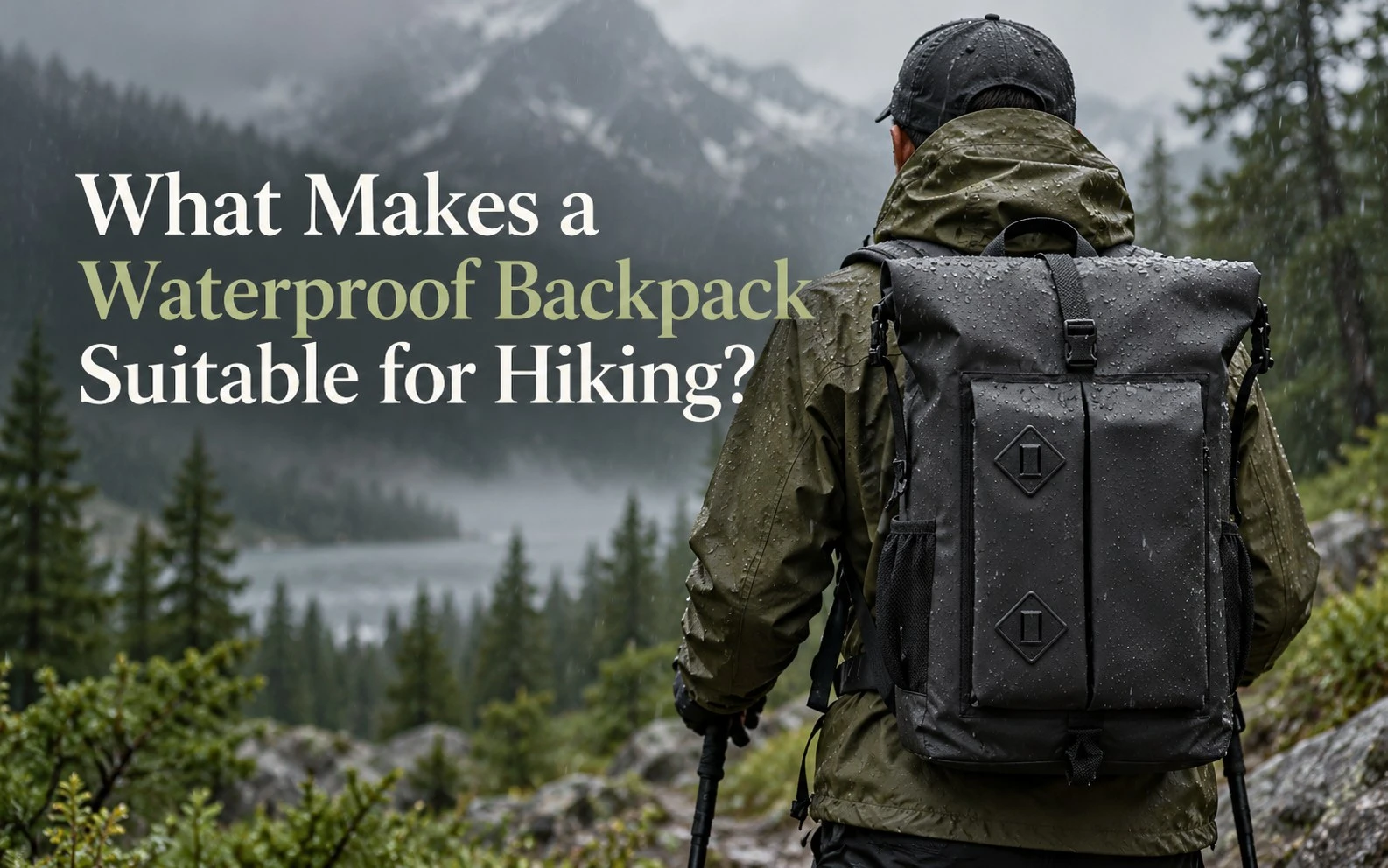
Ask any seasoned hiker what separates a great trail day from a miserable one, and the conversation usually comes down to gear that keeps working when the weather turns. A waterproof backpack for hiking sits near the top of that list. But "waterproof" is one of the most loosely used terms in the outdoor industry, and the label alone says very little about how a backpack will perform after hours of rain, abrasion, movement, and repeated opening and closing.
A reliable waterproof backpack is better understood as a complete system. The waterproof backpack material matters, but so do the seams, closure system, structural details, carrying comfort, durability, and the way the finished bag is tested. Whether you are choosing a pack for the trail or developing one for an outdoor brand, these are the factors worth evaluating.
Waterproof vs. Water-Resistant Backpacks: What Is the Difference?
Most backpacks designed for outdoor use provide at least some level of water resistance, but waterproof vs. water-resistant backpacks are not the same in either construction or expected performance.
Water-resistant packs commonly rely on a surface treatment such as DWR (durable water repellent), which causes water to bead and roll away from the fabric. This can work well in light rain or brief showers. Over time, however, abrasion, dirt, washing, and extended exposure can reduce the effectiveness of the surface treatment.
Waterproof packs use a more continuous barrier, such as a film or waterproof coating bonded to the base fabric. More importantly, the rest of the bag must be designed to preserve that barrier. Waterproof fabric combined with untreated stitched seams or an ordinary zipper can still allow water to enter.
|
Feature |
Water-Resistant |
Waterproof |
|
Barrier type |
DWR or similar surface treatment |
TPU / PU film or waterproof coating |
|
Seam treatment |
Often conventionally stitched |
Welded or seam-taped |
|
Closure |
Standard or covered zipper |
Roll-top or sealed zipper |
|
Typical use |
Light rain and short exposure |
Sustained rain and higher water exposure |
|
Typical protection level |
Lower water-protection levels where tested |
Higher water-protection levels where appropriately tested |
The internationally recognized ingress-protection framework is defined in IEC 60529. The water-protection portion of an IP rating is expressed with an "X" followed by a number when only water ingress is being discussed.
The IEC explanation of IP ratings provides the appropriate reference for interpreting these levels. For example, IPX4 concerns splashing water, while higher levels address increasingly demanding water exposure, including powerful jets or immersion under defined test conditions.
A hiking backpack waterproof rating should therefore be considered together with the actual test method and intended use. A higher rating is not automatically necessary for every hiking trip, and a rating applicable to one product should never be assumed to apply to an entire product range.
Waterproof Backpack Materials for Hiking
Waterproof performance begins with the material. The base textile provides strength, abrasion resistance, and structural stability, while a bonded film or coating provides the water barrier. Brands comparing construction options can also review the main waterproof fabrics used for bags before selecting a substrate.
1. Nylon with TPU Lamination
TPU-laminated nylon is widely used in waterproof backpack construction because it combines textile strength with a weldable waterproof layer.
A high-tenacity nylon base-often in heavier deniers for demanding outdoor use-can provide tear and abrasion resistance, while the TPU layer provides waterproofing and enables RF/HF welding in compatible constructions. TPU also offers useful flexibility for packs that are repeatedly folded, rolled, compressed, and exposed to changing outdoor conditions.
For hiking applications, the more useful question is not simply whether a pack is made from TPU, but how the TPU-coated or laminated material works with the seams, closure, attachments, and load-bearing structure. A lightweight waterproof TPU backpack illustrates how material choice can be combined with a lighter-use backpack format where weight and waterproofing both matter.
2. High-Tenacity Abrasion-Resistant Nylon
For a durable hiking backpack, abrasion resistance can be as important as waterproofing.
A pack may repeatedly contact rock, branches, gravel, vehicle surfaces, and wet ground. High-tenacity abrasion-resistant nylon can therefore be selected when long-term mechanical durability is a priority. When combined with a compatible waterproof lamination or coating, it can form the basis of a robust waterproof hiking pack.
3. Ultralight Composite Laminates
Ultralight composite laminates offer another approach. These materials combine low weight with a waterproof film structure and are often considered for lightweight or long-distance hiking equipment.
The trade-off is that ultralight material selection must balance weight savings against puncture resistance, abrasion, price, manufacturing method, and expected service life. For an ultralight backpack, the lightest available material is not necessarily the most suitable one.
For waterproof bag development, FENGLINWAN works with TPU, PVC, polyester, nylon, and other functional materials, selecting the material according to the required waterproof level, product structure, target market, and manufacturing process.
A useful rule follows from this:
A waterproof fabric does not automatically make a waterproof backpack.
The material is only the first layer of the system.
Why Seam Construction Determines Waterproof Performance
A pack can use excellent waterproof fabric and still leak because conventional sewing creates needle holes through the waterproof barrier.
That makes waterproof backpack seams one of the most important details to inspect.
RF/HF-welded seams are widely used in fully waterproof construction. Radio-frequency or high-frequency welding uses electromagnetic energy to fuse compatible thermoplastic layers together. Instead of joining two panels with needle holes, the process creates a bonded joint between the materials.
For readers who want a deeper explanation of the process, this guide to HF welding for waterproof bags covers why the method is widely used for sealed bag construction.
An HF welded waterproof backpack can reduce leak paths associated with conventional stitching, but welding quality still depends on more than simply owning the equipment. Material compatibility, mold design, welding parameters, panel geometry, reinforcement, and process consistency all influence the finished joint.
Seam taping is another solution when welded construction is not appropriate. Waterproof tape is heat-bonded over the inside of a stitched seam to cover the needle perforations. Proper application requires controlled temperature, pressure, and material compatibility.
Untreated stitched seams, by contrast, generally indicate that the construction is intended primarily for water resistance rather than high-level waterproof protection.
From a manufacturing perspective, the important principle is simple:
waterproof performance should be designed at the seam level, not added as a claim after the bag has already been constructed.
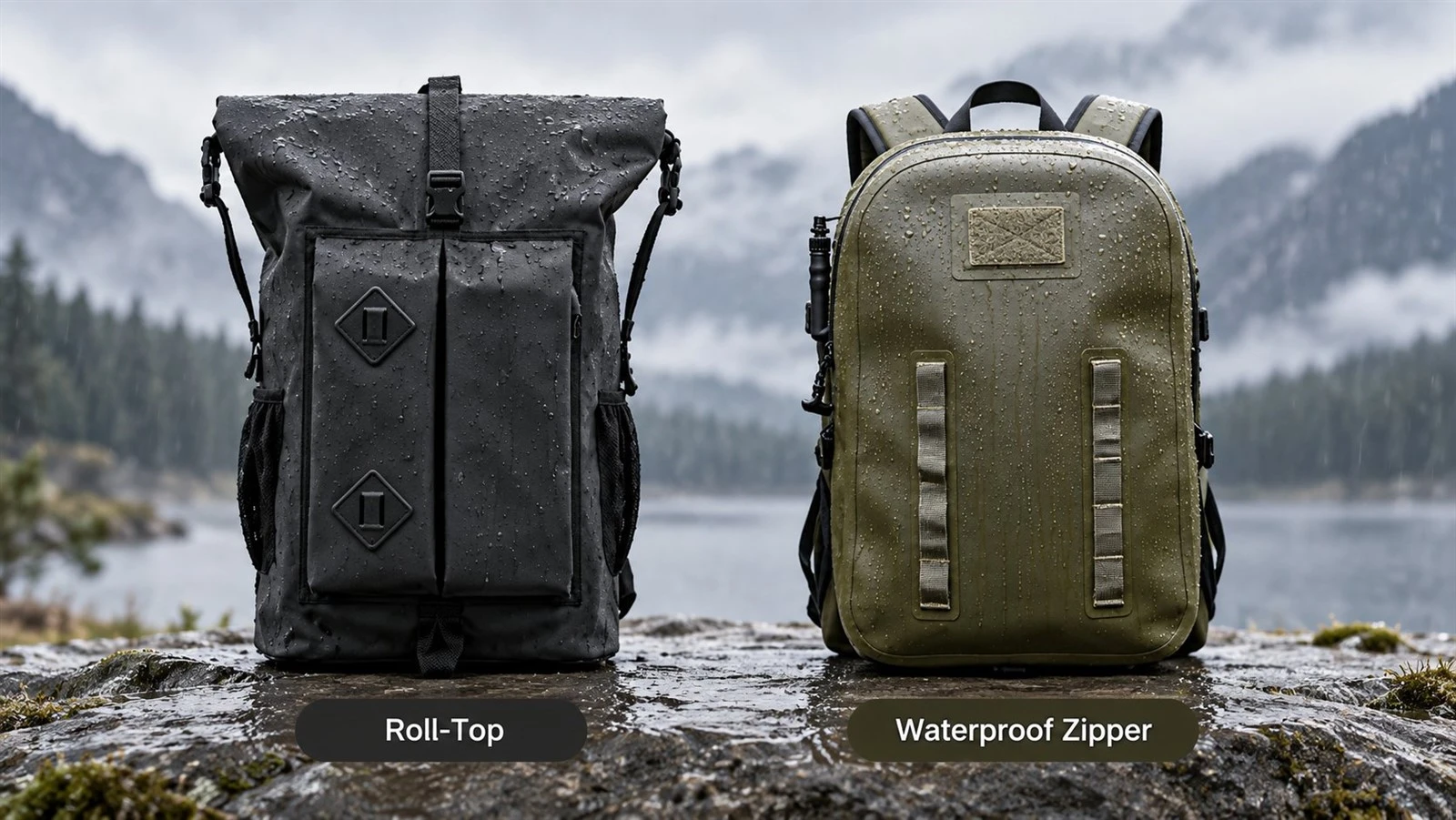
Roll-Top vs. Waterproof Zipper Closures
Every backpack needs an opening, and every opening creates a potential path for water.
Two common solutions are the roll-top waterproof backpack structure and sealed waterproof zippers.
Roll-Top Closures
A roll-top closure removes the need for a long main zipper. The user loads the pack, folds or rolls the opening several times, and secures it with buckles.
Its advantages include:
- relatively simple waterproof construction
- fewer complicated sealing interfaces
- adjustable usable volume
- reliable performance in rain and wet outdoor environments
- fewer moving components
This makes roll-top construction especially useful for outdoor, water-sport, commuting, and hiking applications. A roll-top waterproof backpack provides a practical reference for this style of closure.
Watertight and Airtight Zippers
A watertight zipper or airtight zipper can be more suitable when users need faster access or when the product requires a conventional panel-opening design.
Depending on the project, waterproof bag construction can use water-resistant, watertight, submersible waterproof, or airtight zipper solutions. This guide to waterproof zipper types explains why these categories should not be treated as interchangeable.
The zipper itself is only part of the system. The zipper tape, ends, junctions, surrounding panels, and welding or sealing method must also be properly integrated.
For especially demanding outdoor use, an airtight waterproof expedition backpack demonstrates a different design approach from a simpler roll-top pack.
That means the question is not simply:
"Is a roll-top better than a waterproof zipper?"
A better question is:
"Which closure system best matches the hiking environment, waterproof requirement, and frequency of access?"
For a pack used primarily in prolonged rain, a simple roll-top may be highly practical. For hiking, hunting, or outdoor exploration equipment that requires quick access to specific compartments, a sealed zipper may be worth the added structural complexity.
Why Carrying Comfort Matters on Hiking Trails
A waterproof pack that is uncomfortable to carry is not a good hiking backpack. It is essentially a dry bag with shoulder straps.
Waterproofing protects the contents. The suspension system protects the user from unnecessary fatigue.
A well-designed hiking pack should distribute weight, remain stable during movement, and provide enough structure for the intended load.
Suspension and Load Transfer
A properly designed suspension system can transfer much of the pack load toward the hips through a padded hip belt, leaving the shoulders primarily responsible for stabilization.
For larger hiking packs, an internal frame or structural sheet can improve load transfer and prevent the contents from collapsing against the user's back.
The exact solution depends on:
- backpack capacity
- expected load
- hiking duration
- target user
- pack weight
- desired waterproof construction
Back Panel Ventilation
Waterproof materials typically have limited breathability, which makes back-panel design especially important.
Contoured foam, ventilation channels, mesh, and structured spacing can help reduce heat accumulation between the pack and the user's back.
There is always a design trade-off. More ventilation can improve comfort, while a closer-fitting pack body may provide greater stability under heavier loads.
This reinforces an important design principle for a waterproof backpack for hiking:
Waterproof performance, pack weight, stability, and carrying comfort have to be developed together.
Capacity and Organization
Capacity should match the trip.
Typical requirements may include:
- 20–30 L: day hiking
- 30–45 L: overnight trips
- 45–65 L or more: multi-day backcountry travel
Brands or buyers comparing these ranges can refer to this waterproof backpack capacity guide for a more detailed discussion of 20 L, 30 L, and 40 L configurations.
Fully waterproof construction often favors a simpler main compartment because excessive stitching, openings, and internal structure can complicate waterproofing.
Organization can instead be achieved through removable dividers, internal pouches, welded pockets, or external systems designed so that their attachment does not create uncontrolled leak paths.
Hydration Reservoir Design in a Waterproof Hiking Backpack
Hydration compatibility is useful for many hiking packs, but it requires additional design attention when the backpack is waterproof.
The reservoir sleeve is usually positioned near the back panel so that water weight stays close to the wearer's center of gravity.
The more difficult detail is the tube exit.
An ordinary slit through the waterproof shell creates a potential leak point. A waterproof hiking backpack may instead use:
- a sealed grommet
- a purpose-designed valve
- a protected port structure
- routing that works through or around the closure system
Each solution introduces a trade-off between waterproof integrity and convenience.
Shoulder-strap routing also matters. Tube keepers or clips should hold the hose in place without obstructing the bite valve or interfering with pack movement.
These are small details, but they illustrate a broader principle: every feature added to a waterproof pack should be evaluated for the new openings, seams, or stress points it introduces.
Durability Requirements for a Hiking Waterproof Backpack
Water is only one threat on the trail.
A hiking backpack may also face:
- abrasion from rocks
- puncture from branches
- repeated folding
- UV exposure
- cold temperatures
- mud and dirt
- loaded compression
- repeated zipper and buckle use
That is why waterproof performance should never be evaluated separately from durability.
TPU-based construction can provide a useful combination of flexibility and weldability for high-waterproof applications, while the textile substrate can be selected according to the required abrasion and tear resistance.
Welded seams also have a structural advantage in suitable products because they avoid putting rows of needle holes through the waterproof barrier.
At the same time, not every hiking backpack needs the heaviest possible material. A lightweight waterproof backpack intended for fast day hikes will have different requirements from a high-capacity pack intended for hunting, expeditions, or prolonged exposure to wet terrain.
The end-use environment should drive the material and construction decisions rather than selecting each component independently.
How to Evaluate a Waterproof Backpack for Hiking
If you are assessing a waterproof hiking backpack-whether for personal use or as part of a brand's product line-the following checkpoints help determine whether the construction matches the claim.
|
Checkpoint |
What to Look For |
Potential Red Flag |
|
Fabric |
Waterproof laminate or coating appropriate for the use case |
Water-repellent surface treatment presented as full waterproofing |
|
Seams |
HF/RF welded or properly seam-taped |
Untreated stitched seams in critical waterproof areas |
|
Closure |
Roll-top, watertight zipper, or airtight zipper matched to the application |
Standard unprotected zipper |
|
Waterproof rating |
Clearly defined test level and method where a rating is claimed |
"Waterproof" with no explanation of construction or testing |
|
Suspension |
Structure appropriate for expected hiking load |
Dry-bag body with minimal carrying support |
|
Back panel |
Stability and ventilation suited to intended trip length |
Poor load control or excessive heat buildup |
|
Hydration port |
Sealed or purpose-designed penetration |
Unprotected opening through the shell |
|
Attachments |
Waterproof integration of load-bearing details |
Unsealed stitching through critical waterproof areas |
|
Finished-product testing |
Testing of seams, zipper areas, and complete bag |
Reliance only on raw-material specifications |
One point deserves particular attention:
material specifications describe the material, while finished-bag testing describes the backpack.
A waterproof laminate may perform exactly as specified while the finished product still leaks through a zipper junction, weld, attachment, or structural interface.
A more detailed explanation of waterproof bag leak testing shows why air-leakage and water-leakage checks can be useful for evaluating appropriate airtight or waterproof constructions.
This supports a useful five-part framework for evaluating waterproof backpack features:
Material → Seams → Closure → Structural Details → Validation
Weakness in any one of these areas can compromise the complete system.
FAQ
Is a waterproof backpack necessary for hiking?
Not for every hike. A water-resistant backpack can be sufficient for short day hikes in mild or predictable weather. A true waterproof backpack becomes more valuable when the pack may face sustained rain, river crossings, wet snow, water sports combined with hiking, or when sensitive equipment needs a higher level of protection.
Is a roll-top backpack better for hiking?
A roll-top is a strong option when simple and reliable water protection is a priority. It reduces the complexity of the main opening and can also provide adjustable capacity. However, hikers who need frequent access to equipment may prefer a watertight-zipper design or a combination of a roll-top main compartment and sealed quick-access pockets.
What material is best for a waterproof hiking backpack?
There is no single best waterproof backpack material for every application. TPU-laminated nylon is commonly used for high-waterproof products because it combines textile strength, flexibility, and compatibility with welding processes. The final choice should also consider abrasion resistance, weight, temperature range, cost, required waterproof level, and manufacturing method.
Are welded seams better than stitched seams for waterproof backpacks?
For fully waterproof constructions, HF/RF-welded seams can eliminate the needle holes created by conventional sewing. Properly applied seam tape can also waterproof stitched seams. The better solution depends on the material, bag structure, production method, and intended performance level.
Does an IPX8 rating automatically make a backpack better for hiking?
No. IPX8 addresses water ingress protection under test conditions defined for a particular product, but hiking suitability also depends on weight, comfort, durability, organization, accessibility, and load-carrying performance. A backpack should therefore be matched to its intended trail environment rather than judged by the highest possible waterproof rating alone.
Final Thoughts
What makes a waterproof backpack suitable for hiking is not one fabric, one zipper, or one waterproof rating. It is the way multiple systems work together: a suitable waterproof material, properly sealed seams, a closure matched to the expected exposure, durable structural details, comfortable load carrying, and finished-product testing that verifies the complete construction.
The most waterproof option is not automatically the best hiking option either. A day-hiking pack, an ultralight backpack, a multi-day trekking pack, and a pack designed for hunting or water-based outdoor activities can require very different balances of waterproofing, weight, access, durability, and carrying comfort.
Dongguan Fenglinwan Leisure Products Co., Ltd. develops and manufactures outdoor waterproof and functional bags through OEM/ODM cooperation, with capabilities covering material selection, waterproof structures, welded construction, sampling, testing, and mass production.
If you are developing a custom waterproof hiking backpack or evaluating materials, welded seams, roll-top construction, or sealed zipper options for a new product line, contact FENGLINWAN to discuss the application and the level of protection your project actually requires.