

Why Waterproof Fabric Alone Does Not Make a Waterproof Bag
Oct 26, 2026
Leave a message
A 20,000 mm hydrostatic-head fabric is only the first page of the story. The bag that keeps your gear dry is built from the seams, the closure, the zipper, and the assembly discipline behind them-not from the roll of fabric alone.
Ask any product developer who has watched a "waterproof" prototype fail in a rain chamber, and you will hear the same confession: the fabric was never the problem. The fabric passed. The bag still leaked. Water found a needle hole, a zipper gap, a fold in a roll-top, or a bond that looked sealed but was not.
That gap between a waterproof material and a waterproof product is where most of the engineering actually lives. Good waterproof bag construction is not defined by one material specification. It depends on how the fabric, seams, zipper, closure, attachment points, manufacturing process, and finished-product testing work together.
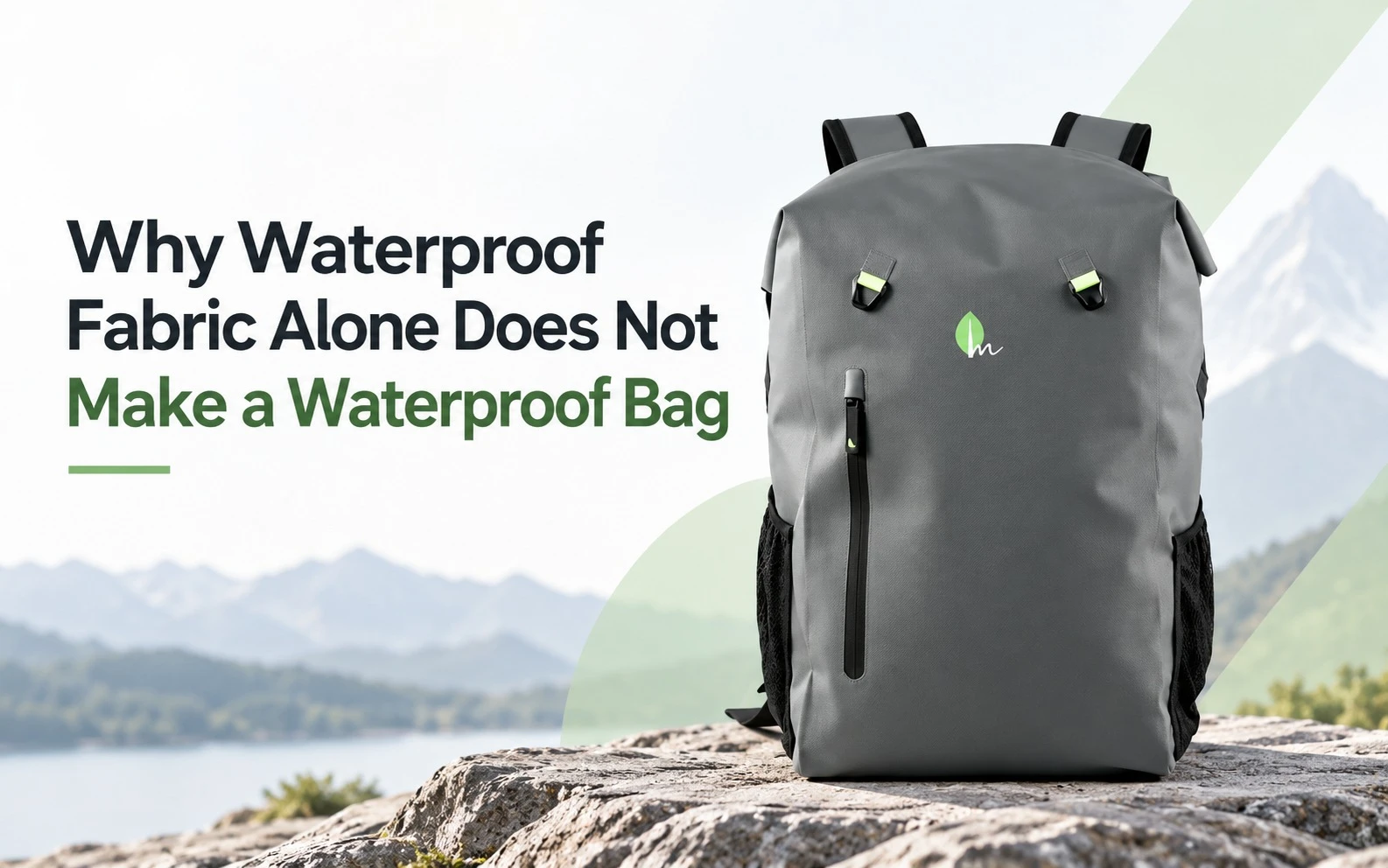
Why Waterproof Fabric Alone Is Not Enough
A waterproof fabric gives you a hydrostatic head-the height, in millimetres, of a water column the material can resist before water pushes through. It is one of the most quoted numbers in the industry, and it is genuinely useful: it tells you what the sheet of fabric can survive. Standardized hydrostatic-head testing provides a more meaningful basis for comparing textile resistance to water pressure than relying on broad marketing descriptions alone.
20,000 mm
Typical hydrostatic head of a high-end shell fabric-before it is cut, sewn, or assembled into anything.
But a bag is not a sheet of fabric. The moment you cut that fabric into panels, you create edges. The moment you join two panels, you create a seam. The moment you add an opening so someone can use the bag, you introduce a closure.
The hydrostatic head of the fabric sets the theoretical potential of the material. The finished bag still has to preserve that protection through every seam, zipper, closure, and structural interface.
Put differently: a 20,000 mm fabric assembled with an unsealed seam, a water-resistant rather than watertight zipper, and a poorly designed roll-top can still leak quickly in the field. The material specification becomes much less meaningful once water reaches the weakest part of the finished construction.
For buyers comparing material options, understanding the differences among waterproof fabrics for bags is useful-but material selection should always be evaluated together with the construction method.
This is why the more useful question is not simply, "Is the fabric waterproof?" It is:
How is the complete waterproof bag construction engineered to keep water out?
Where Waterproof Bags Actually Leak
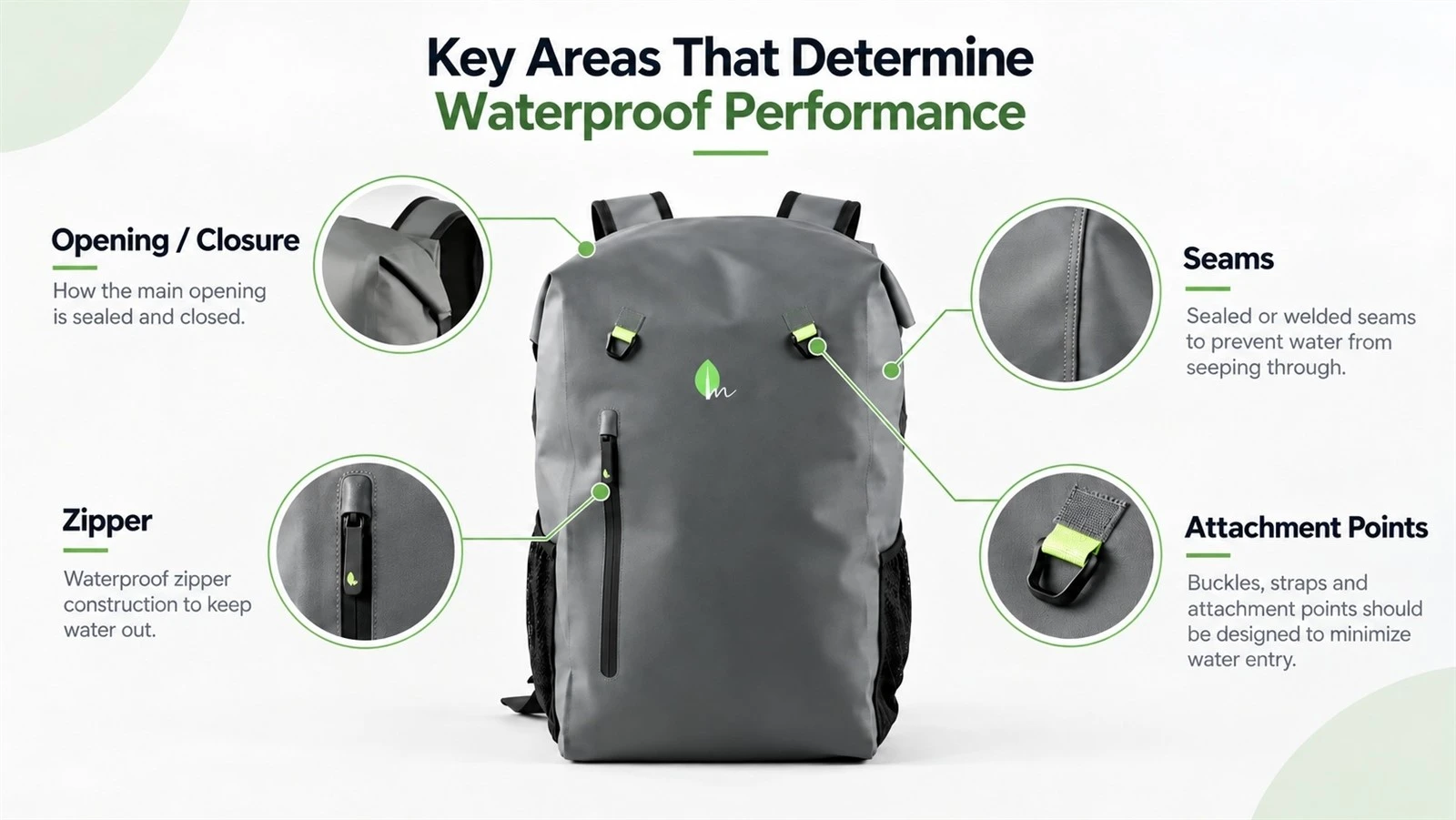
Field failures tend to cluster at a relatively small number of predictable points. They are usually the places where a continuous waterproof surface is interrupted.
|
Failure point |
Why it leaks |
What real waterproofing requires |
|
Sewn seams |
Every stitch creates a needle hole through the material. A bag can contain thousands of them. |
Seam taping, seam sealing, or a construction method that avoids stitch holes entirely. |
|
Zippers |
Standard zippers contain gaps between their interlocking elements, allowing water to track through the chain. |
A zipper selected for the required protection level, such as a water-resistant, watertight, airtight, or submersible zipper system. |
|
Roll-top closure |
A roll-top only seals properly when there is enough material to form clean folds and the closure remains under tension. |
Correct fold geometry, sufficient roll length, appropriate buckle positioning, and suitable material stiffness. |
|
Bonded / welded joints |
Welds can fail at the bond line if welding energy, pressure, alignment, or dwell time is not properly controlled. |
Stable welding parameters, compatible materials, tooling control, and production validation. |
|
Hardware penetrations |
Rivets, webbing anchors, D-rings, valves, handles, and other attachments can interrupt the waterproof envelope. |
Sealed or welded attachment solutions and thoughtful placement outside critical waterproof zones where possible. |
Notice the pattern: every row represents a place where a continuous waterproof plane has been interrupted.
A waterproof bag is essentially a protective envelope, and that envelope is only as reliable as its weakest interface. Fabric is one part of it. The seams, zipper, closure, and attachment points are equally important.
For higher-protection products, this is why material selection and construction method have to be decided together rather than one after the other.
Why Seams Are a Common Leak Point
Sewing is one of the most versatile ways to join fabric, but conventional stitching creates needle holes. Thread fills part of those holes, but it does not automatically create a watertight seal. Under sufficient rain exposure or pressure, water can wick along the stitch line and pass through the penetrations.
There are two common approaches to dealing with this, and they should not be treated as interchangeable.
1. Seam Taping and Seam Sealing
A thermoplastic tape can be heat-bonded over the seam on the inside of the bag, covering the stitch line and needle holes.
This approach is widely used in sewn waterproof or weather-resistant products and can work very well when the tape, fabric coating, temperature, pressure, and application process are compatible.
Its long-term performance, however, depends on the integrity of the bonded tape. Repeated folding, abrasion, environmental exposure, improper laundering, or poor initial adhesion can eventually affect the seal.
2. Welded Seams
For compatible thermoplastic materials-including many TPU- and PVC-based constructions-panels can be joined using HF welding, also known as high-frequency or radio-frequency welding, rather than relying on stitching through the waterproof layer.
The process fuses compatible material surfaces into a sealed joint and avoids the needle holes created by conventional sewing. If you want a deeper explanation of the process, see this guide to HF welding for waterproof bags.
This is one of the key reasons HF welding is widely used in dry bag construction, airtight waterproof backpacks, waterproof travel bags, and other products where seam integrity is a primary requirement.
At FENGLINWAN, high-waterproof and airtight products can combine TPU or PVC materials with HF welding, heat-sealed construction, and dedicated airtight or watertight components. The appropriate process depends on the product geometry, required protection level, material system, and end-use environment.
That distinction matters because welded construction is not simply "better sewing." It is a different manufacturing system that requires compatible materials, suitable tooling, stable process parameters, and manufacturing control. For a closer comparison, see TPU waterproof bag seam construction.
A poor weld can sometimes look perfectly acceptable from the outside. The important question is not just whether a product uses welded seams, but whether the welding process is consistent and whether the finished bag is validated afterward.
Why Zippers Can Limit Waterproof Performance
A zipper is one of the most difficult parts of waterproof bag design because it creates a large, frequently operated opening in the protective envelope.
Standard coil zippers contain gaps and are not designed to form a watertight barrier. Under rain, splash, or pressure, water can move along the zipper chain and eventually reach the interior.
There is therefore an important distinction between different zipper protection levels.
|
Zipper type |
How it resists water |
Typical field behaviour |
|
Standard coil zipper |
No dedicated waterproof barrier |
Water can pass through readily; a storm flap may improve rain protection. |
|
Water-resistant zipper |
A coated tape or reversed construction helps reduce water entry |
Suitable for splash and rain protection, but not equivalent to a watertight or airtight closure. |
|
Watertight / waterproof zipper |
Uses a dedicated sealed construction designed to resist water ingress |
Suitable for higher-protection applications when properly integrated into the bag. |
|
Airtight / submersible zipper |
Designed for much higher sealing requirements |
Used where airtightness, high water resistance, or controlled immersion performance is required. |
This hierarchy matters because the term "waterproof zipper" is often used too loosely. Our detailed guide to waterproof zipper types explains the practical differences between water-resistant, watertight, and airtight options.
A commuter backpack designed for rain exposure does not necessarily need the same zipper system as an airtight waterproof backpack, a rescue transport bag, or a product designed around temporary immersion.
The zipper also cannot be evaluated in isolation. How it is integrated into the bag-its weld area, end termination, opening geometry, and relationship with surrounding panels-can be just as important as the zipper specification itself.
For example, an airtight waterproof expedition backpack may combine TPU material, welded construction, and a specialized airtight closure system, while a roll-top product may avoid a zipper at the main opening entirely.
The engineering question is therefore not:
"Does this bag have a waterproof zipper?"
It is:
"Is the zipper appropriate for the protection level the finished bag is expected to achieve?"
How Roll-Top Closures Affect Waterproofing
The roll-top closure is one of the most widely used systems in dry bags and waterproof backpacks because it can create an effective barrier without a conventional zipper.
It works by folding the opening over itself several times so that water has to travel through a longer folded path before reaching the interior. Once the folds are secured under tension, the opening becomes significantly more resistant to rain and splash.
But "roll-top" on a specification sheet does not automatically mean "waterproof."
A roll-top can fail when:
- The bag is over-stuffed, leaving too little material at the top to create a clean roll.
- The fold count is too low, producing a short water path.
- The buckle does not maintain sufficient tension, allowing the folds to loosen.
- The opening material is too stiff or too slippery, making the folded structure unstable during use.
None of these are fabric problems. They are waterproof bag design problems.
A roll-top is a system involving panel length, fold geometry, buckle location, opening stiffness, material hand-feel, and user behaviour. Those variables have to work together.
This is also why the correct closure depends on the application. A roll-top waterproof duffel bag uses a fundamentally different opening strategy from a bag built around an airtight zipper, even though both may use waterproof materials and welded seams.
How Waterproof Coatings and Membranes Differ
Even "waterproof fabric" is not one single technology. Different coating and membrane systems behave differently during manufacturing and throughout the life of the bag.
A. DWR (Durable Water Repellent)
DWR is a surface treatment that encourages water to bead and roll away from the textile surface.
It is not, by itself, a waterproof barrier. It primarily reduces wetting of the outer fabric and can support the performance of a waterproof layer underneath.
Because it is a surface treatment, its effectiveness can decrease with wear, contamination, and repeated washing.
B. PU / TPU Coating
Polyurethane and thermoplastic polyurethane layers are widely used in waterproof bag materials.
They create a continuous barrier against water, and suitable TPU constructions can also support welding processes used in welded waterproof bags.
TPU is frequently selected for products requiring flexibility, weldability, and higher waterproof performance. A TPU waterproof backpack is a practical example of how material selection and construction method can be combined within the same product architecture.
C. ePTFE Membrane
An expanded PTFE membrane contains microscopic pores engineered to block liquid water while allowing water vapour to pass through.
This is particularly useful in breathable waterproof apparel. In many waterproof bags, however, breathability is less important than abrasion resistance, structural stability, weldability, and sealing performance.
D. Coated Single-Layer PVC / TPU Construction
In many traditional dry bags and welded waterproof products, the waterproof polymer layer forms a major part of the exposed material system itself.
These materials can be particularly suitable for welded construction because the panels can be joined through heat or high-frequency welding rather than relying exclusively on stitched seams.
FENGLINWAN works with both TPU and PVC options for heat-sealed waterproof products, with the material selected according to the required product structure, performance target, application, and other project requirements.
For standardized evaluation of coated fabrics, methods such as ASTM D751 for coated fabrics provide a recognized testing framework covering relevant physical properties.
The important point is not that one waterproof material is universally better than another.
The more important question is whether the material, waterproof seams, zipper, closure, and manufacturing process are compatible with one another.
A high-rated waterproof fabric combined with the wrong construction method can still produce a leaking bag. A properly engineered material-and-construction system has a much better chance of delivering predictable finished-product performance.
How Finished Waterproof Bags Should Be Tested
Specification sheets describe components. Testing tells you how the finished waterproof bag actually performs.
The question that matters is not only:
"What is the fabric rated?"
It is:
"What does the assembled bag survive?"
That difference is critical because a material test cannot reveal a leaking zipper end, an incomplete weld, a poorly formed roll-top, or another assembly-related problem.
Useful waterproof bag testing methods can include:
- Hydrostatic-head testing on seams, not only on the base fabric, to identify whether the joint is significantly weaker than the material.
- Submersion or immersion testing, where the assembled product is exposed to defined water conditions and checked for leakage.
- Dynamic spray testing, which helps expose water tracking along seams, openings, and zipper interfaces.
- Weld-strength or destructive testing, which can help validate the mechanical integrity of welded joints during production.
- Air leakage testing, particularly for airtight products, to identify small leaks that may not be visible during ordinary inspection.
For airtight waterproof products, FENGLINWAN uses air-leakage and water-leakage inspection methods as part of product validation. One documented method involves inflating the bag, closing the waterproof zipper, and checking whether the bag maintains its form after 24 hours. Another involves placing the closed product in water and observing for bubbles that may indicate a leak.
For airtight testing, the company's documented custom-service process specifies 100% testing, rather than relying only on a small sample. For more detail, see our guide to waterproof bag leak testing.
The IEC 60529 IPX rating system can also provide useful terminology when the product is being evaluated against defined water-exposure conditions. IPX4, IPX6, IPX7, and IPX8 refer to different test conditions, so the rating should always be interpreted together with the relevant test method and product requirements.
A waterproof claim becomes far more meaningful when it is linked to a defined use condition and finished-product validation.
What to Check When Specifying a Waterproof Bag
If you are sourcing a waterproof bag, whether it is a touring bag exposed to days of rain, a commuter roll-top carried on a bicycle, a waterproof backpack for outdoor use, or a dry bag used around water, the fabric specification should be the beginning of the conversation rather than the end.
A useful sourcing checklist is relatively straightforward:
- Is the seam sewn or welded? Sewn construction may require appropriate seam sealing; welded construction requires compatible materials and stable process control.
- What zipper is actually being used? Ask about the zipper construction and protection level rather than relying on the generic term "waterproof zipper."
- How is the closure engineered? For roll-top products, consider fold length, buckle tension, material behaviour, and loaded geometry.
- What was tested? A waterproof fabric test is not the same as a finished-bag test. Ask how the assembled product is validated.
- What is creating the waterproof barrier? Distinguish between DWR surface treatment, PU/TPU coating, PVC construction, membrane systems, and other material technologies.
- Where are attachment points located? Handles, webbing, valves, D-rings, pockets, and other details should be considered part of the waterproof envelope.
- What protection level does the end use actually require? A commuter rain bag and an airtight waterproof transport bag should not be engineered to the same specification.
A useful way to think about the entire system is as a waterproof chain:
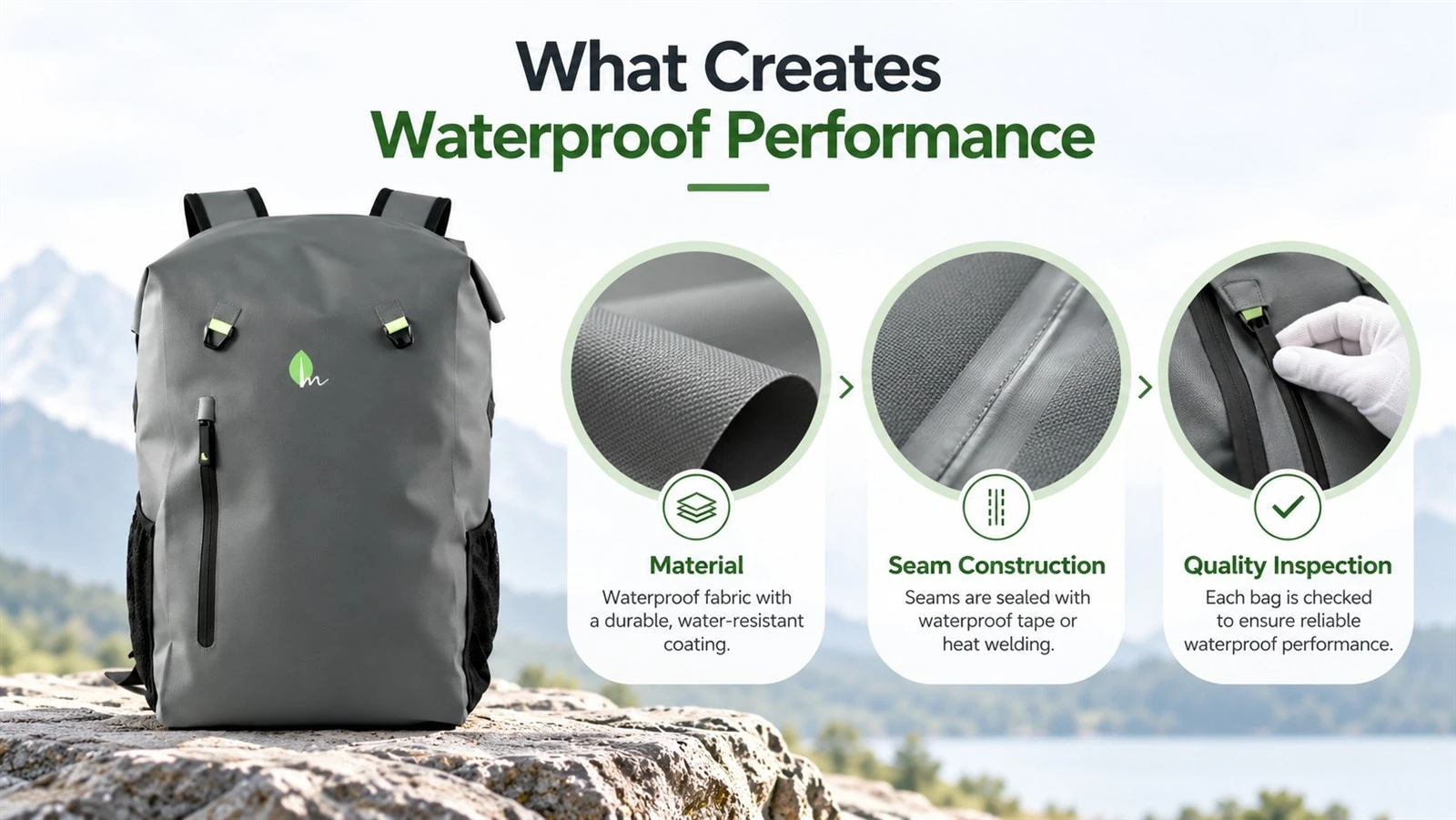
Fabric → Seams → Zipper → Closure → Attachment Points → Manufacturing → Testing
The finished product performs according to the weakest link in that chain.
This is also why two bags made from the same TPU waterproof fabric can perform very differently. One may use welded seams, an appropriate roll-top, carefully sealed attachment points, and finished-product leakage testing. Another may use ordinary stitched construction and a water-resistant zipper.
The material name alone does not tell you which product you are buying.
FAQ
Does waterproof fabric automatically make a bag waterproof?
No. Waterproof fabric prevents water from passing through the material itself, but a finished bag also contains seams, zippers, openings, webbing attachment points, and other structural interfaces. Each of those areas can become a leak path if it is not properly designed and sealed.
What is the difference between waterproof and water-resistant bags?
A water-resistant bag is generally designed to resist limited rain, splash, or short exposure to moisture. A waterproof bag uses a more complete waterproof construction system intended to provide a higher level of protection.
The exact difference depends on the product design and test conditions, so buyers should look beyond the marketing term and ask how the finished product is constructed and tested.
Are welded seams better than sewn seams for waterproof bags?
Welded seams can provide an important advantage because they join compatible thermoplastic materials without creating sewing needle holes. This makes HF welding and other welded-seam methods especially useful for dry bags, waterproof backpacks, and other high-waterproof products.
However, welded construction requires compatible materials, appropriate tooling, and stable process control. A well-designed sewn-and-sealed product may still be the better solution for applications that do not require airtight or higher-level waterproof construction.
Is a roll-top bag completely waterproof?
Not automatically. A roll-top can provide excellent rain and splash protection when it has enough roll length, suitable material stiffness, correct fold geometry, and adequate buckle tension.
Its performance also depends on how the user closes it and on the waterproof integrity of the rest of the bag.
How do manufacturers test whether a waterproof bag leaks?
Depending on the product, manufacturers may use water immersion, spray testing, air leakage testing, seam testing, weld-strength testing, or other methods.
For airtight products, one useful method is to inflate the bag and check whether it maintains pressure or shape over a defined period. Another is to submerge the closed product and look for bubbles that indicate an air or water leakage path.
conclusion
Waterproof fabric alone does not make a waterproof bag because waterproofness belongs to the finished construction, not to one material specification.
The fabric provides the foundation, but real waterproof performance depends on the seams, zipper, closure, attachment points, manufacturing consistency, and finished-product testing working together. A strong material cannot compensate for a leaking seam, and a well-welded body cannot compensate for the wrong closure system.
For brands developing waterproof backpacks, dry bags, waterproof travel bags, or other functional outdoor products, FENGLINWAN provides OEM/ODM development combining material selection, HF welding, heat-sealed construction, roll-top or airtight/watertight closure solutions, sample development, and waterproof validation.
If you are working on a specific waterproof bag project, contact FENGLINWAN to discuss your target application, construction requirements, materials, and testing expectations.