


Do Compression Bags for Travel Really Work?
Nov 23, 2026
Leave a message
Travel compression bags remove trapped air from soft goods to cut their packed volume. They work - but only within limits set by material science, seal integrity, and what you actually put inside them. The category spans cheap roll-top plastic pouches to welded TPU dry sacks built for backcountry abuse, and the gap between best and worst is wider than most travel blogs admit.
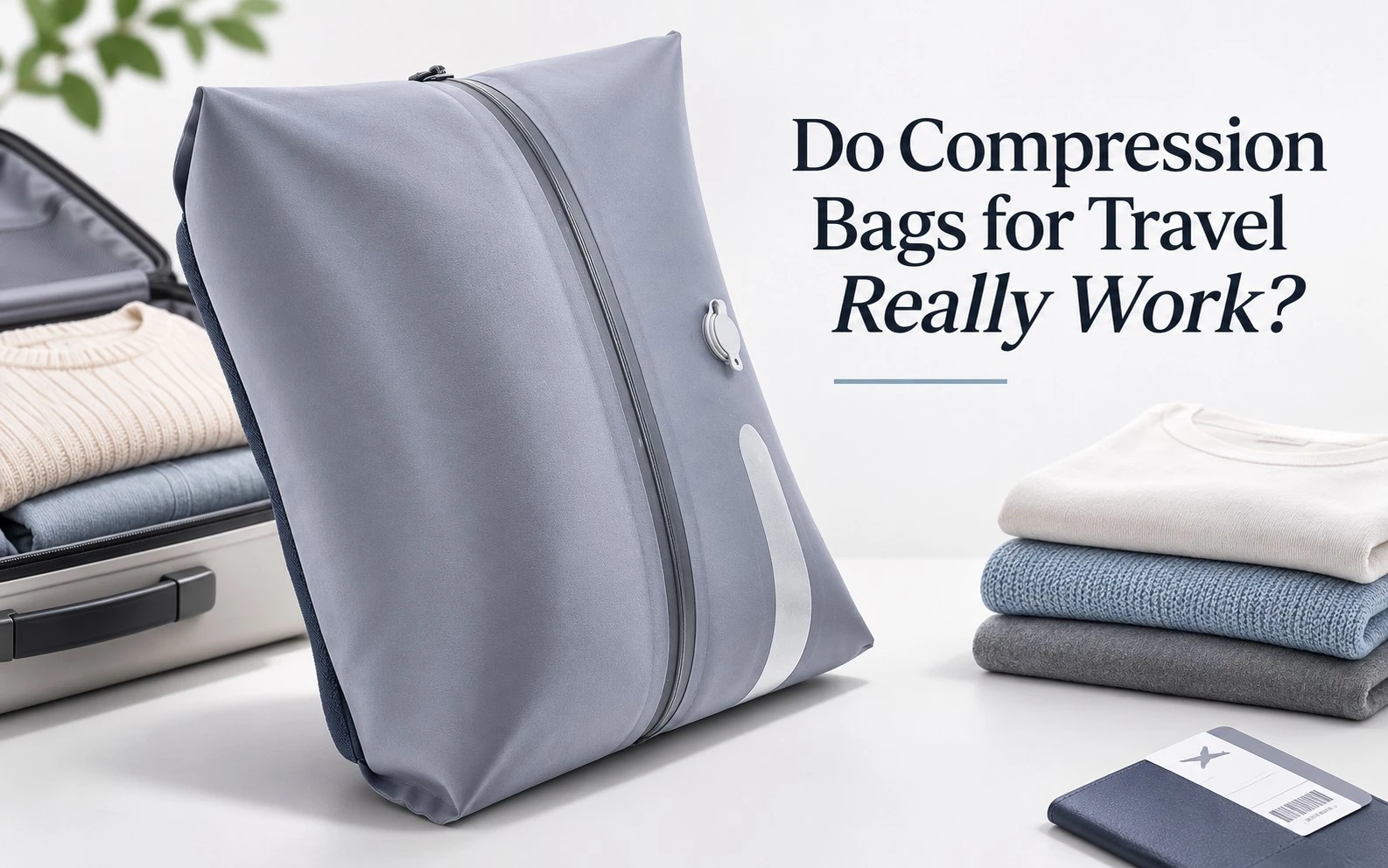
A travel compression bag is a sealed container that reduces the volume of soft, air-trapped items - clothing, sleeping bags, down jackets - by evacuating the air between fibers. Two mechanisms dominate the market. Vacuum compression bags use a one-way valve and a pump (manual, electric, or a household vacuum cleaner) to actively draw air out, creating a pressure differential between the bag interior and ambient atmosphere. Compression sacks - the type favored by backpackers - use mechanical straps or a roll-top closure to squeeze air out physically, without any pump.
The physics is straightforward. Standard atmospheric pressure is approximately 101.3 kPa. When a pump evacuates a sealed bag to roughly 20 kPa internal pressure, the resulting 80 kPa differential forces loose fiber structures to collapse and pack densely. This is the same principle behind vacuum-sealed food storage, scaled up for textiles.
What this means in practice: compression bags do not reduce the mass or weight of your gear. They only reorganize the air gaps. A 2 kg down jacket still weighs 2 kg after compression - it just occupies less suitcase volume, which is the variable that matters for carry-on limits and backpack capacity.
How Much Space Can Travel Compression Bags Save?
Independent testing and user reports converge on a range that is narrower than marketing claims but still meaningful.
Table 1. Typical Volume Reduction by Compression Type
|
Compression Type |
Mechanism |
Typical Volume Reduction |
Best For |
|
Zip-compression packing cube |
Outer zipper compresses fabric panel |
7–10% |
Organization, light compression |
|
Roll-top compression sack |
Manual rolling forces air out |
30–50% |
Sleeping bags, bulky synthetics |
|
Vacuum bag with manual pump |
Hand pump evacuates air via one-way valve |
50–60% |
Down jackets, fleece, mid-layers |
|
Vacuum bag with electric pump |
Electric pump delivers negative pressure |
60–70% |
Bedding, parkas, maximum reduction |
The numbers above reflect typical results on cotton, synthetic blends, and down - the materials that compress well. Wool and silk retain natural loft and compress less. Structurally dense items like folded denim or stiff canvas jackets barely compress at all, because there is little trapped air to remove.
Several product roundups published in 2026 confirm this hierarchy. Vacuum bags with rechargeable pumps consistently outperform zip-compression packing cubes on bulky items, while cubes win on convenience and access speed. One widely cited comparison notes that vacuum bags sacrifice quick retrieval - you must unseal the entire bag to pull out one shirt, whereas a packing cube opens with a single zipper.
Marketing claims of "80% space savings" or "fits twice as much" should be read with skepticism. Those figures usually assume ideal conditions: maximally fluffy down, a high-quality seal, and measurement against loosely folded rather than tightly packed originals. Real-world savings of 50–65% are far more typical for mixed clothing loads.
Which Materials and Features Make Compression Bags More Durable?
The single biggest predictor of whether a compression bag works - and keeps working - is material. This is where budget products fail and premium ones earn their price.
PA+PE (Polyamide + Polyethylene) composites are the workhorse material for travel vacuum bags. PA provides puncture resistance and tear strength; PE provides flexibility and an airtight seal. Travel-grade PA+PE film typically runs 75–90 microns thick. Below 70 microns, bags puncture easily on zipper teeth, buttons, or jewelry. Above 100 microns, the film becomes rigid and resists forming a tight seal around irregular loads.
TPU (Thermoplastic Polyurethane) is the premium choice for outdoor and waterproof applications. TPU bags - typically 0.3–0.5 mm thick - use radio-frequency welded seams rather than heat-sealed or glued edges, eliminating the stitch holes and adhesive failures that plague cheaper bags. TPU is also inherently waterproof, flexible at low temperatures, and resistant to hydrolysis, making it the standard for backcountry dry sacks and high-end compression gear.
Nylon with PU coating occupies the middle ground for compression sacks (as opposed to vacuum bags). 70D nylon with a PU coating rated to approximately 2,000 mm hydrostatic head offers meaningful moisture protection for backpacking without the weight penalty of a submersion-grade dry bag. Higher denier fabrics (210D, 320D, 600D ripstop) trade weight for durability and appear in compression packing cubes where abrasion resistance matters more than waterproofing.
Table 2. Material Comparison for Travel Compression Bags
|
Material |
Typical Use |
Thickness Range |
Waterproof |
Durability |
Relative Cost |
|
PA+PE composite |
Vacuum travel bags |
75–90 microns |
No (moisture-resistant only) |
Moderate |
Low |
|
TPU welded |
Premium dry sacks, outdoor |
0.3–0.5 mm |
Yes |
High |
High |
|
70D nylon + PU |
Compression sacks |
Varies by coating |
Splash to light rain |
Good |
Medium |
|
210D–600D ripstop nylon |
Compression packing cubes |
Fabric weight varies |
Water-resistant (DWR) |
Good to high |
Medium |
Seam construction matters as much as the film itself. Heat-sealed edges on budget PA+PE bags can delaminate after 5–10 uses, especially if the bag is folded along the seal line during storage. Welded seams on TPU bags are structurally part of the material - they fail only when the material itself fails. Double-zipper designs on vacuum bags provide a second closure line that tolerates minor contamination (dust, fabric fibers) better than single-zip equivalents.
The one-way valve is the other critical failure point. Cheap valves use a simple rubber flap that degrades after repeated use. Better designs incorporate a threaded cap with a silicone gasket that maintains positive seal even after dozens of compression cycles. If the valve leaks, the bag re-inflates within hours, and the compression is lost.
What Are the Disadvantages of Travel Compression Bags?
Compression bags are not a universal solution. They fail in specific, predictable ways.
Wrinkling. Vacuum compression presses garments flat under sustained pressure. Natural fibers - cotton, linen, wool - emerge creased. Synthetic blends and performance fabrics (nylon, polyester) resist wrinkling far better. If you are packing dress shirts or business attire, compression bags will cost you ironing time at your destination.
Down loft recovery. Down jackets and sleeping bags rely on trapped air for insulation. Short-term compression (a flight, a weekend trip) does not permanently damage down loft - the fibers re-expand when released. But long-term storage under vacuum, measured in months, can degrade the cluster structure of down and reduce insulation value. Manufacturers of quality down gear routinely advise against prolonged vacuum compression for seasonal storage.
Seal failure in transit. A vacuum bag that holds at home can fail in a cargo hold. Temperature swings, pressure changes during flight, and physical compression from other luggage all stress the seal. A bag that was rock-solid when you packed it may arrive partially re-inflated. This is not a defect - it is the physical reality of maintaining a pressure differential through a polymer membrane under changing conditions.
Access tradeoff. Once a vacuum bag is sealed, you cannot pull out one item without breaking the seal and re-compressing. For trips where you need mid-transit access to specific garments, compression packing cubes or compression sacks with strap closures are the better choice.
How to Choose the Right Compression Bag for Your Trip
The decision should be driven by what you pack and how you travel, not by the headline compression percentage.
For Air Travel and Checked Luggage
Vacuum bags with a rechargeable electric pump are the strongest option for maximizing checked-bag capacity. Electric pumps delivering approximately -50 kPa negative pressure can compress a full bag in under a minute, compared to several minutes of manual pumping. USB-rechargeable pumps rated for 80–100 compression cycles per charge cover most multi-week trips without needing a wall outlet.
The tradeoff is weight and bulk. A pump adds roughly 150–300 g to your kit, and the flat vacuum bags lack the structural rigidity of packing cubes - they slide around in a suitcase rather than stacking neatly. For carry-on-only travelers, this matters.
For Backpacking and Outdoor Use
Waterproof compression sacks, also called compression dry bags, serve a dual purpose: volume reduction and moisture protection. A 70D nylon sack with PU coating compresses a sleeping bag or down jacket to roughly 40–50% of its stuffed volume while keeping it dry in a pack that may see rain, stream crossings, or condensation.
TPU welded dry sacks offer the highest protection level - fully submersible - but weigh more and cost significantly more than coated nylon. For most three-season backpacking, a PU-coated compression sack at the 2,000 mm hydrostatic head level is the practical sweet spot. Reserve full TPU dry sacks for paddling trips, canyoneering, or conditions where full submersion is a realistic possibility.
For Short Trips and Business Travel
Zip-compression packing cubes are the right tool here. They provide modest volume reduction (roughly 7–10%), keep garments organized and accessible, and add negligible weight. A set of two or three cubes in different sizes handles a 3–5 day business trip without the overhead of a pump or the wrinkling risk of vacuum compression.
The key insight: compression bags are tools with specific use cases, not universal packing upgrades. Matching the tool to the trip is what determines whether they work for you.
FAQ
Do compression bags make luggage lighter?
No. Compression bags reduce the space occupied by clothing and other soft items, but they do not reduce their weight. A smaller packed volume can make a suitcase easier to organize without changing the baggage weight shown on a scale.
Are compression packing cubes better than vacuum bags?
It depends on the trip. Compression packing cubes provide modest space savings and easier access to clothing, while vacuum compression bags generally reduce the volume of bulky items more effectively but require resealing and re-compression after opening.
Are travel compression bags waterproof?
Not always. Standard compression packing cubes and many vacuum storage bags are not designed for outdoor immersion. The distinction between waterproof and water-resistant matters when choosing outdoor compression gear. Waterproof compression sacks require suitable materials, seams, and closures; the finished bag's protection depends on its complete construction, not the fabric alone.
Can you use compression bags for down jackets and sleeping bags?
Yes, short-term compression can make down jackets and sleeping bags easier to transport. However, prolonged vacuum storage may affect loft recovery, so these items should generally be stored uncompressed between trips.
Final Thoughts
Yes - compression bags genuinely reduce packed volume, with vacuum-type bags delivering 50–70% reduction on compressible items like down and fleece, and compression sacks delivering 30–50% on sleeping bags and bulky layers. The caveats are real but manageable: choose PA+PE for budget travel vacuum bags, TPU for outdoor waterproof needs, and nylon compression sacks for backpacking. Avoid vacuum compression for long-term down storage, expect some wrinkling on natural fibers, and carry a backup method if you depend on a pump.
For travel and outdoor brands exploring custom waterproof or functional bag projects, FENGLINWAN provides OEM/ODM development and manufacturing expertise in TPU/PVC materials, HF-welded seams, and airtight/watertight construction. Contact our team to discuss your product concept, performance requirements, and customization needs.