


Waterproof vs. Water-Resistant Laptop Bags: What's the Difference?
Nov 19, 2026
Leave a message
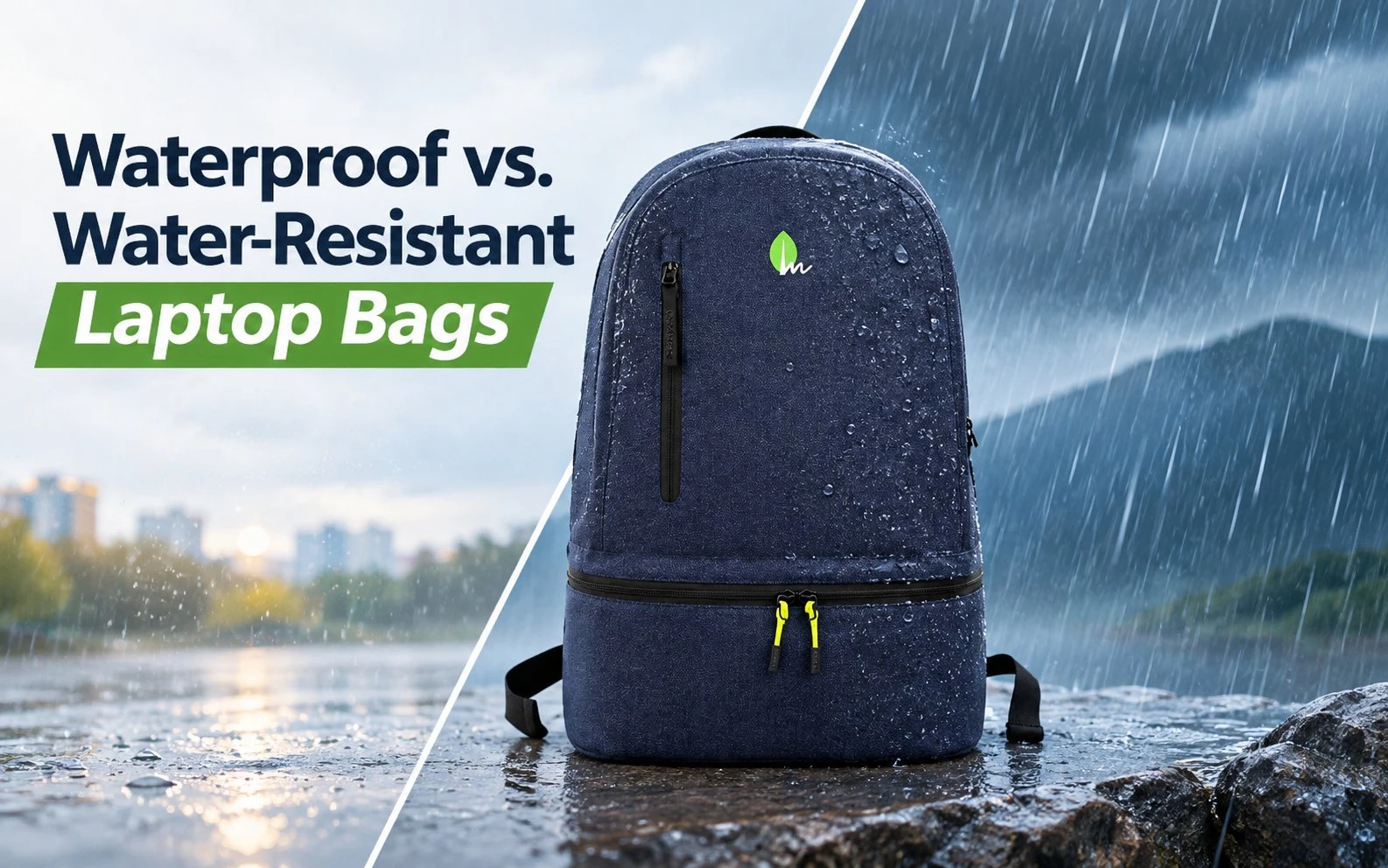
Most laptop bag listings use "waterproof" and "water-resistant" as if they mean the same thing. They don't. Water-resistant laptop bags shed light rain for a limited time; waterproof laptop bags are built to keep water out under sustained pressure, and in some cases during full submersion. The gap between the two is not a marketing nuance - it is a structural difference in materials, seam construction, and closure type that determines whether a laptop survives a downpour or an accidental drop into a stream.
What Do Waterproof and Water-Resistant Mean for Laptop Bags?
Water-resistant means the bag's outer fabric has been treated to slow water penetration but cannot stop it indefinitely. The most common treatment is a DWR (Durable Water Repellent) coating - a chemical finish applied to the fabric surface that lowers surface tension so water beads up and rolls off, much like water on a lotus leaf. DWR is effective against splashes and brief showers, but it wears down with abrasion, washing, and UV exposure. Once the coating degrades, the fabric begins to absorb water.
Waterproof means the bag forms a continuous physical barrier against water entry. This is achieved not by a surface coating but by impermeable materials - typically TPU (thermoplastic polyurethane) or PVC film laminated to the base fabric - combined with sealed or welded seams and a waterproof closure system such as a roll-top or airtight zipper. A genuinely waterproof bag can resist sustained water pressure and, at higher ratings, survive submersion.
The distinction between waterproof and water-resistant protection matters because a water-resistant bag will eventually let water through, while a properly waterproof bag will not - at least not within its rated conditions.
How IPX Ratings Measure Water Protection in Laptop Bags
The most widely used framework for rating water protection is the IPX rating, derived from the international standard IEC 60529 (Ingress Protection). The "IP" code uses two digits: the first rates dust protection, the second rates water protection. When a product is rated only for water, the dust digit is replaced with "X" - hence IPX4, IPX6, IPX7, and so on.
Higher numbers indicate more demanding test conditions, but they are not strictly linear. IPX6 (high-pressure water jets) and IPX7 (immersion) test fundamentally different failure modes, so a bag rated IPX6 is not automatically superior to one rated IPX7 - it depends on what kind of water exposure you need to survive.
The table below maps the IPX levels most relevant to laptop bags:
Table 1. IPX Water Protection Ratings Relevant to Laptop Bags
|
IPX Rating |
Test Condition |
What It Survives |
Typical Bag Application |
|
IPX3 |
Spraying water at up to 60° from vertical |
Light rain at an angle |
Urban commuter bags, minimal exposure |
|
IPX4 |
Splashing water from all directions |
Rain, splashes from any angle |
Everyday commuter and campus bags |
|
IPX5 |
Low-pressure water jet (6.3 mm nozzle, ~12.5 L/min) |
Sustained rain, water spray |
Cycling bags, light outdoor use |
|
IPX6 |
High-pressure water jet (~100 L/min) |
Heavy storms, powerful spray |
Hiking and expedition packs |
|
IPX7 |
Immersion at 1 m depth for 30 minutes |
Brief accidental submersion |
Watersports bags, kayak and rafting use |
|
IPX8 |
Continuous immersion (depth and duration set by manufacturer) |
Sustained submersion per spec |
Dive-grade dry bags, specialized equipment cases |
Source: IEC 60529 / GB/T 4208-2017 standard definitions.
A critical detail: IPX8 is a "negotiated" rating. Unlike IPX7, which has fixed test parameters (1 meter, 30 minutes), IPX8 conditions are agreed between the manufacturer and the testing party. This means two IPX8 bags may have very different real-world submersion performance - one might survive 1.5 m for 30 minutes, another 10 m for an hour. Always check the stated depth and duration, not just the number.
How Fabric, Seams, and Closures Affect Laptop Bag Waterproofing
Understanding the difference between waterproof and water-resistant laptop bags requires looking at the three places water enters a bag.
Fabric and Coatings
The outer fabric is the first line of defense. Common materials include high-tenacity nylon (often abrasion-resistant nylon fabrics known for exceptional abrasion and tear resistance), polyester oxford cloth, and laminated composites. Fabric alone - even durable high-tenacity nylon - is not waterproof by nature. It becomes water-resistant when treated with DWR, and waterproof only when laminated with a continuous TPU or PVC membrane.
DWR-treated fabric typically withstands hydrostatic pressure in the range of roughly 500–2,000 mm before water begins to penetrate. Fully laminated waterproof fabrics can withstand significantly higher pressure, often rated at 5,000 mm or above, depending on the membrane and construction.
Seams
This is where most bags reveal their true category. Every stitch hole is roughly 0.1 mm in diameter - large enough to wick water under pressure. A sewn seam without taping will leak at hydrostatic pressures above approximately 30 cm of water head, because each needle puncture acts as a capillary channel.
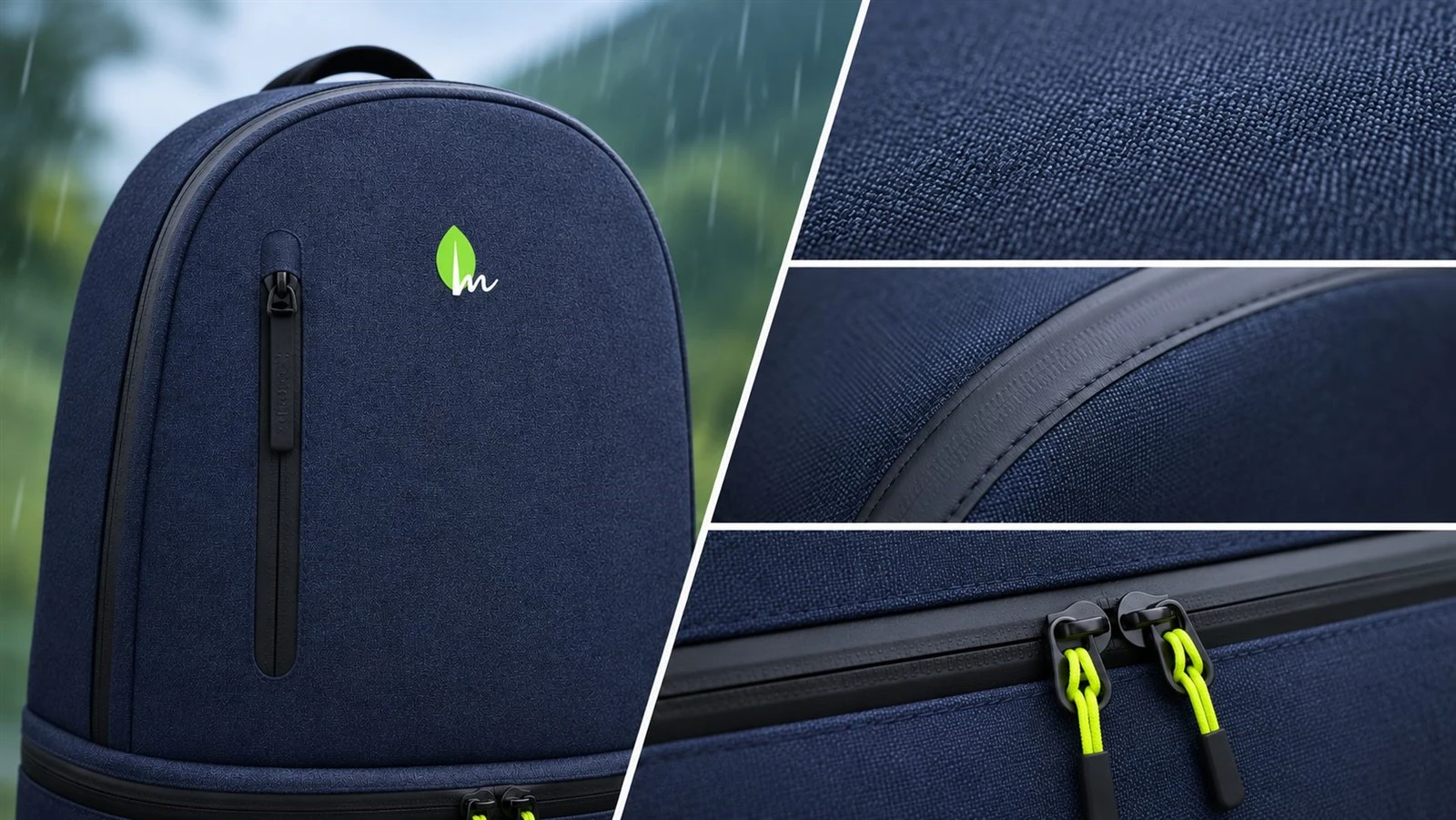
Water-resistant bags generally have standard sewn seams, sometimes with a thin PU seam sealer that degrades over time. Waterproof bags use seam taping or RF (radio frequency, also known as high-frequency or HF) welding - heat-bonded tape or welded joints that fuse the fabric layers into a continuous, stitch-free seal. If a bag's seams are stitched but not taped or welded, it is water-resistant at best, regardless of what the fabric can do.
Closures
The closure is often the weakest point. Standard zippers, even those with a water-resistant PU or TPU coating on the tape, typically achieve only IPX4 to IPX6 - the interlocking teeth still create gaps that admit water under sustained spray or pressure. True waterproof closures fall into two categories:
- Roll-top closures: The opening is folded over several times and buckled shut, creating a path that water cannot follow. Roll-tops can achieve IPX7 or higher and are the standard for dry bags.
- Airtight (gas-tight) zippers: These use a TPU-sealed tooth system that interlocks into a hermetic seal. Airtight zippers can reach IPX7–IPX8, with precision-engineered teeth biting to tolerances around 0.01 mm and TPU film heat-sealed across the entire zipper tape. They are significantly more expensive and less convenient to open than roll-tops or standard zippers.
The closure type sets a hard ceiling on a bag's waterproof rating. No amount of fabric or seam engineering can compensate for a standard zipper at the main opening.
Waterproof vs. Water-Resistant Laptop Bags: Side-by-Side Comparison
The differences extend beyond a single metric. The table below compares the two categories across the factors that determine real-world performance:
Table 2. Waterproof vs. Water-Resistant Laptop Bags - Key Differences
|
Factor |
Water-Resistant |
Waterproof |
|
Primary mechanism |
DWR surface coating on fabric |
TPU/PVC membrane lamination + sealed seams + waterproof closure |
|
Water exposure limit |
Splashes and light rain for limited duration |
Sustained rain, spray, and submersion within rated depth/time |
|
Seam construction |
Sewn, optionally with light seam sealer |
Taped or RF-welded, stitch-free seal |
|
Typical closure |
Standard or water-resistant coated zipper |
Roll-top or airtight zipper |
|
IPX range commonly seen |
IPX3–IPX4 (occasionally IPX5–IPX6 with coated zippers) |
IPX6–IPX8 |
|
Weight |
Lighter |
Heavier (denser materials, sealed construction) |
|
Breathability |
Better (fabric remains permeable) |
Limited or none (membrane blocks air and moisture) |
|
Durability of water protection |
Degrades as DWR wears off; re-treatable |
Stable unless membrane or seal is physically damaged |
|
Cost |
Lower |
Higher (materials, welding, airtight hardware) |
|
Best for |
Daily commuting, campus, urban travel |
Outdoor expeditions, cycling in heavy rain, watersports, fieldwork |
A water-resistant bag is the pragmatic choice when the realistic threat is a short walk through light rain. A waterproof bag is necessary when the threat is sustained downpour, water crossing, or the possibility of the bag being submerged - situations where a laptop has zero tolerance for moisture.
How to Choose the Right Laptop Bag for Your Needs
The decision should be driven by the actual risk profile, not by the highest number on a spec sheet.
For urban commuting and business travel, a water-resistant laptop backpack rated IPX4 is usually sufficient. The most common hazards are brief rain between a train station and an office, coffee spills, and splashes from passing traffic. A DWR-treated high-tenacity nylon or high-density nylon bag with a coated zipper handles these well, weighs less, and breathes better than a fully sealed alternative. Adding a rain cover for heavier downpours is a cost-effective upgrade that doesn't add permanent weight.
For cycling and motorcycle commuting, the exposure is more intense - sustained wind-driven rain at speed. Here, IPX5 or IPX6 becomes the realistic minimum, and a roll-top closure or a waterproof commuter backpack with a suitable closure system is worth considering.
For outdoor activities - hiking, kayaking, fishing, field research, or any environment where the bag may be submerged or exposed to heavy storms for extended periods - a fully waterproof bag rated IPX7 or IPX8 is not optional. The laptop, along with electronics, documents, and spare clothing, needs a barrier that will not fail under pressure or immersion. Roll-top dry-bag construction or an airtight-zipper hardcase design is the standard.
One practical note: many bags marketed as "waterproof" are in fact only water-resistant, relying on DWR-coated fabric and standard zippers while omitting sealed seams. If a manufacturer claims waterproof performance without specifying an IPX rating, seam construction method, or closure type, treat the claim with caution. Reputable products state their tested rating and construction details explicitly. Testing methods such as air and water leakage checks can further help verify waterproof construction.
Frequently Asked Questions
1. Can a Water-Resistant Laptop Bag Protect a Laptop in Heavy Rain?
A water-resistant laptop bag can protect against light rain, splashes, and brief exposure to moisture, but it may not keep water out during prolonged heavy rain. DWR-treated fabrics and coated zippers can delay water penetration, but unsealed seams and openings remain vulnerable. For frequent exposure to heavy rain, a properly constructed waterproof laptop bag offers more reliable protection within its tested conditions.
2. Is a Waterproof Laptop Sleeve Enough to Protect a Laptop From Water?
A waterproof laptop sleeve can provide an additional layer of protection, but its effectiveness depends on the material, seam construction, and closure design. A sleeve made from waterproof fabric is not necessarily fully waterproof if water can enter through its zipper or stitching. For demanding outdoor conditions, a properly sealed waterproof bag combined with a padded laptop compartment or protective sleeve can provide both moisture and impact protection.
3. Does a Waterproof Laptop Backpack Need an IPX8 Rating?
Not necessarily. The appropriate IPX rating depends on how the backpack will be used. For everyday commuting or cycling in rain, resistance to splashing water or water jets may be more relevant than immersion protection. IPX7 or IPX8 becomes more important when accidental submersion is a realistic risk. Buyers should check the tested exposure conditions rather than choosing a backpack based solely on the highest rating.
4. Are Waterproof Laptop Bags Also Shockproof?
Not automatically. Waterproofing and impact protection are separate design requirements. Waterproof materials, welded seams, and airtight closures help prevent water entry, while padded compartments, EVA protection structures, and reinforced construction help protect a laptop from bumps and drops. Choosing the right materials for a laptop sleeve or protective compartment is an important part of addressing both risks according to the intended use.
Final Thoughts
The difference between waterproof and water-resistant laptop bags comes down to engineering, not labeling. Water-resistant bags use surface coatings to delay water entry; waterproof bags use impermeable membranes, sealed seams, and specialized closures to block it within specified conditions. The right choice depends on what your gear actually faces - a commuter needs splash protection, while an outdoor professional may need a barrier that holds under immersion.
At FENGLINWAN, we specialize in OEM/ODM manufacturing of outdoor waterproof bags and functional laptop and commuter bags, with capabilities in TPU/PVC material selection, HF welding, airtight and watertight closures, and protective compartment design. If you're developing or sourcing custom waterproof laptop bags or backpacks, contact our team to discuss your project requirements and find the right balance of waterproof performance, protection, and usability.