


What Features Should You Look for in a High-Quality Laptop Bag?
Nov 19, 2026
Leave a message
A high-quality laptop bag is not just a fashion accessory. It is a protective shell for a device that holds your work, your data, and often your livelihood. Yet most buyers spend more time choosing the laptop inside than the bag carrying it. The gap between a bag that lasts a decade and one that fails in six months comes down to a handful of measurable features-materials, padding, weather resistance, compartment logic, ergonomics, and hardware. This article breaks down these essential laptop bag features so you can evaluate a laptop bag the way a product designer would, not the way a marketing page wants you to.
Laptop Padding and Drop Protection
What Padding Actually Does
Padding in a laptop compartment is not about softness. It is about energy absorption-specifically, the ability to decelerate a laptop over a longer distance so that peak force on the device stays below the threshold where screens crack, hinges shear, or internal components disconnect.
The industry term for this is drop protection-the capacity of a bag's padded sleeve to cushion a laptop from impact force when the bag falls or is set down hard. A well-designed padded laptop compartment uses closed-cell foam (commonly EVA, or ethylene-vinyl acetate) in a thickness of roughly 10 to 20 mm, sometimes layered with a softer open-cell foam nearest the device and a denser layer facing outward. Some premium bags add a rigid or semi-rigid panel-often HDPE (high-density polyethylene)-along the spine to prevent the bag from flexing inward under lateral pressure.
|
Padding Type |
Typical Thickness |
Impact Absorption |
Best Use Case |
|
Open-cell foam |
5–10 mm |
Low; compresses easily |
Lightweight sleeves, low-risk carry |
|
Closed-cell EVA foam |
10–20 mm |
Medium to high; resists permanent deformation |
Standard laptop compartments |
|
Multi-density layered foam |
15–25 mm |
High; combines soft contact layer with dense impact layer |
Premium commuter and outdoor bags |
|
Suspended / floating sleeve |
Varies |
Highest; laptop hangs above bag floor, avoiding corner impacts |
Rugged and travel-oriented bags |
A suspended laptop compartment-sometimes called a floating sleeve-elevates the laptop so its bottom edge does not touch the base of the bag. When the bag is set down or dropped, the impact never reaches the device directly. This design, originally borrowed from outdoor and military pack construction, is one of the strongest indicators that a manufacturer thought seriously about protection rather than just adding a padded divider.
Corner and Edge Protection
Most impact damage occurs at corners and edges, not flat surfaces. A high-quality laptop bag reinforces these zones with extra foam blocks, TPU (thermoplastic polyurethane) bumpers, or molded corner guards. If a bag's laptop sleeve has uniform padding with no additional corner reinforcement, it will protect against scratches but not against the drops that actually destroy laptops.
The difference between adequate and excellent padding is not thickness alone. It is whether the design addresses the specific failure points-corners, edges, and the bag floor-where real-world damage concentrates. For buyers looking for a portable protective solution, a padded laptop sleeve with handle is another practical design to consider.
Water Resistance and Waterproofing
Understanding Water Resistance Ratings
Not all "waterproof" bags are waterproof. The term is used loosely in marketing, and the gap between splash resistance and true waterproofing is wide. Understanding the difference between waterproof and water-resistant protection is essential when choosing a water-resistant laptop bag or a fully waterproof laptop bag for outdoor use.
The IPX rating system (Ingress Protection, defined by IEC standard 60529) classifies how well an enclosure resists water intrusion. The "X" indicates that dust protection is not rated; the number that follows specifies water resistance level. For laptop bags, the relevant range runs from IPX1 (dripping water) through IPX4 (splash resistance from any direction) up to IPX7 (immersion up to 1 meter for 30 minutes) and IPX8 (continuous immersion under conditions specified by the manufacturer).
|
Rating |
Protection Level |
Real-World Scenario |
|
IPX1–IPX3 |
Light dripping or spraying water |
Brief exposure to mist or drizzle |
|
IPX4 |
Splash resistance from any direction |
Light rain, accidental spills, splashing at a sink |
|
IPX5–IPX6 |
Low to high-pressure water jets |
Heavy rain, direct spray |
|
IPX7 |
Immersion up to 1 m for 30 min |
Dropped in a puddle or shallow stream |
|
IPX8 |
Continuous immersion per manufacturer spec |
Sustained submersion; conditions vary by product |
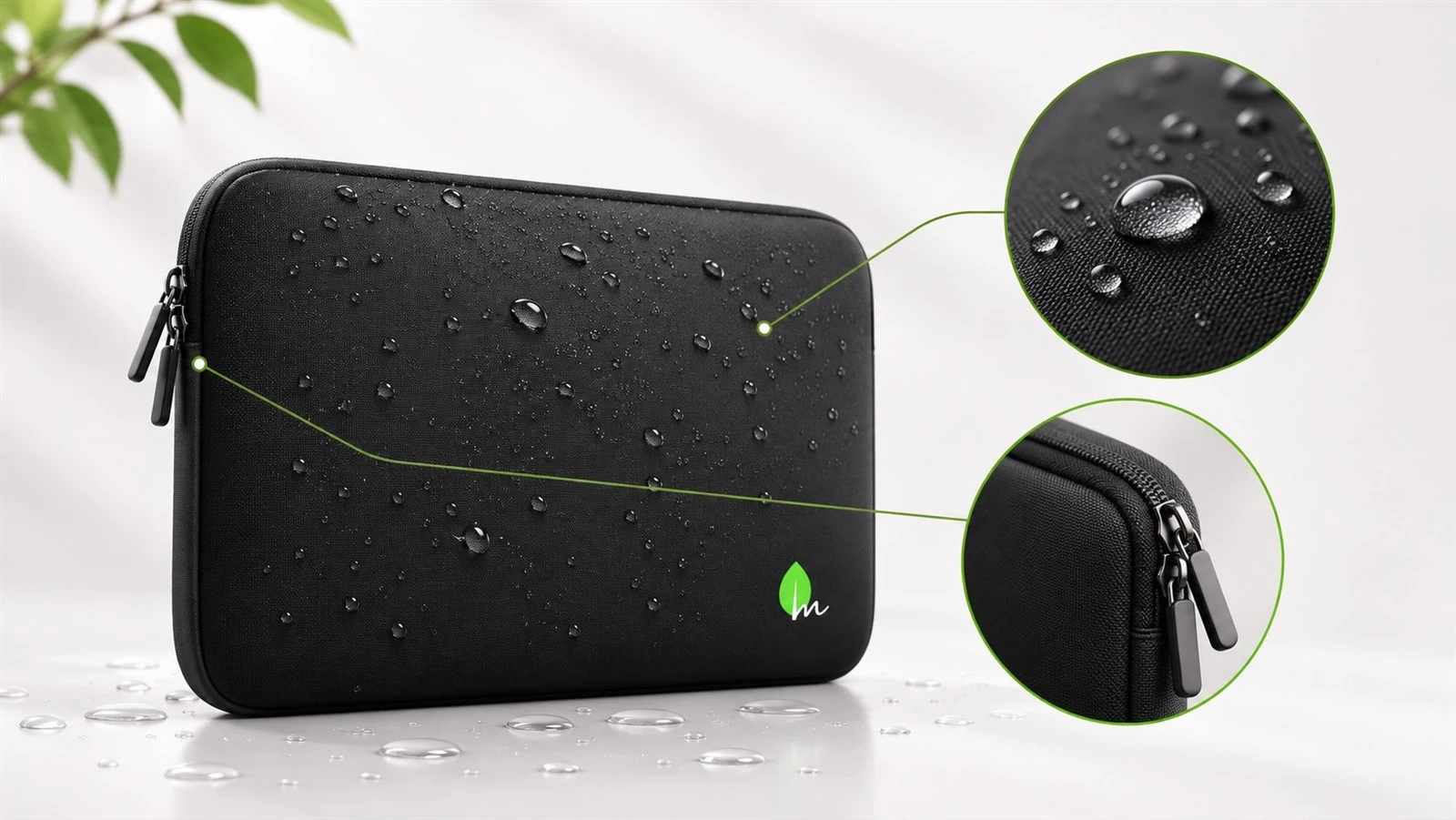
Most commuter laptop bags on the market carry no formal IPX rating at all. They rely on a DWR (Durable Water Repellent) coating applied to the outer fabric, which causes water to bead and roll off under light rain. DWR is effective for short exposure but degrades with abrasion and washing. It is not the same as waterproofing.
True Waterproofing Requires More Than Coated Fabric
A bag is only as waterproof as its weakest seam. Water enters through stitch holes, zipper tracks, and unsealed junctions long before it penetrates the main fabric. True waterproof construction requires seam sealing or welded seams-techniques that fuse fabric panels together without stitching, or that tape every stitch line with waterproof film-combined with suitable waterproof zipper types (either coated water-resistant zippers or full RF-welded airtight zippers).
For outdoor and adventure-oriented laptop bags, look for bags that specify both a waterproof main fabric (such as TPU-coated nylon or laminated polyester) and sealed or welded seams. A bag with coated fabric but standard stitched seams will hold up in a drizzle and fail in a downpour. For laptop-specific applications, a waterproof laptop sleeve is another protective option worth considering.
From a manufacturing perspective, FENGLINWAN can combine TPU or PVC materials, high-frequency welding, heat-sealed seams, and suitable water-resistant or watertight zippers for custom waterproof bag projects. The actual waterproof performance of any finished laptop bag depends on its complete construction and appropriate testing.
If your use case involves predictable exposure to heavy rain, water crossings, or marine environments, do not settle for DWR alone. The cost difference between a splash-resistant bag and a genuinely waterproof one is modest compared to the cost of a water-damaged laptop.
Durable Materials for Laptop Bags
Denier and What It Tells You
Fabric weight in bag construction is measured in denier (D)-a unit that describes the weight in grams of 9,000 meters of the yarn. Higher denier means thicker, heavier yarn, which generally translates to greater abrasion resistance and tear strength. A 1680D ballistic nylon is substantially more rugged than a 420D polyester, though also heavier.
Denier alone does not guarantee durability. The weave pattern, fiber type, and coating all matter. But denier gives you a starting reference point for comparing fabrics within the same fiber family.
|
Fabric |
Typical Denier Range |
Key Characteristics |
Common Application |
|
Ballistic nylon |
840D–1680D |
High abrasion and tear resistance; heavy |
Premium commuter and travel bags |
|
High-tenacity nylon |
500D–1000D |
Excellent strength-to-weight ratio; resists scuffing |
Outdoor and tactical laptop bags |
|
Ripstop nylon / polyester |
200D–400D |
Reinforced grid weave stops tears from spreading; lightweight |
Ultralight and minimalist bags |
|
Oxford cloth (polyester) |
300D–600D |
Budget-friendly; moderate durability with PU coating |
Entry-level laptop bags |
|
TPU-coated fabrics |
Varies |
Waterproof when seam-sealed; highly abrasion-resistant |
Rugged and marine-grade bags |
For applications requiring enhanced weather protection, understanding the properties of different waterproof fabrics for bags can help buyers compare materials beyond denier alone.
Fiber Type Matters More Than Denier Alone
Nylon (particularly ballistic and high-tenacity variants) offers superior abrasion resistance and elasticity compared to polyester at equivalent denier. Nylon fibers recover better from stretching and deformation, which means straps and stress points maintain their shape longer under load. Polyester, while less expensive and inherently more UV-resistant, tends to be used in mid-range bags where cost sensitivity outweighs the need for maximum durability.
For bags that will see daily outdoor use-commuting through all seasons, trail approaches, or fieldwork-ballistic nylon or high-tenacity nylon in the 500D to 1000D range is the practical sweet spot. It balances ruggedness against weight. Going above 1000D adds durability but also significant weight, which becomes a daily burden.
Leather, while valued for aesthetics and patina development, is a different category. Full-grain leather offers excellent durability and water resistance when properly maintained, but it is heavier, requires conditioning, and lacks the modularity of synthetic fabrics for compartment design. It suits executive and lifestyle bags more than technical outdoor use.
When evaluating materials for a dedicated protective sleeve, it is also worth comparing the best materials for making a laptop sleeve, since the ideal combination of exterior fabric, lining, and padding depends on the intended level of protection.
Laptop Compartments and Storage Organization
The Logic Behind Good Compartment Layout
A laptop bag's organization system determines how efficiently you can access gear and how safely that gear is stored. The key principle is compartmentalization-separating the laptop from items that could scratch or crush it, and giving each category of item a dedicated location so you are not digging through the main compartment to find a cable.
A well-organized laptop bag typically follows a three-tier structure:
- Dedicated laptop compartment: Padded, suspended, and accessible without opening the main compartment. Ideally positioned against the wearer's back for both protection (the body cushions impact) and security (harder to pickpocket).
- Main storage compartment: For books, documents, a change of clothes, or larger accessories. Should not share space with the laptop.
- Quick-access front organizer: Pen slots, card pockets, key leash, phone pocket, and small cable storage. Designed for items you reach for multiple times per day without opening the bag fully.
Features That Separate Good from Generic
Several compartment features distinguish a thoughtfully designed bag from a generic one:
- Tablet sleeve: A secondary padded pocket, usually 10–11 inches, positioned adjacent to the laptop compartment. Prevents the tablet from sliding against the laptop or other items.
- Hidden security pocket: A zippered pocket against the back panel or inside a non-obvious location for passports, cash, or sensitive documents.
- Side water bottle pockets: Stretch-mesh or structured pockets that keep hydration outside the main compartment, eliminating the risk of condensation or leaks reaching electronics.
- TSA-friendly laptop compartment: A compartment that lays flat when the bag is unzipped, allowing the bag to pass through airport security scanners without removing the laptop. This feature, originally standardized for frequent flyers, has become common in premium commuter bags.
- Compression straps: External straps that cinch the bag's volume when partially loaded, preventing contents from shifting during movement.
A bag with too few compartments forces you to pile everything together, risking scratches and making access inefficient. A bag with too many tiny compartments adds weight and complexity without proportional benefit. The best designs find the middle ground: enough separation to protect and organize, not so much that the bag becomes a puzzle to pack.
Comfortable Straps, Back Panels, and Weight Distribution
Why Carry Comfort Is a Feature, Not a Luxury
A laptop bag is a load-bearing system. A typical 15-inch laptop weighs 1.5 to 2.5 kg; add a charger, accessories, documents, and a water bottle, and a daily carry can easily reach 4 to 6 kg. How that load is distributed across the body determines whether the bag is comfortable for a ten-minute walk or a two-hour commute.
Ergonomics in bag design refers to how the bag's strap, back panel, and weight distribution system interact with the wearer's body to minimize strain on the shoulders, neck, and spine. The goal is to transfer weight to the body's strongest support structures-the hips and core-rather than suspending it entirely from the shoulders.
The preferred carrying system also depends on whether you choose a shoulder bag or backpack. Understanding the differences between a laptop bag and a laptop backpack can help you select a design that matches your commuting habits and carrying needs.
The Components of a Good Carry System
|
Component |
What to Look For |
Why It Matters |
|
Shoulder straps |
Width of 5–8 cm; S-curve following shoulder contour; multi-density foam padding |
Wide, contoured straps distribute pressure over a larger area, reducing point loading on the trapezius muscles |
|
Sternum strap |
Adjustable, removable, positioned across the chest |
Prevents shoulder straps from sliding outward under load; stabilizes the bag during movement |
|
Hip belt |
Padded or webbing; removable for urban use |
Transfers up to 60–70% of load weight from shoulders to hips on heavier carries |
|
Back panel |
Contoured to follow spine curve; ventilated channels or 3D mesh |
Maintains airflow to reduce sweating; structural support prevents the bag from sagging against the spine |
|
Load lifters |
Straps from the top of the bag to the upper shoulder strap |
Pulls the load closer to the body's center of gravity, reducing the lever arm that causes backward pull |
Back Panel Ventilation
A common failure point in laptop bags is the back panel. A flat, unpadded back panel allows the bag to press directly against the wearer's back, trapping heat and moisture. A well-designed back panel uses 3D mesh or contoured foam channels to create an air gap between the bag and the spine. This gap allows air to circulate, significantly reducing perspiration during warm-weather commutes or active use.
Some outdoor-oriented bags use a suspended mesh back panel-a tensioned mesh trampoline that holds the entire bag away from the back. This design, adapted from hiking backpacks, offers the best ventilation but adds some weight and reduces the bag's internal volume slightly.
Weight Considerations
The bag's own weight is a feature, not an afterthought. A heavy empty bag compounds the problem of a heavy load. Premium commuter bags typically weigh between 0.8 and 1.5 kg empty. Ultralight designs can come in under 0.6 kg, but they achieve this by using thinner fabrics and minimal padding-acceptable for low-risk urban carry, not for rugged outdoor use. At the other end, heavily padded tactical or travel bags can exceed 2 kg before anything is loaded.
The right weight depends on your use case. For daily urban commuting, aim for a bag under 1.2 kg. For outdoor or multi-day travel use, accept a heavier bag in exchange for the protection and load-bearing features it provides. A lightweight business laptop backpack is one option to consider when comparing designs for everyday professional commuting.
Laptop Bag Size and Fit
Matching Bag Size to Laptop Size
Laptop bags are sized by the maximum laptop screen diagonal they accommodate-typically 13, 14, 15.6, or 16 inches, with some travel bags extending to 17.3 inches. The laptop compartment's internal dimensions should exceed the laptop's external dimensions by roughly 10 to 20 mm in each direction. Too tight, and the laptop is difficult to insert or remove; too loose, and the laptop can shift inside the compartment, defeating the padding's purpose.
|
Laptop Size |
Typical External Dimensions (mm) |
Recommended Compartment Internal Size (mm) |
|
13-inch |
304 × 212 × 15 |
320 × 230 × 25 |
|
14-inch |
312 × 222 × 16 |
330 × 240 × 25 |
|
15.6-inch |
358 × 245 × 20 |
380 × 260 × 30 |
|
16-inch |
355 × 248 × 17 |
380 × 270 × 30 |
|
17.3-inch |
399 × 275 × 25 |
420 × 300 × 35 |
Note that laptops with the same screen size can vary significantly in physical dimensions, particularly thickness. A slim ultrabook and a gaming laptop with the same 15.6-inch screen may differ by 10 mm or more in thickness. Always check the bag's internal compartment dimensions against your laptop's external measurements rather than relying on the screen size label alone.
For a more detailed comparison of laptop dimensions and protective sleeve measurements, refer to our laptop sleeve size guide.
Bag Volume and Daily Carry Capacity
Bag volume, measured in liters, indicates total storage capacity. For laptop bags, the practical ranges are:
15–20 liters: Minimalist daily carry-laptop, charger, small accessories, a notebook. Suitable for short commutes with light loads.
20–28 liters: Standard commuter range-laptop, accessories, documents, water bottle, light jacket or lunch. The most versatile size for daily professional use.
28–35 liters: Extended carry-adds capacity for a change of clothes, gym gear, or travel essentials. Suitable for those who combine commuting with travel or active use.
35+ liters: Travel-oriented-enough for a short trip but increasingly cumbersome for daily urban use.
Choose a volume that fits your daily carry with roughly 20% headroom. A bag that is packed to capacity every day puts stress on seams and zippers, and it becomes difficult to access items without unpacking others.
Zippers, Buckles, Stitching, and Build Quality
Zippers: The Most Common Failure Point
Zippers fail more often than any other component on a laptop bag. They are subjected to repeated cycling, lateral stress, and contamination from dust and grit. The quality of the zipper is therefore one of the most reliable indicators of overall build quality.
Established zipper manufacturers with proven production standards play an important role in the premium bag market. Bags that specify reliable zipper components in their product descriptions are signaling a commitment to component quality. Generic or unbranded zippers are not necessarily defective, but they may lack the track record and documented quality consistency of established manufacturers.
|
Zipper Type |
Characteristics |
Typical Application |
|
Coil zipper (polyester) |
Self-healing; flexible; moderate abrasion resistance |
Most standard laptop bags |
|
Molded plastic-tooth zipper |
Stiffer; more weather-resistant; larger teeth |
Outdoor and water-resistant bags |
|
Metal zipper |
Strong; premium feel; heavier |
Leather and executive-style bags |
|
Waterproof zipper (coated or RF-welded) |
Water-resistant to waterproof; stiffer operation |
Rugged and marine-grade bags |
Buckles, Stitching, and Stress Points
Beyond zippers, evaluate the following hardware and construction details:
- Buckles: Should be made of acetal or nylon, not cheap polystyrene. Acetal buckles resist cracking under cold temperatures and impact. Look for reliable hardware with consistent material quality and proven performance, particularly for outdoor and heavy-duty applications.
- Stitching: Key stress points-shoulder strap attachments, handle anchors, and zipper junctions-should feature bar-tack stitching (dense, reinforced stitching in a narrow band) or box-X stitching (an X pattern within a sewn rectangle). These patterns distribute load across multiple stitch points rather than concentrating it on a single line.
- Seam allowance: The fabric folded under at a seam should be at least 10 mm and ideally double-stitched. Narrow, single-stitched seams at stress points are a red flag for premature failure.
- Base reinforcement: The bottom of the bag, which contacts the ground most frequently, should have an additional layer of abrasion-resistant material-often a heavier denier fabric, a rubberized coating, or molded EVA.
Hardware quality is where cost-cutting is most visible and most consequential. A bag with excellent fabric and padding but cheap zippers and single-stitched straps will fail at its weak points long before the main materials show wear.
For brands sourcing custom laptop bags, consistent manufacturing quality is equally important. FENGLINWAN incorporates incoming material inspection, in-process quality control, final product inspection, and outgoing quality control into its manufacturing workflow, including 100% final inspection before packaging.
FAQ
1. What Is the Most Important Feature of a High-Quality Laptop Bag?
The most important feature is reliable laptop protection. A high-quality laptop bag should have a properly fitted, padded laptop compartment that helps reduce impact damage, especially around the corners, edges, and bottom of the device. Durable materials, dependable zippers, weather resistance, and carrying comfort are also essential for long-term use.
2. How Much Padding Should a Laptop Bag Have?
A well-designed laptop compartment commonly uses approximately 10–20 mm of closed-cell EVA foam, although the ideal thickness depends on the bag's construction and intended use. Padding thickness alone does not determine protection. Corner reinforcement, material density, and a suspended laptop compartment can also help reduce the risk of impact damage.
3. Is a Water-Resistant Laptop Bag the Same as a Waterproof Laptop Bag?
No. A water-resistant laptop bag generally protects against light rain and occasional splashes, while a genuinely waterproof laptop bag requires a more complete protective construction. Waterproof fabrics, sealed or welded seams, and suitable closure systems help prevent water from entering. Always check the finished product's stated protection level and supporting test information.
4. What Materials Are Best for a Durable Laptop Bag?
Nylon and polyester are common choices for durable laptop bags because they offer different combinations of strength, weight, cost, and weather resistance. High-denier nylon is often preferred for rugged applications, while polyester is widely used in business and commuter bags. TPU-coated fabrics are also suitable for designs requiring enhanced waterproof protection. The best material depends on how and where the bag will be used.
5. How Do I Choose the Right Laptop Bag Size?
Measure your laptop's actual length, width, and thickness, then compare those dimensions with the bag's internal laptop compartment. Screen size labels alone are not enough because laptops with identical screen sizes can have different external dimensions. Choose a compartment that provides sufficient clearance for easy insertion while keeping the device securely positioned.
Final Thoughts
A high-quality laptop bag is the sum of its engineering decisions: padding that absorbs impact at the corners where damage actually occurs; weather resistance matched to your real exposure, not to a marketing claim; fabrics chosen for their strength-to-weight ratio in your use context; compartments that separate and protect rather than just divide; a carry system that distributes load across the body's strongest structures; and hardware that will survive thousands of cycles without failing.
No single feature makes a bag good. But the absence of any one of them-thin padding, unsealed seams, cheap zippers, a flat back panel, a loose laptop sleeve-reliably makes it inadequate. Evaluate each feature against your specific carry scenario, and you will be able to distinguish a bag engineered for protection from one designed only to look like it.
At FENGLINWAN, we specialize in OEM/ODM manufacturing of waterproof and functional bags, including custom laptop bags, protective sleeves, and business backpacks, with expertise in material selection, product development, and quality control. Contact our team to discuss your laptop bag design, protective features, material requirements, or custom manufacturing project.