

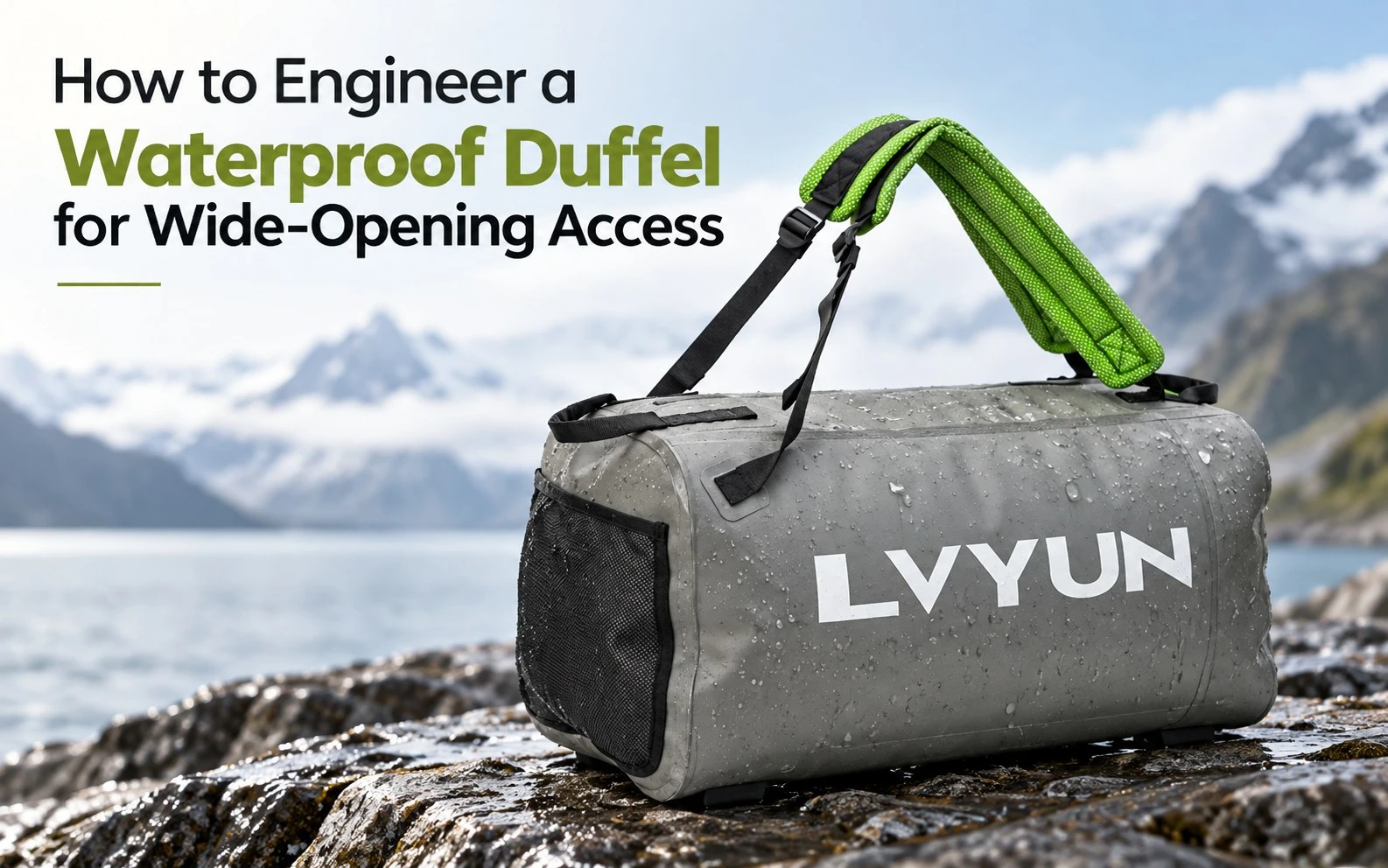
How to Engineer a Waterproof Duffel for Wide-Opening Access
Nov 02, 2026
Leave a message
A waterproof duffel lives or dies by one moment: the instant a user pulls the zipper and looks inside. If the opening is narrow, stiff, or fights back, the bag becomes a black hole-gear goes in and never comes out the same way. If the opening is wide, smooth, and weatherproof, the duffel becomes far easier to load, organize, and use in the field.
That is what makes wide-opening waterproof duffel bag design more complicated than simply adding a longer zipper. The opening geometry, waterproof zipper, fabric, welded seams, reinforcement, and load paths must work as one system. This article examines the engineering decisions behind a waterproof duffel with wide-opening access, from zipper architecture and closure geometry to fabric selection, seam construction, structural reinforcement, and validation.
Wide-Opening Access vs. Waterproof Performance
Every waterproof duffel design begins with a fundamental tension. The wider the opening, the longer the zipper track, and the more seam length that must be protected against water ingress.
A standard top-loading dry bag with a roll-top closure is inherently simple from a waterproofing perspective because the opening is folded over rather than closed with a long zipper. The trade-off is access. A tubular opening makes it difficult to see what is at the bottom, and packing often becomes a vertical stuffing exercise.
Wide-opening access changes that equation. A U-shaped zipper running across the top and down both sides allows the lid to fold back like a clamshell, exposing most or all of the interior. Users can organize equipment in layers, see individual items, and retrieve gear from the bottom without unpacking everything above it. For multi-day travel, wet/dry organization, paddling, and professional field use, that difference can have a major impact on usability.
The engineering target, however, should not simply be the longest possible zipper. A better question is:
How much of the internal volume can the user actually see and reach when the bag is open?
Usable opening size depends on the zipper path, panel geometry, corner radius, fabric stiffness, and the way the lid folds. A longer zipper that binds at the corners or allows the surrounding panels to collapse may provide less practical access than a shorter, better-engineered opening.
The challenge is therefore to create a long, accessible closure without turning the opening into the weakest point of the waterproof system.
Choosing a Waterproof Zipper for a Wide-Opening Duffel
The zipper is one of the most critical components in a wide-opening waterproof duffel. The right choice depends on the required level of protection rather than on the highest available waterproof specification. Understanding the differences between water-resistant, watertight, and airtight zipper types is therefore an important early design decision.
Three common strategies illustrate the trade-offs:
|
Strategy |
Waterproof Rating |
Opening Smoothness |
Durability |
Best For |
|
TPU-coated (polyurethane-coated) zipper |
Water-resistant, not submersible |
Very smooth |
High - coated teeth resist corrosion |
Rain, splash, spray environments |
|
RF-welded zipper with storm flap |
Highly water-resistant |
Smooth with slight resistance |
Very high - flap backs up the seal |
Paddling, marine, heavy rain |
|
Dry-seal zipper (tooth-interlock TPU) |
Submersible-rated |
Stiffer, requires lubrication |
Moderate - needs regular maintenance |
Submersion, dive, extreme conditions |
For many wide-opening duffels designed for outdoor and adventure-travel use, a TPU-coated zipper backed by a storm flap provides a practical balance. The coated zipper sheds rain and splash, while the storm flap creates a second barrier against driven rain and spray. The zipper can also remain relatively smooth to operate, which matters when users are wearing gloves or working in wet conditions.
A product intended for sustained immersion is a different engineering problem. In that case, a watertight, airtight, or submersible waterproof zipper may be necessary, but designers must accept the corresponding differences in stiffness, operating force, maintenance, cost, and opening feel. The distinction between ordinary waterproof protection and submersible bag performance should be defined in the product brief before the closure system is selected.
The first question should therefore not be "Which waterproof zipper has the highest rating?" It should be "What level of water protection does the actual use case require?"
A rain-resistant travel duffel, a paddling gear bag, and a bag designed for temporary submersion should not automatically use the same closure system.
Several details are particularly important when integrating the zipper:
- Zipper tape bonding: The zipper tape should be integrated into the waterproof structure through an appropriate RF/HF welding or heat-sealing process rather than relying on exposed stitching through the waterproof membrane. Needle holes can create potential water paths, while welded construction can form a continuous sealed interface.
- Zipper track length and curve radius: A U-shaped zipper that turns too sharply at the corners can bind and place additional stress on the coated zipper and surrounding material. A minimum corner radius of 25 mm helps the zipper flex more smoothly over repeated opening and closing cycles.
- End-stop reinforcement: Zipper termination points concentrate mechanical stress. A reinforced TPU patch welded around the end-stop can help distribute that load and reduce the risk of the zipper pulling away from the bag body.
The important principle is that the opening is not a single component. It is a system consisting of the zipper, zipper ends, surrounding panels, welded interfaces, reinforcement, and the loads transmitted through them.
FENGLINWAN's waterproof product platform supports different closure approaches, including water-resistant, watertight, and airtight zipper configurations together with HF Welding and waterproof structural development. This allows zipper selection to be matched to the actual protection target instead of treating every waterproof duffel as the same engineering problem.
Choosing the Opening Geometry: Clamshell vs. Three-Quarter
A wide zipper is only half the story. The geometry of how the lid opens, stays open, and closes determines whether wide-opening access actually improves the product in real-world use.
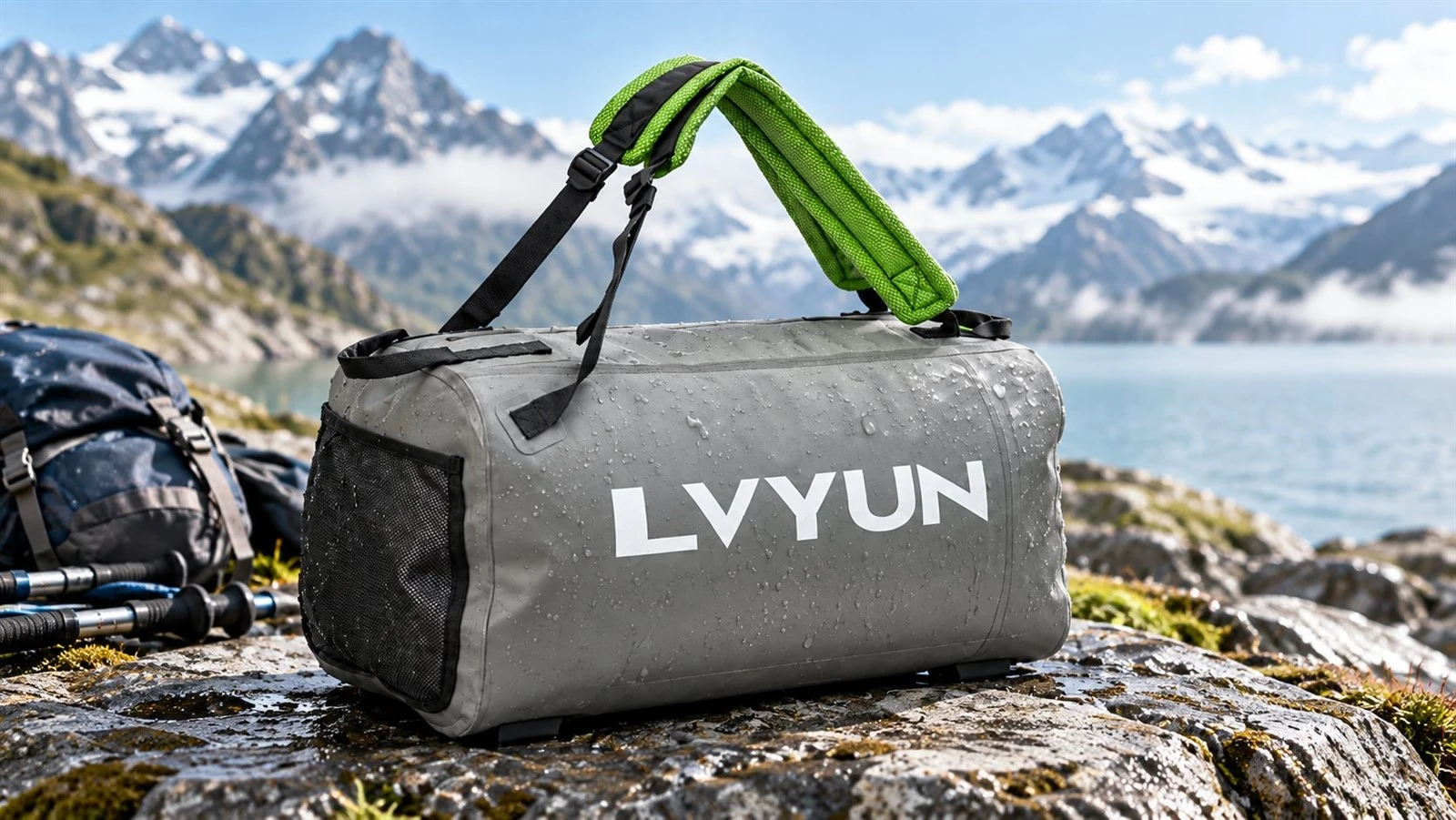
Clamshell vs. three-quarter opening. A true clamshell design hinges the lid along one long edge so that it opens flat like a suitcase. This normally requires a zipper that runs in a full U-shape across the top and down both short ends, together with a hinge edge made from a flexible but durable section of material.
The advantage is maximum visibility and easy access to the complete packing area. The trade-off is a longer zipper track and more sealing length.
A three-quarter opening runs the zipper across the top and partway down each side while leaving the final section as a fixed fabric panel. This reduces zipper length and waterproof seam length while still providing broad access, although the lid does not open completely flat.
For duffels in the 40–60 liter range, a three-quarter opening is often an effective engineering compromise. For 80+ liter expedition duffels, full clamshell access can justify the additional sealing complexity because reaching bulky equipment deep inside a large bag becomes increasingly important. A large waterproof duffel bag is a useful reference point for understanding how capacity and access requirements begin to influence the overall structure.
This is why waterproof duffel bag design should focus on usable access rather than zipper length alone.
Lid stay and self-support. Once the zipper is open, the lid should remain out of the way instead of repeatedly falling onto the contents. Slight structural stiffness can be introduced through a double layer of fabric with a thin foam interlayer or through a semi-rigid stay near the hinge. The lid then behaves more like a controlled panel than a loose fabric flap.
Interior organization integration. Wide-opening access also makes more sophisticated interior organization possible. Mesh divider panels can separate clean and wet gear, pockets can be integrated into the underside of the lid, and compression straps can secure loads when the bag is only partially full.
These features should be planned during product engineering rather than added late in development. Each pocket, divider, or anchor introduces an attachment point, and its location can affect both the waterproof construction and the load path of the surrounding panels.
A useful way to evaluate the design is to consider three variables together:
Access Geometry × Closure System × Load Management
The goal is not to maximize any single variable. The goal is to balance them so the opening remains accessible, the closure provides the required protection level, and carrying loads do not distort critical sealed areas.
Selecting Fabric and Welding Waterproof Seams
The zipper and closure system are only as waterproof as the material and seams they connect to. For a wide-opening waterproof duffel intended for demanding outdoor use, fabric and seam construction must therefore be specified together with the zipper.
Fabric selection. Common materials for high-performance waterproof duffels include TPU-coated nylon and TPU-coated polyester, often in the 500–840 denier range. Denier influences the fabric's weight, abrasion resistance, and tear behavior, while TPU, a member of the broader polyurethane material family, provides the thermoplastic coating surface required for many waterproof and welding applications.
|
Fabric |
Typical Weight |
Abrasion Resistance |
Weldability |
Common Use |
|
500D TPU-coated nylon |
~280 g/m² |
High |
Excellent |
Mid-size duffels, 30–60 L |
|
840D TPU-coated nylon |
~420 g/m² |
Very high |
Excellent |
Expedition duffels, 60–120 L |
|
420D TPU-coated nylon (ripstop) |
~210 g/m² |
Moderate-high |
Excellent |
Lightweight travel duffels |
For this type of welded waterproof bag construction, coating configuration matters as much as the base textile. A double-sided TPU-coated fabric provides a weldable surface on both sides and can simplify the creation of sealed interior and exterior structures.
Material choice should also account for the behavior of the opening itself. A fabric that is too soft may allow a large opening to collapse during loading, while excessive stiffness can make the zipper path and lid harder to manipulate. Flexibility, stiffness, weldability, abrasion resistance, target weight, and intended environment therefore need to be evaluated as a system.
TPU is widely used for high-performance welded waterproof bags, but it is not the only possible waterproof material. Depending on the project requirements, PVC can also be used for heat-sealed waterproof products. A PVC/TPU waterproof duffel bag illustrates how different waterproof material systems can be applied within the same broad product category.
FENGLINWAN's customization system supports both TPU and PVC material options, allowing the material to be selected together with the intended structure, cost target, and manufacturing process rather than in isolation.
Seam construction. In a welded waterproof duffel, the main waterproof body should minimize penetrations through the sealed membrane. HF Welding for waterproof bags and other suitable heat-welding processes can fuse thermoplastic-coated fabric panels together, creating continuous waterproof connections without conventional needle holes through the primary sealed areas.
HF Welding is particularly useful around waterproof bag body seams and selected zipper interfaces because it can combine the coating layers under pressure to form a sealed joint. For a more detailed look at how these joints are engineered, TPU waterproof bag seam construction explains the relationship between welding, bonding, and structural design.
Stitched construction may still be appropriate for selected components, including handles, shoulder strap structures, or other non-primary waterproof assemblies. Where stitching interacts with a waterproof zone, the construction has to account for the resulting penetrations through additional sealing, welded backing, or an alternative attachment architecture.
Stress point reinforcement. Handles, shoulder straps, anchor loops, and compression straps transmit significant loads into the body of the bag. Reinforcement patches can spread these forces across a larger surface instead of concentrating them at a narrow seam or zipper end.
This leads to another useful design principle:
Whenever possible, the main water-sealing path and the highest mechanical loads should not compete for the same weak points.
A waterproof zipper can perform correctly as a closure and still experience premature problems if carrying loads continuously distort the zipper ends or surrounding welded panels.
FENGLINWAN's production system combines traditional sewing, bonding, HF Welding, heat-sealing, and waterproof structural development. In practice, this allows different manufacturing methods to be used where they make structural sense instead of forcing every component into a single process. Brands that want a broader view of how these techniques fit together can also review the complete process behind how waterproof bags are made.
Maintaining Duffel Shape and Managing Loads
A wide-opening duffel faces a structural challenge that a narrow-opening bag does not. When the zipper is open, much of the tension that normally holds the upper body together disappears, allowing the sides to collapse inward. When the bag is closed and heavily loaded, the wide span of the lid can bow outward under internal pressure.
Base panel engineering. A flat, semi-rigid base panel gives the waterproof duffel a stable floor and helps it retain its shape whether it is full or empty. This can be created with a double layer of TPU-coated fabric and a closed-cell foam or stiffener insert between the layers.
The base also allows the bag to remain upright during loading, which is especially useful in tents, vehicle cargo areas, workshops, and on boat decks.
Side panel structure. Vertical stiffener strips or semi-rigid stays can be integrated into side-panel structures to help the walls remain upright while the zipper is open. The objective is not to turn a soft duffel into a hard case but to provide enough structural support for the opening to remain usable during packing.
Compression and load management. External compression straps can reduce gear movement when the bag is partially filled and help control deformation when it is heavily loaded. These straps should transfer forces into the lower side panels or base structure rather than pulling directly on the lid.
This distinction becomes particularly important in a wide-opening waterproof duffel because poorly routed forces can distort the zipper path.
A waterproof opening should therefore be evaluated not only as a water barrier but also as part of the bag's mechanical structure. The design must answer two questions simultaneously:
Where can water enter?
and
Where does the load travel when the bag is lifted, compressed, or overfilled?
Testing a Wide-Opening Waterproof Duffel Before Production
Engineering decisions are only as useful as the testing that validates them. A wide-opening waterproof duffel should pass a defined validation protocol before mass production. For additional context on production-level verification methods, see how waterproof bags are leak tested using air and water leakage checks.
|
Test |
Method |
Pass Criterion |
|
Water ingress (rain) |
Spray head at 12 L/min for 30 min, bag partially filled with absorbent paper |
No moisture on interior paper |
|
Water ingress (immersion) |
Submerge to 30 cm for 15 min |
No water ingress through zipper or seams |
|
Zipper cycle durability |
Open/close cycle at 10 cycles/min |
5,000+ cycles without coating degradation |
|
Seam peel strength |
Peel test per ISO 11339 |
Peel strength ≥ 4 N/mm |
|
Abrasion resistance |
Martindale abrasion, 10,000 cycles |
No TPU coating breakthrough |
|
Load carry |
1.5× rated load, 500 carry cycles |
No seam or attachment failure |
The immersion test is particularly useful for distinguishing a product designed for rain and splash from one designed for actual submersion. A TPU-coated zipper with a storm flap may perform well in rain while still allowing gradual seepage during sustained immersion. If the product brief requires submersible performance, a dry-seal, airtight, or appropriately rated watertight zipper becomes necessary, together with the corresponding trade-offs in operating force and maintenance.
Testing should also reflect the intended product specification rather than applying an immersion requirement to every bag marketed as waterproof. A travel duffel intended for heavy rain and a professional equipment bag intended for temporary submersion need different validation criteria.
Where a project uses standardized ingress protection terminology, the IEC overview of IP ratings provides a useful reference for understanding how protection against water and solid ingress is formally classified. A bag should only be represented as meeting a specific standardized rating when the relevant construction and test conditions actually support that claim.
Prototype validation is especially important for wide-opening designs because drawings alone cannot fully reveal zipper operating force, lid behavior, corner binding, panel collapse, or the way a loaded bag distorts the opening.
FENGLINWAN's waterproof product development process includes paper-pattern development, HF welding mold development, sample production, air leakage testing, and water leakage testing before mass production. For airtight products, its documented process specifies 100% air leakage testing. New products can also proceed through pre-production review, first-finished-product inspection, and IQC/IPQC/FQC/OQC controls as they move toward production.
The company has also developed large-capacity waterproof products such as a 100L Waterproof Travel Bag using HF Welding and an airtight waterproof zipper. Products at this scale illustrate why closure geometry, large-volume load management, welded seams, and zipper integration need to be considered together rather than as separate specifications.
A waterproof duffel is not fully engineered simply because one prototype works. The construction also has to be reproducible under real production conditions.
FAQ
What is the best opening design for a waterproof duffel?
There is no single best opening for every application. A full U-shaped clamshell opening provides maximum visibility and access, while a three-quarter opening can reduce zipper length, sealing complexity, and cost. The best choice depends on bag capacity, equipment size, waterproof requirements, and how users need to access the contents.
Are waterproof zippers completely waterproof?
Not all waterproof zippers provide the same protection. Some coated zippers are designed primarily for rain and splash, while watertight, airtight, or submersible zipper systems are intended for more demanding exposure. The zipper rating should be matched to the actual waterproof performance required by the product.
Is TPU or PVC better for a waterproof duffel bag?
Both can be used in welded waterproof bag construction. TPU is commonly selected for high-performance waterproof products because of its flexibility, weldability, and suitability for demanding outdoor applications. PVC can also be appropriate for certain heat-sealed products depending on cost, construction, appearance, and performance requirements. Material selection should be made together with the closure system and manufacturing process.
Does a larger zipper automatically create better wide-opening access?
No. Practical access depends on the complete opening geometry, including zipper length, corner radius, side-panel shape, lid stiffness, and hinge design. A long zipper with poor geometry can bind or leave the interior difficult to reach, while a properly engineered opening can expose more usable volume with less zipper length.
Can a wide-opening waterproof duffel be customized for OEM or ODM projects?
Yes. A custom waterproof duffel can be developed around specific capacity, opening geometry, TPU or PVC material, zipper protection level, carrying system, internal organization, branding, and target use conditions. For welded products, these requirements should ideally be defined before paper-pattern development, welding mold development, prototyping, and waterproof testing.
Final Thoughts
Engineering a waterproof duffel for wide-opening access is not about selecting one premium zipper or maximizing one specification. The opening has to be treated as a complete system: usable access geometry, closure performance, material behavior, welded seam construction, reinforcement, and load management all influence one another.
The most effective waterproof duffel bag design therefore starts by defining how the product will actually be used and what level of water protection it needs. From there, the zipper, opening geometry, fabric, welding method, and structural support can be engineered together so the bag remains easy to open, reliable in wet environments, and practical to manufacture at scale.
FENGLINWAN is an OEM/ODM manufacturer specializing in outdoor waterproof and functional bags, with capabilities in TPU/PVC materials, HF Welding, waterproof and airtight structures, sampling, testing, and production. If you are developing a custom wide-opening waterproof duffel, contact us to discuss your required capacity, closure system, waterproof performance, materials, and project specifications.