


How to Pack a Suitcase with Vacuum Compression Bags
Nov 25, 2026
Leave a message
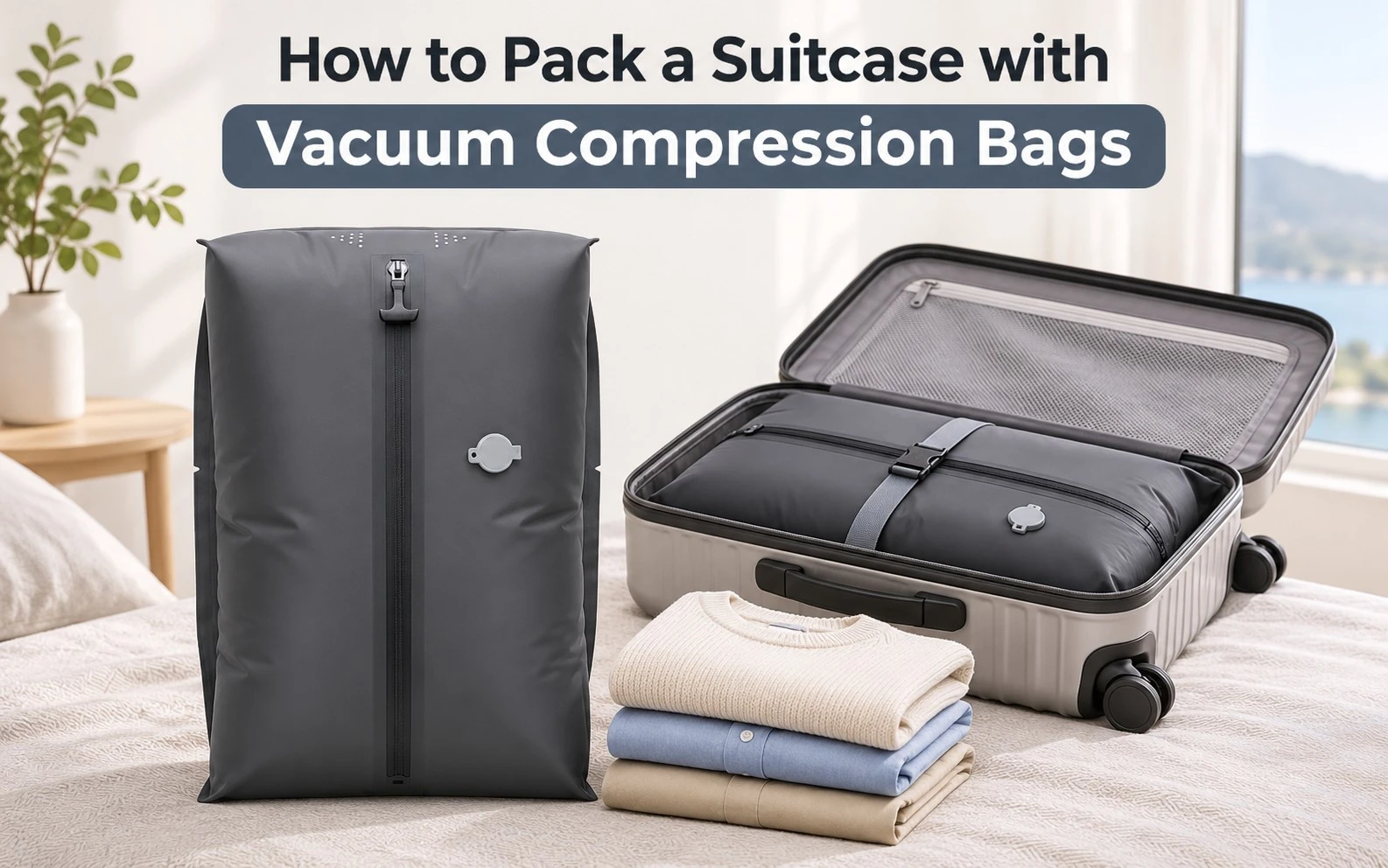
Vacuum compression bags are airtight storage bags - typically made from PA+PE or PET+PE composite films - that shrink bulky clothing by extracting internal air, reducing volume by up to roughly 60% while adding moisture protection and helping contain odors. For travelers wrestling with airline weight limits and limited suitcase space, they are one of the most effective packing tools available. If you want to know how to pack a suitcase with vacuum compression bags, this guide walks through selecting the right bag, packing step by step, avoiding fabric damage, and staying within airline baggage rules.
How Vacuum Compression Bags Save Suitcase Space
A vacuum compression bag works on a simple principle: seal soft goods inside an airtight bag, remove the air, and the contents compress into a dense, flat package. The bag does not reduce weight - your clothes weigh the same whether fluffy or flattened - but it reclaims the empty space trapped between fibers and folds.
What changes after compression:
|
Dimension |
Before Compression |
After Compression |
|
Volume |
Full loft of fabric |
Reduced by roughly 30–60% depending on material |
|
Weight |
Unchanged |
Unchanged |
|
Moisture exposure |
Open to ambient humidity |
Sealed against external moisture |
|
Storage flexibility |
Irregular, bulky shape |
Flat, stackable brick |
The compression ratio depends heavily on what you pack. Down jackets and thick wool sweaters compress dramatically; tightly woven cotton shirts barely shrink at all. Understanding this difference is the first step to using vacuum compression bags for travel effectively.
How to Choose Vacuum Compression Bags for Travel
Bag Types by Exhaustion Method
Three main types of travel vacuum compression bags dominate the market, each suited to different scenarios.
Pump-based bags require a manual hand pump or an electric pump to extract air through a one-way valve. They achieve the tightest compression and are ideal for home use or hotel rooms with access to a vacuum cleaner. The downside is obvious: you need to carry the pump, and without it mid-trip repacking becomes difficult.
Roll-up bags (also called hand-roll or no-pump bags) use a one-way exhaust channel built into the seal. You load clothing, close the zipper, and roll the bag from bottom to top, forcing air out through the valve. No pump required. These have become the most popular travel format because they work anywhere - airport lounges, hostel floors, hotel beds - with zero additional equipment.
Electric pump bags pair with portable, often rechargeable wireless pumps roughly the size of a smartphone. According to product trend reports, battery-powered mini pumps have emerged as a notable growth category, solving the long-standing problem of travelers having no vacuum cleaner on the road. They cost more and add a small device to your kit, but they deliver consistent compression in seconds.
|
Bag Type |
Compression Strength |
Equipment Needed |
Best Use Case |
|
Pump-based (manual/electric) |
Highest |
Pump required |
Home packing, long trips with hotel stays |
|
Roll-up (no-pump) |
Moderate–High |
None |
Short trips, carry-on only travel, repacking on the road |
|
Wireless electric pump |
High |
Rechargeable mini pump |
Frequent travelers, bulkier loads |
Size and Material Specifications
Travel-specific vacuum storage bags typically come in two standard sizes: small (around 40 × 60 cm) and medium (around 50 × 70 cm). A small bag generally holds 6–8 sweaters or equivalent items; a medium bag fits 10–15 pieces of mid-weight clothing. Larger household sizes (60 × 80 cm and above) are less practical for suitcases - compressed bags become rigid bricks that do not conform to case interiors, wasting corner space.
Material thickness matters for durability. Most travel bags use PA+PE or PET+PE composite films, with thickness measured in "si" (a Chinese unit where 1 si ≈ 0.01 mm). Travel-grade bags typically range from 6 to 11 si (roughly 0.06–0.11 mm). Thinner bags save weight but puncture more easily; thicker bags survive repeated use and rougher handling but add grams.
Higher-end travel compression bags have begun incorporating waterproof, tear-resistant nylon-blend materials, moving beyond pure plastic film toward more durable constructions that withstand the rigors of checked baggage handling.
From a functional bag manufacturing perspective, material durability is only one part of reliable performance. FENGLINWAN's experience with HF-welded seams, airtight/watertight bag constructions, and air and water leakage testing highlights the importance of seam integrity and closure design, although travel vacuum compression bags have their own specific performance requirements.
How to Pack a Suitcase with Vacuum Compression Bags: 5 Steps
Step 1: Sort and Select What to Compress
Not everything belongs in a compression bag. The best candidates are bulky, low-weight items where volume - not weight - is the problem.
Compress these:
- Down and synthetic insulated jackets
- Fleece and thick wool sweaters
- Bulk-knit items and hoodies
- Spare bedding or travel blankets
Do not compress these:
- Silk and fine wool garments (permanent creasing risk)
- Structured blazers or tailored jackets
- Down items for extended storage (loft degradation over time)
- Anything not fully dry (mold and mildew risk inside a sealed bag)
Step 2: Fold Flat and Load
Fold each item neatly - the flatter the fold, the more uniform the compression. Lay items flat inside the travel vacuum storage bag, stacking evenly. Avoid overfilling: leave enough slack at the opening so the zipper can close cleanly. An overstuffed bag will not seal properly, and the zipper is the most common failure point.
Step 3: Seal the Zipper Completely
Press the sliding zipper clip firmly across the full width of the opening, then run it back again. A double pass catches gaps that a single pass misses. Before moving on, squeeze the bag gently - if you feel or hear air escaping, reseal that section.
Step 4: Extract the Air
For roll-up bags, start from the bottom (opposite the valve end) and roll tightly toward the valve. Air exits through the one-way channel as you apply pressure. Keep rolling until the bag is flat and no more air escapes. This method is particularly useful for travelers using vacuum bags without a pump.
For pump-based bags, place the pump nozzle over the valve and operate until the bag stops shrinking. Stop before the bag becomes rock-hard - over-compression stresses seams and can damage delicate fabrics.
Step 5: Position in the Suitcase
When packing a suitcase with vacuum bags, place compressed bags flat at the bottom of the suitcase, near the wheels, where their weight helps stabilize the case. Distribute weight evenly side to side. Fill gaps between bags with softer items - socks, underwear, charging cables - to prevent shifting during transit.
Keep one uncompressed bag or packing cube on top with items you will need immediately at your destination, so you are not tearing open every compression bag on arrival.
Which Clothes Can You Safely Pack in Vacuum Compression Bags?
Compression is not free. Sustained high pressure affects different fibers in different ways, and ignoring this is the fastest way to ruin good clothing.
Synthetic fibers (polyester, nylon, polypropylene) tolerate compression well. Their elasticity allows them to recover loft after release, especially for short-duration travel compression of a few hours to a couple of days.
Natural fibers are more vulnerable. Wool and silk can develop permanent creases under prolonged pressure - the fibers deform and do not spring back. Cashmere is particularly susceptible. If you must compress these, limit compression time and expect to steam or iron upon arrival.
Down insulation deserves special caution. Down loft comes from the three-dimensional structure of plumage, and extended forceful compression can reduce that loft over time. For a weekend trip, compressing a down jacket is acceptable. For weeks of storage, hang it loose instead.
Moisture is the hidden danger. If you seal even slightly damp clothing in an airtight bag, you have created a greenhouse for mold. Always confirm garments are completely dry before compression - especially relevant in humid climates or after hand-washing items during a trip. Proper drying and storage practices are essential to prevent mold and mildew in travel gear.
Airline Baggage Rules for Vacuum Compression Bags
Vacuum compression bags are not on any major airline's prohibited items list. They are not dangerous goods, and they pose no security threat. That said, two practical constraints apply.
Size limits still govern. Compression reduces volume, not the external dimensions of your suitcase. If your carry-on exceeds the airline's dimensional limits (commonly around 56 × 45 × 25 cm, or a total linear dimension near 115 cm for international economy), compression bags will not save you - the case itself is too large. Whether you use a suitcase or an air travel backpack, know your airline's specific dimensions before packing.
Weight limits are unforgiving. This is where travelers get caught. Compression lets you fit more clothing into the same case, but every additional garment adds weight. Budget and low-cost carriers are particularly strict, with carry-on limits as low as 7 kg on some Asian and European routes. A suitcase packed to bursting with compressed down jackets can easily exceed the limit while appearing deceptively compact.
Checked baggage pressure changes. During flight, cargo hold pressure decreases and air inside a vacuum bag expands. According to physics principles (the ideal gas law), a sealed bag at lower external pressure will expand until internal and external pressure equalize. In practice, modern cargo holds are pressurized, so expansion is modest - but a bag sealed to maximum compression has no room to give. Leave a small margin rather than compressing to absolute maximum if the bag will be checked.
Zipper stress. A suitcase full of dense compression bricks concentrates weight differently than loosely packed clothing. Ensure your case's zipper and hinges can handle the load. Hard-shell cases handle compressed loads better than soft-sided bags, which may bulge.
Vacuum Compression Bags vs. Packing Cubes
Packing cubes - lightweight fabric organizers with zippers - are the most common alternative to vacuum compression bags. They serve fundamentally different purposes.
|
Feature |
Vacuum Compression Bags |
Packing Cubes |
|
Primary function |
Reduce volume |
Organize and segment |
|
Space savings |
Up to ~60% |
Minimal |
|
Weight added |
Very low (thin film) |
Low (fabric + zipper) |
|
Moisture protection |
Yes (airtight seal) |
No |
|
Re-packing ease |
Difficult (must re-compress) |
Easy (zip and go) |
|
Fabric safety |
Risk for delicate fibers |
Safe for all fabrics |
|
Best for |
Bulky items, volume-constrained travel |
Organization, frequent access |
The two are not mutually exclusive. Many experienced travelers use vacuum bags for bulky transit items and packing cubes for everyday clothing that needs to stay accessible. The combination gives you both space efficiency and organizational clarity.
Common Vacuum Packing Mistakes to Avoid
Compressing everything indiscriminately. Not every garment benefits. T-shirts and jeans compress marginally and come out wrinkled. Reserve vacuum bags for items where volume is genuinely the constraint.
Skipping the dry check. Sealing dampness inside an airtight bag is a recipe for mold. This is the single most preventable mistake, and the most damaging.
Over-compressing to the point of rigidity. A bag that feels like a brick has no give. In checked luggage subject to pressure changes, that rigidity can stress seams to failure. Stop compressing when the bag is firm but still slightly yielding.
Forgetting the pump. If you use pump-based bags for outbound packing, you need the same pump - or a roll-up alternative - for the return trip. Travelers routinely forget this and end up with an overstuffed suitcase on the way home.
Ignoring weight while chasing volume. The most common trap. Compression solves the space problem but creates the weight problem. Weigh your packed case before leaving home.
FAQ
How Much Space Do Vacuum Compression Bags Save in a Suitcase?
Vacuum compression bags can reduce clothing volume by roughly 30–60%, depending on the fabric and compression method. Bulky items such as jackets, sweaters, and blankets generally benefit more than tightly woven or already compact clothing. Actual space savings also depend on how the compressed bags fit inside your suitcase.
Can You Use Vacuum Compression Bags Without a Pump?
Yes. Roll-up vacuum compression bags allow you to remove air manually without a vacuum cleaner or electric pump. Simply load the clothes, seal the opening, and roll the bag according to its exhaust-valve design. These no-pump bags are especially convenient for hotel stays, short trips, and return travel.
Do Vacuum Compression Bags Make Your Suitcase Heavier?
No. Vacuum compression bags reduce the volume of packed clothing, not its weight. However, because compression creates extra suitcase space, travelers may pack more items and accidentally exceed airline baggage weight limits. Always weigh your suitcase after packing.
Can You Bring Vacuum Compression Bags in Carry-On Luggage?
Vacuum compression bags are generally permitted in carry-on luggage because they are ordinary storage accessories. However, your suitcase must still meet the airline's size and weight restrictions, and security personnel may need to inspect its contents. Check the relevant airline and airport security requirements before traveling.
Can You Reuse Vacuum Compression Bags for the Return Trip?
Yes, most travel vacuum compression bags are designed for repeated use if the material, zipper, and valve remain intact. For pump-based bags, bring a compatible portable pump or make sure you have access to suitable equipment at your destination. Roll-up bags are easier to reuse without additional tools.
Final Thoughts
Packing a suitcase with vacuum compression bags comes down to a few clear principles: compress the right items - bulky, low-weight garments - not everything; seal carefully and extract air fully; protect delicate fibers from prolonged pressure; and never forget that compression shrinks volume, not weight, so airline limits still apply. Used with judgment, these bags can transform a cramped carry-on into a week's worth of well-organized travel gear.
FENGLINWAN is an experienced OEM/ODM manufacturer specializing in waterproof and functional bags, offering custom travel bag development, material selection, airtight/watertight construction, and production solutions for outdoor and travel brands. If you are developing or sourcing waterproof travel bags or related functional storage products, contact FENGLINWAN to discuss your design requirements and explore suitable manufacturing solutions.