


Travel Compression Bags vs. Packing Cubes: Which Is Better for your Need
Nov 24, 2026
Leave a message
Packing cubes organize. Compression bags shrink. That distinction drives every purchase decision in this category, yet many buyers conflate the two and end up with the wrong tool. When comparing travel compression bags vs. packing cubes, the right choice depends on trip length, luggage capacity, and whether your priority is finding things fast or fitting more in.
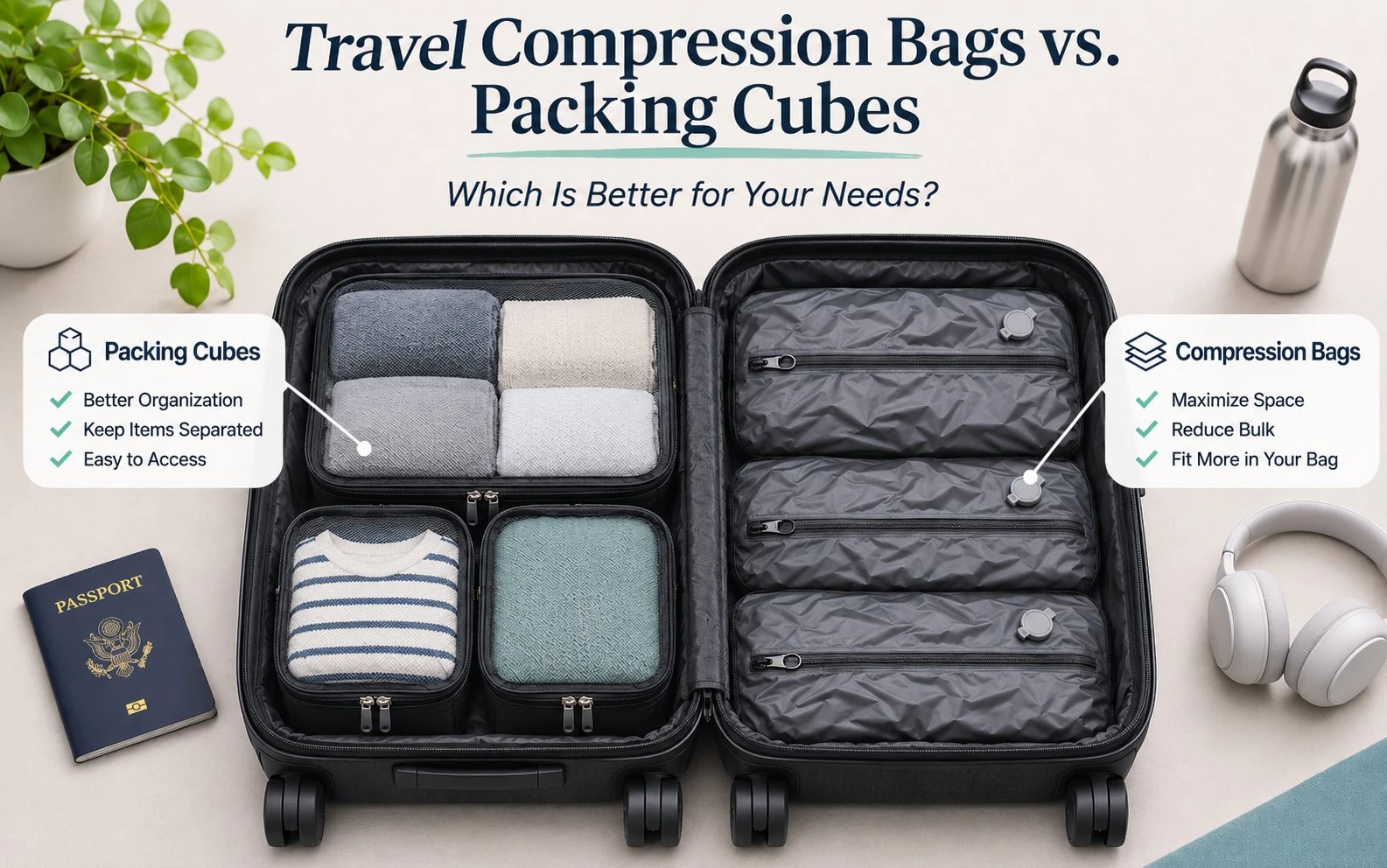
What Are Packing Cubes?
Packing cubes are rectangular fabric containers - typically zippered, lightweight, and semi-structured - designed to segment clothing and accessories inside a suitcase. Their primary job is luggage organization: separating clean from dirty, shirts from pants, electronics from laundry. You gain visibility and access speed, not volume reduction.
Standard materials range from 210D diamond-lattice waterproof polyester to 320D nylon and 600D ripstop, with mesh panels on one or more faces for breathability and quick visual identification. Most cubes add negligible weight - typically under 100 grams per piece - and provide no dedicated compression on their own. They simply partition.
The global packing cubes market is projected to expand from approximately USD 1.3 billion in 2024 to roughly USD 2.5 billion by 2033, reflecting a compound annual growth rate of about 8.2% based on industry data. That growth is driven less by novelty than by durable demand for tidier, more modular travel.
For short-haul trips, business travel, and anyone who unpacks into a dresser at the destination, regular packing cubes are the stronger default. They trade compression for convenient organization, a lower risk of wrinkles, and instant access.
What Are Travel Compression Bags?
Travel compression bags reduce the physical volume of packed clothing by forcing air out. Unlike regular packing cubes, their core function is space maximization, not segmentation. There are two dominant designs:
- Vacuum-sealed bags - remove air via a built-in hand pump, manual zip-and-squeeze system, or rechargeable electric pump. High-end models use waterproof anti-rip nylon, TPU coatings, and airtight zipper systems, with some premium designs offering IPX8-rated waterproof protection. Typical dimensions hover around 12 × 19 × 4 inches, with each bag compressing roughly 15 garments.
- Roll-top compression sacks - borrowed directly from outdoor packing solutions. Some models use 30D lightweight nylon with a 40D waterproof base, roll-top closures, and integrated compression straps. These reduce bulky items - down jackets, sleeping bags, fleece - to about one-third their unpacked volume, with a 2000mm waterhead rating.
Compression systems can save up to 60% of luggage space. That number is real, but it comes with a trade-off: compressed garments crease. Breathable fabric panels on some models vent air during compression and reduce wrinkling, but they cannot eliminate it.
If you are packing for a two-week trek, flying with a carry-on only, or transporting bulky insulation layers, compression bags for travel solve a problem regular packing cubes cannot touch.
What Are Compression Packing Cubes?
Compression packing cubes sit between the two categories. They look and function like standard cubes - zippered rectangles with mesh panels - but add a secondary zipper that cinches the cube's depth down once filled. You get segmentation and volume reduction in one product.
The trade-off is compression force. A dual-zipper cube compresses far less aggressively than a vacuum bag or roll-top dry sack. Based on typical product specs, expect 20–30% volume reduction rather than the 60% ceiling of dedicated compression systems. Wrinkling is also lighter, since the compression is mechanical and moderate.
For travelers who want organization first and a modest space bonus second, the hybrid is the pragmatic pick. It underperforms both specialists at their respective strengths but eliminates the need to carry two product types.
Compression Bags vs. Packing Cubes: Side-by-Side Comparison
|
Feature |
Packing Cubes |
Travel Compression Bags |
Compression Packing Cubes |
|
Primary function |
Organization |
Volume reduction |
Organization + light compression |
|
Space savings |
None |
Up to ~60% |
~20–30% |
|
Wrinkle risk |
Low |
High (moderate with breathable panels) |
Low–moderate |
|
Typical material |
210D–600D nylon/polyester, mesh |
PA+PE composite, TPU-coated nylon, airtight zipper |
210D–320D nylon with dual-zipper system |
|
Waterproofing |
Varies (splash-resistant to none) |
High (IPX8 on premium vacuum models; 2000mm waterhead on dry sacks) |
Varies |
|
Best trip type |
Short-haul, business, hotel-based |
Long-haul, carry-on-only, outdoor/backcountry |
Mixed-use, 3–7 day trips |
|
Access speed |
Fast (mesh visibility, zipper access) |
Slow (must unseal to access) |
Fast (zipper access like standard cube) |
|
Weight per piece |
~50–100 g |
~80–150 g (vacuum); ~40–60 g (dry sack) |
~70–120 g |
The table makes the decision framework explicit. If access speed and wrinkle prevention matter more than fitting an extra sweater, regular packing cubes win. If you are fighting for every cubic inch of pack volume, dedicated compression bags deliver the most significant space savings.
However, compressing clothing reduces its volume, not its weight. Travelers using carry-on luggage still need to consider airline weight restrictions when choosing a packing system.
Materials and Durability: What to Look For
Fabric choice separates a product that lasts five trips from one that lasts fifty. Understanding the best waterproof fabrics for bags can also help travelers evaluate material performance for different packing needs. The category runs on a spectrum:
- 100D–210D ripstop nylon - lightweight, adequate for casual travel, but more vulnerable to tearing under heavy loads.
- 320D fabric - the mid-range workhorse for standard cubes and hybrids.
- 600D ripstop nylon - heavy-duty, resists abrasion, suited for outdoor packing solutions where gear contacts rock, dirt, and pack frames.
- PA+PE composites - used in vacuum bags for flexibility and tear resistance; the laminate layer provides the airtight seal.
- TPU coatings - applied to premium vacuum bags and dry sacks for waterproofing beyond splash resistance.
For waterproof travel gear specifically, the waterhead rating is an important consideration. A 2000mm rating means the fabric withstands a 2000mm column of water before penetration, providing a measure of its resistance to rain and spray. However, protection against submersion also depends on seam construction, closures, and the overall bag design. IPX8-rated waterproof systems go further by meeting specified continuous-immersion test conditions.
Material is not a vanity spec. It dictates whether your dry sack keeps a sleeping bag dry in a storm or fails on the first portage.
For durable travel packing organizers, zipper quality, seam construction, and material selection are also important. Even a waterproof fabric cannot guarantee a fully waterproof bag if its seams or closures allow water to enter. Understanding the difference between waterproof and water-resistant construction helps travelers choose products with appropriate protection.
When Should You Choose Compression Bags or Packing Cubes?
The decision collapses to three questions:
How long is the trip? Under five days with hotel laundry access - packing cubes. Over a week, or carry-on-only on a long route - compression bags.
What are you packing? Structured clothing (dress shirts, blazers, business wear) - cubes or compression packing cubes. Bulky soft goods (down jackets, fleeces, sleeping bags) - compression bags or dry sacks. For outdoor trips, choosing the right dry sack size is also important; a dry bag capacity guide can help with that decision.
Where are you going? Urban and hotel-based travel - cubes. Backcountry, kayaking, bikepacking, or any environment where waterproof travel gear is non-negotiable - compression bags with verified waterproof ratings.
There is no universal winner. Compression bags dominate on volume reduction and can provide weather protection when designed for waterproof use. Packing cubes dominate on access and garment care. Compression packing cubes split the difference. Match the product to the trip, not the marketing.
FAQ
1. Are Compression Bags Better Than Packing Cubes for Carry-On Luggage?
Compression bags are generally better when maximizing limited carry-on space is the priority. They reduce the volume of bulky clothing, allowing travelers to fit more items into a small suitcase. However, regular packing cubes are more convenient for organizing clothes and accessing them quickly. Compression packing cubes offer a compromise between the two.
2. Do Packing Cubes Actually Save Space?
Regular packing cubes primarily improve luggage organization rather than significantly reducing clothing volume. They can help travelers use available suitcase space more efficiently by keeping items grouped and neatly arranged. Compression packing cubes, however, use an additional zipper to reduce packed volume, typically by around 20–30% depending on the product and contents.
3. Do Travel Compression Bags Make Clothes Wrinkle?
Yes, travel compression bags can increase wrinkling because they press garments tightly together. The effect depends on fabric type, compression level, and packing method. Delicate or structured clothing may be better suited to regular packing cubes, while compression bags work well for bulkier, wrinkle-resistant items.
4. Are Compression Packing Cubes Waterproof?
Not all compression packing cubes are waterproof. Many standard designs use nylon or polyester with mesh panels, which provide ventilation but limited water protection. Some specialized models use coated fabrics and water-resistant construction. For reliable waterproof performance, travelers should check the complete bag design, including seams, zippers, and verified waterproof ratings.
5. Can You Use Compression Bags and Packing Cubes Together?
Yes. Combining both products can be an effective packing strategy. Use regular packing cubes to organize everyday clothing, accessories, and items that need quick access, while reserving compression bags for bulky jackets, fleece, or other soft goods. This approach balances organization, space efficiency, and convenience.
Final Thoughts
Travel compression bags and packing cubes solve different problems - one maximizes space, while the other prioritizes organization and access speed. The better choice depends on your trip length, packing contents, and destination conditions. For travelers who need both benefits, compression packing cubes offer a practical middle ground.
At FENGLINWAN, we specialize in OEM/ODM manufacturing of outdoor waterproof bags and functional travel bags, offering material selection, product development, and customized manufacturing solutions for international brands. If you're exploring custom travel packing organizers or functional storage bags for your product line, contact us to discuss your design requirements, material options, and project feasibility.