


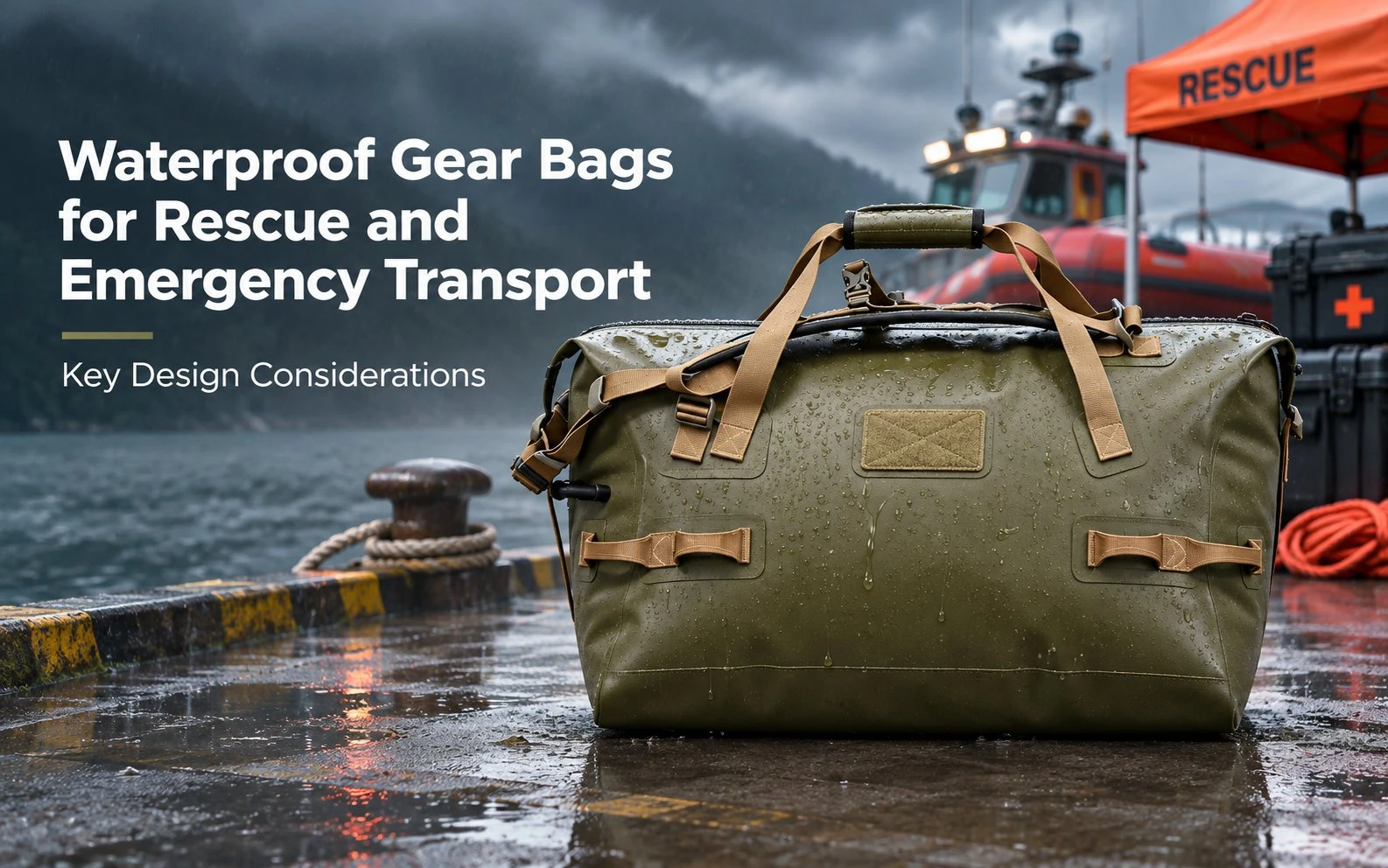
Waterproof Gear Bags for Rescue and Emergency Transport: Key Design Considerations
Nov 09, 2026
Leave a message
Rescue operations fail at the seam, not the slogan. When a dry bag leaks at the weld line or a strap anchor tears free under load, the mission stops and the gear inside is compromised. Waterproof gear bags for rescue and emergency transport are not accessories - they are structural components whose material, welding, closure, and load-bearing choices determine whether critical equipment arrives dry, intact, and ready to deploy.
For rescue equipment brands, emergency response organizations, and buyers developing custom waterproof rescue bags, the design process therefore needs to go far beyond selecting a waterproof fabric. Material compatibility, seam construction, closure systems, transport loads, manufacturing control, and finished-product testing all need to work as one system. For a broader overview of how these elements come together, see how waterproof bags are made.
Choosing Materials for Waterproof Rescue Gear Bags
The fabric on a rescue transport bag is the first and most consequential decision in the design chain. Get this wrong and no amount of clever closure engineering or quality inspection will save the product.
TPU Coated Nylon: The Industry Standard for a Reason
TPU (Thermoplastic Polyurethane) is a thermoplastic elastomer whose molecular chain alternates hard and soft segments, giving it a broad hardness range - roughly Shore 60A to 80D - along with strong resistance to oil, water, and microbial growth. It retains useful elasticity at temperatures down to approximately –35°C.
Two main variants exist: polyester-based TPU, which offers higher mechanical strength and abrasion resistance, and polyether-based TPU, which performs better in hydrolysis resistance and low-temperature flexibility. Compared with PVC, TPU maintains flexibility across roughly –40°C to 120°C without relying on plasticizers, making it lighter and more environmentally stable.
TPU coated nylon is a technical composite fabric formed by bonding a TPU film to a nylon base cloth. The nylon provides tensile strength and tear resistance; the TPU layer delivers waterproofing, airtightness, flexibility, and - critically for manufacturing - a weldable surface.
This combination is why TPU coated nylon has become a common substrate for emergency dry bags, waterproof rescue bags, waterproof equipment bags, and other products that demand reliable seams, air retention, abrasion resistance, and cold-weather performance. Common specifications range from 20D to 1680D denier, with fabric weights spanning approximately 90 to 1500 gsm, giving designers a wide envelope to match weight and durability targets to the mission profile.
The material decision cascades into every downstream choice. A fabric that cannot be HF-welded forces the manufacturer into stitched-and-taped construction, which introduces needle holes and a secondary seal that can fail. TPU coated nylon avoids that compromise entirely.
Material Processing Methods
TPU coated nylon can be joined through several techniques, each with trade-offs in seam strength, production speed, and equipment cost:
- Heat sealing: Direct contact with a heated bar melts the TPU surface layers together. Simple and fast, but seam strength depends heavily on precise temperature and dwell-time control.
- Hot-air welding: A stream of heated air pre-melts the join area before rollers press the layers together. Suitable for long, continuous seams on large panels.
- HF welding: The premium method for many rescue-grade waterproof gear bags, discussed in detail below.
- Ultrasonic welding: High-frequency mechanical vibration creates frictional heat at the bond interface. Fast and clean, but limited to thinner materials and smaller bond areas.
For rescue transport bags where seam integrity is non-negotiable, HF welding remains a preferred route.
How HF Welding Strengthens Waterproof Rescue Gear Bags
High-frequency welding (HF welding, also called high-frequency sealing or RF welding) joins thermoplastic materials by applying an alternating electric field at 27.12 MHz. The field causes polar molecules within the material to vibrate, generating internal heat that melts the bond interface from within rather than applying external heat to the surface.
Under correct processing parameters, the result is a molecular-level fusion - a seam whose tensile strength can equal or exceed that of the base fabric itself, with no needle holes and no need for seam tape.
The process follows a fixed sequence: positioning the material between the electrode and the bed, clamping under pressure, energizing the RF field, fusing the interface, holding under pressure during cooling, then releasing and inspecting the weld.
Each step has tight tolerances. Too little energy produces a cold weld that delaminates under stress; too much degrades the polymer and embrittles the seam.
One hard constraint defines the technology's scope: only polar thermoplastic materials respond to the 27.12 MHz field. PVC, TPU, PET, and EVA are all weldable. Ordinary polyolefins - polyethylene and polypropylene without modification - are non-polar and cannot be HF-welded.
This is why many heavy-duty waterproof gear bags and emergency transport bags are built on TPU or PVC substrates rather than cheaper polyolefin alternatives. Buyers who want a deeper explanation of the process can also review this HF welding guide for waterproof bags.
A welded seam is only as reliable as the material on either side of it. Specifying a non-weldable fabric to save cost upstream is a false economy that surfaces as field failure downstream.
Closure Systems: Roll-Top vs. Waterproof Zipper
The closure is the most frequently operated component on any dry bag and one of the most important potential water-ingress points. Two designs dominate waterproof rescue gear bags and emergency transport applications, each suited to different operational needs.
Roll-Top Closure
A roll-top closure works by folding the bag's open end downward several times and buckling it shut. The folds compress the TPU-coated fabric layers against each other, creating a tortuous path that water cannot easily penetrate.
The design is mechanically simple - no teeth, no sliders, no tracks to jam or corrode - which makes it exceptionally durable under repeated opening and closing. Roll-top closures are a standard choice for emergency dry bags and rescue transport bags that will be accessed frequently in the field.
The trade-off is that a roll-top is water-resistant, not fully airtight. Under sustained submersion or pressure differentials, a small amount of air or water can migrate through the folded layers. For most rescue applications this is acceptable. For equipment that requires a true gas-tight or submersion-proof seal, it is not. For more context on immersion terminology and performance expectations, see what "submersible" means for a waterproof bag.
Waterproof Zipper
A waterproof zipper - typically a polyurethane-coated, toothless sealing zipper - provides a continuous, hermetic closure when correctly installed. It is the right choice for modular rescue bags and specialized transport cases that must maintain a complete air or water seal, such as bags carrying electronics, medical kits, or items that must float with guaranteed buoyancy.
The cost of that seal integrity is manufacturing complexity. A waterproof zipper must be HF-welded to the bag panel with a void-free bond along its entire tape length. Any gap in the weld - even a microscopic one - creates a leak path that bypasses the zipper entirely.
The folding area on roll-top designs also demands reinforcement, but zipper installation raises the stakes: the weld quality bar is higher, the rejection rate in quality control is higher, and the per-unit cost reflects both. Different waterproof products may use water-resistant, watertight, or airtight zipper structures depending on the application; this guide to waterproof zipper types for custom bags explains those distinctions in more detail.
Closure Comparison
|
Parameter |
Roll-Top Closure |
Waterproof Zipper |
|
Water resistance |
High - water-resistant, not fully airtight |
Full hermetic seal |
|
Typical use case |
Frequent-access emergency dry bags |
Air/water-tight modular rescue bags |
|
Durability under repeated cycling |
Excellent - no moving parts to wear |
Good - depends on zipper quality and weld integrity |
|
Manufacturing complexity |
Moderate - reinforced fold area required |
High - void-free panel welding mandatory |
|
Field repairability |
High - fold and buckle, minimal failure modes |
Low - zipper or weld failure requires factory repair |
|
Cost impact |
Lower |
Higher |
|
Best suited for |
Standard rescue transport and gear organization |
Electronics, medical kits, buoyancy-critical loads |
The closure choice should follow the mission, not the catalog. A bag that will be opened twenty times during a flood rescue needs a roll-top; a bag carrying a defibrillator that must survive a full submersion needs a welded waterproof zipper.
More broadly, buyers developing custom waterproof rescue bags should first define the intended exposure condition - rain, splash, temporary immersion, sustained immersion, buoyancy, or airtight protection - and only then specify the closure system.
How Waterproof Rescue Gear Bags Are Manufactured
A waterproof gear bag is not simply assembled - it is engineered in sequence. Each production stage either preserves or compromises the waterproof barrier established in the previous one.
The standard manufacturing chain for HF-welded rescue bags proceeds as follows:
- Material selection: The substrate must be a weldable polar thermoplastic - PVC, TPU, PET, or EVA. Non-polar materials are rejected at incoming inspection.
- 2D welding pattern design: The flat layout of panels and weld lines is engineered before any cutting begins. Panel overlaps, seam placement, and strap-anchor positions are all determined at this stage.
- Mold and electrode fabrication: Copper or brass electrodes are machined to the welding pattern. Electrode geometry dictates weld width and pressure distribution.
- Cutting: Panels are cut to the 2D pattern, typically by die-cut or automated blade cutting to maintain dimensional consistency.
- HF welding: Panels are joined using the 27.12 MHz process described above. This is the core structural operation.
- Strap anchor welding: Shoulder straps and carry handles are welded directly into the shell. The waterproof layer must remain continuous across the anchor point, and the weld must withstand the full single-strap pull load without delamination. This is the single most failure-prone joint in the bag.
- Closure system installation: Airtight zippers are seamlessly welded to the panel surface. Roll-top designs require reinforcement at the folding area to prevent fatigue cracking over hundreds of fold cycles.
- Assembly and hardware: Buckles, D-rings, compression straps, and reflective elements are attached. Hardware mounting points must not penetrate the waterproof membrane.
- Three-tier quality control: Incoming Quality Control (IQC) verifies raw materials; In-Process Quality Control (IPQC) monitors welding parameters and seam integrity during production; Outgoing Quality Control (OQC) performs the final functional test.
The finished product must pass an IPX7-level submersion test - immersion at one meter of water depth for 30 minutes with no water ingress detected inside the bag. IP rating waterproof standards are defined through the IEC 60529 classification system, which uses "IP" followed by two digits: the first rates solid-particle ingress protection, the second rates liquid ingress protection. IPX7 specifically denotes protection against temporary immersion. Bags that fail this test do not ship.
The strap anchor is the joint where theory meets load. A weld that looks perfect on visual inspection can still fail under dynamic pull if the TPU layer was contaminated or the pressure profile was uneven during fusion. This is why IPQC checks strap anchors with pull testing, not just visual sign-off.
For any waterproof equipment bag project, finished-product testing matters as much as material selection. A waterproof material specification alone does not guarantee that the completed bag will remain waterproof after welding, zipper installation, reinforcement, and hardware assembly. Air and water leakage checks are therefore important parts of validating waterproof integrity; see how waterproof bags are leak tested for a more detailed explanation.
Standards and Compliance for Rescue Gear Bags
Rescue equipment does not exist in a specification vacuum. Several established standards define minimum performance thresholds for bags and protective gear used in emergency operations, and designers who ignore them do so at their own liability.
NFPA Standards for Rescue Equipment
In the United States, the NFPA (National Fire Protection Association) maintains standards relevant to rescue gear and its associated protective equipment.
NFPA 1952 covers the design, testing, and certification of surface water protective clothing and equipment - including dry suits, wet suits, helmets, and personal flotation devices (PFDs) used in surface water rescue operations.
While NFPA 1952 addresses the protective equipment itself, the bags that transport and store this equipment must be compatible with the same operational conditions: sustained water exposure, abrasion against debris, and rapid deployment under time pressure.
NFPA 1950 addresses personal protective equipment for technical rescue incidents more broadly. It establishes minimum requirements for structural strength, protective performance, and ergonomic design - the latter being directly relevant to rescue transport bags, which must be carried by personnel already encumbered with PPE.
A waterproof rescue bag that protects its contents but is ergonomically poor can still become a liability in a technical rescue where mobility and speed are critical.
GB/T 36750-2025: Emergency Kit Standards
China's national standard GB/T 36750-2025 sets stringent requirements for emergency kit bags. The standard specifies that the bag body must demonstrate resistance to abrasion, corrosion, static electricity buildup, and tearing, along with waterproof performance and the ability to withstand a free-fall drop from one meter height without damage to the bag or its contents.
The standard also tests contents: waterproof and windproof matches, for example, must remain ignitable after 24 hours of immersion in water. Information on Chinese national standards can be checked through the National Public Service Platform for Standards Information.
These standards are not interchangeable. A bag certified to GB/T 36750-2025 drop-test requirements may or may not meet NFPA ergonomic criteria, and vice versa.
Manufacturers serving both markets must design to the more stringent requirement in each category, or maintain separate product lines - a decision that affects everything from material specification to strap-anchor weld geometry.
Designing Modular Rescue Bags for Different Rescue Missions
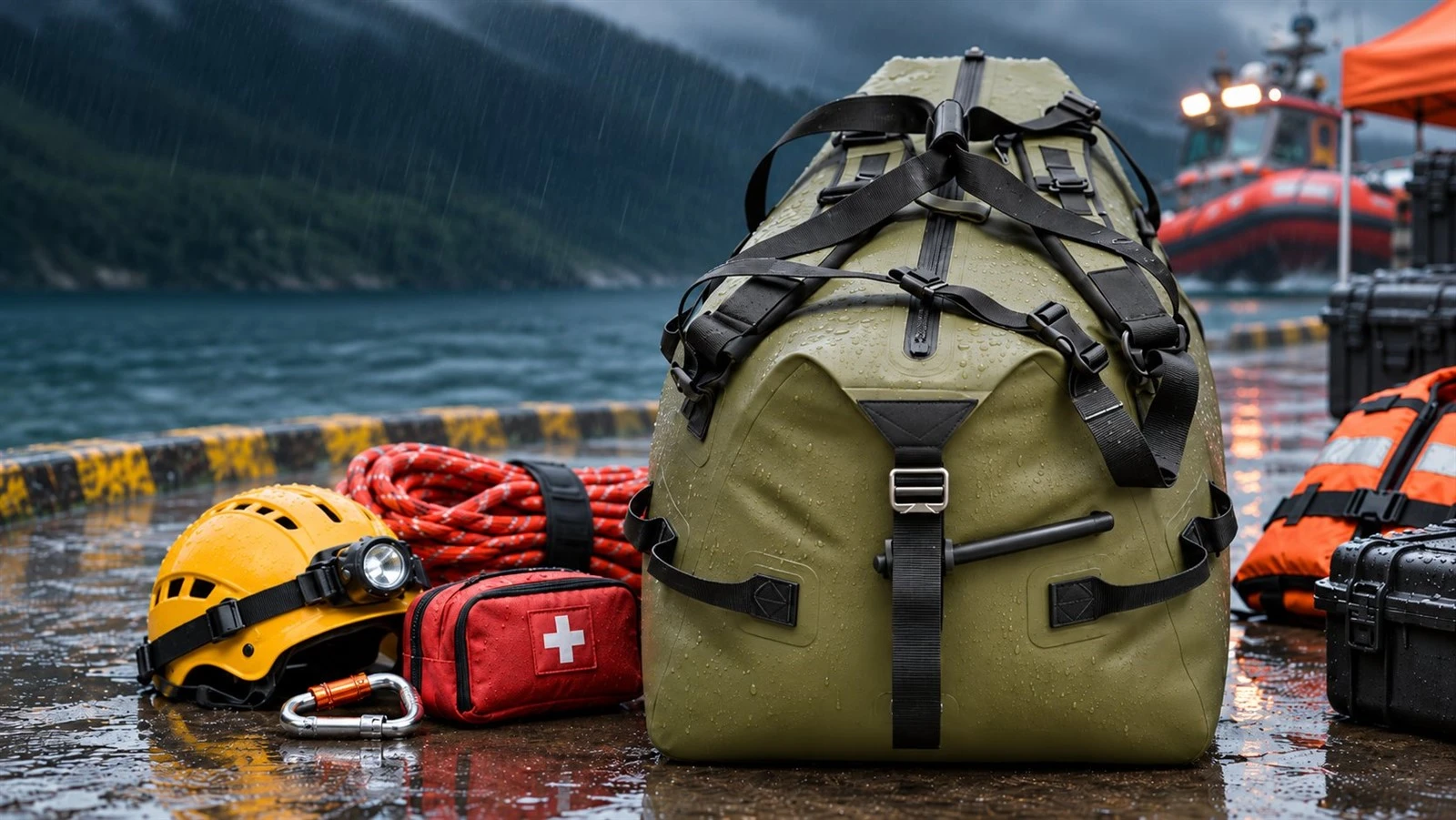
Rescue equipment configuration should be tiered by mission type. In water rescue operations, equipment selection must be driven by task conditions, with verification of parameters including buoyancy, fabric specification, quick-release functionality, reflective area, waterproof rating, and thermal insulation.
The bag that carries this equipment is not a generic container - it is part of the system. A purpose-built waterproof swimming survival backpack, for example, represents a different design problem from a general-purpose transport duffel because water exposure, buoyancy, access, and carrying requirements may all change.
Modular rescue bags address this by allowing task-specific configuration within a standardized platform. A modular system typically uses a common shell - built on TPU coated nylon with HF-welded seams - fitted with interchangeable internal dividers, removable pouches, and attachment points for specialized loads.
The shell provides the waterproof and structural baseline; the internal configuration adapts to the mission.
For large-capacity rescue and emergency transport, the design problem becomes even more demanding. The waterproof structure must work together with carrying points, closure length, load distribution, reinforcement, access speed, and overall handling. A 100L waterproof transport bag or a larger all-terrain emergency supply package therefore cannot simply be treated as an enlarged recreational dry bag.
Brands evaluating this type of product can also compare broader waterproof duffel bag configurations when determining the most appropriate capacity, carrying method, and closure structure for a particular transport scenario.
Key Design Parameters by Mission Type
|
Parameter |
Water Rescue |
Technical Rescue (Rope/Confined Space) |
Mass Casualty / Field Medical |
|
Waterproof rating (IP) |
IPX7 minimum - full submersion likely |
IPX4-6 - rain and splash exposure |
IPX4 - environmental protection |
|
Closure type |
Roll-top for frequent access |
Waterproof zipper for gear protection |
Roll-top for rapid access |
|
Buoyancy requirement |
Critical - bag must float with gear |
Not required |
Not required |
|
Reflective area |
Large - low-visibility conditions common |
Moderate |
Large - night operations common |
|
Strap anchor load rating |
High - wet gear is heavy |
Very high - vertical carry and haul |
Moderate |
|
Drop resistance |
Per GB/T 36750-2025 (1 m free fall) |
Per NFPA 1950-2026 ergonomics |
Per GB/T 36750-2025 |
|
Typical fabric weight |
500-1000 gsm TPU coated nylon |
800-1500 gsm TPU coated nylon |
300-500 gsm TPU coated nylon |
The table above reflects typical industry practice rather than absolute mandates. Actual specifications should be validated against the applicable standard and the specific operational requirements of the deploying organization.
A modular platform only works if the shell is over-specified for the worst-case mission it will encounter. Designing to the average scenario guarantees failure in the extreme one.
For brands developing emergency gear bags, a useful starting point is therefore the mission profile rather than the product catalog: what will the bag carry, how heavy will the load be, how long could it be exposed to water, could it be submerged, must it float, how frequently must users access the contents, and how will the bag be carried or transported?
Those answers should drive the material, seam construction, closure system, capacity, reinforcement, and waterproof testing requirements.
FAQ
What is the best material for waterproof rescue gear bags?
TPU coated nylon is widely used for waterproof rescue bags because it combines the tensile and tear strength of nylon with a waterproof, flexible, and weldable TPU surface. PVC can also be used for HF-welded waterproof equipment bags. The best choice depends on the required waterproof performance, flexibility, abrasion resistance, weight, operating environment, and project budget.
Is a roll-top bag fully waterproof?
A properly designed roll-top closure provides strong protection against rain, splashes, and short-term water exposure, but it is generally not considered fully airtight. Applications requiring airtight protection or reliable performance during submersion normally require a watertight or airtight zipper combined with welded construction.
Why is HF welding used for emergency transport bags?
HF welding joins compatible thermoplastic materials without creating needle holes. This allows the bag body and seams to form a continuous waterproof barrier. For heavy-duty waterproof gear bags used in rescue and emergency transport, HF welding can also provide strong, repeatable seams when material selection, tooling, welding parameters, and quality control are properly managed.
How should a waterproof rescue bag be tested?
Testing should address the completed bag rather than the waterproof fabric alone. Depending on the required performance level, evaluation may include air leakage testing, water leakage testing, submersion testing, seam inspection, strap-anchor load testing, and production quality checks. The exact test method should be defined according to the product's intended operating environment and applicable standards.
Can waterproof rescue gear bags be customized for specific equipment?
Yes. Custom waterproof rescue bags can be developed around the equipment being carried, required capacity, access frequency, closure type, internal organization, carrying system, reflective features, waterproof level, and transport method. For OEM/ODM projects, these requirements should ideally be established before material selection, pattern development, tooling, prototyping, and waterproof testing begin.
Conclusion
Waterproof gear bags for rescue and emergency transport are defined by a chain of interdependent decisions: selecting a weldable and durable substrate, using suitable seam construction, matching the closure system to access frequency and sealing requirements, reinforcing high-load areas, and validating the completed product through appropriate waterproof and quality-control testing.
The central design principle is straightforward: a waterproof rescue bag should be engineered as a complete protection and transport system, not simply as a bag made from waterproof fabric. Material, welds, zippers, load-bearing points, carrying structures, and testing all contribute to the final performance, and the weakest element can limit the reliability of the entire product.
FENGLINWAN is an OEM/ODM manufacturer specializing in outdoor waterproof and functional bags, with capabilities including TPU and PVC material applications, HF welding, heat-sealed construction, airtight and watertight zipper solutions, and air and water leakage testing. Our product experience also includes large-capacity waterproof rescue and transport bags for professional applications.
If you are developing custom waterproof rescue bags, emergency transport bags, or other heavy-duty waterproof equipment bags, contact FENGLINWAN to discuss your required capacity, materials, waterproof structure, closure system, testing requirements, and OEM/ODM project specifications.