


Heat Sealing vs HF Welding: What Is the Difference for Waterproof Bags?
Oct 19, 2026
Leave a message
When you are sourcing waterproof bags, the seam is one of the most critical parts of the product. A bag can use high-quality TPU or PVC-coated fabric, but if the seam fails, the waterproof system fails with it. Two technologies frequently used in waterproof bag manufacturing are heat sealing and HF welding (high-frequency welding). They may sound similar because both can create welded waterproof seams, but they use fundamentally different heating mechanisms, suit different materials and constructions, and can deliver different results.
This guide explains heat sealing vs HF welding, how each waterproof bag welding process works, where each is best suited, and what brands and product developers should consider before selecting a process.
What Is Heat Sealing?
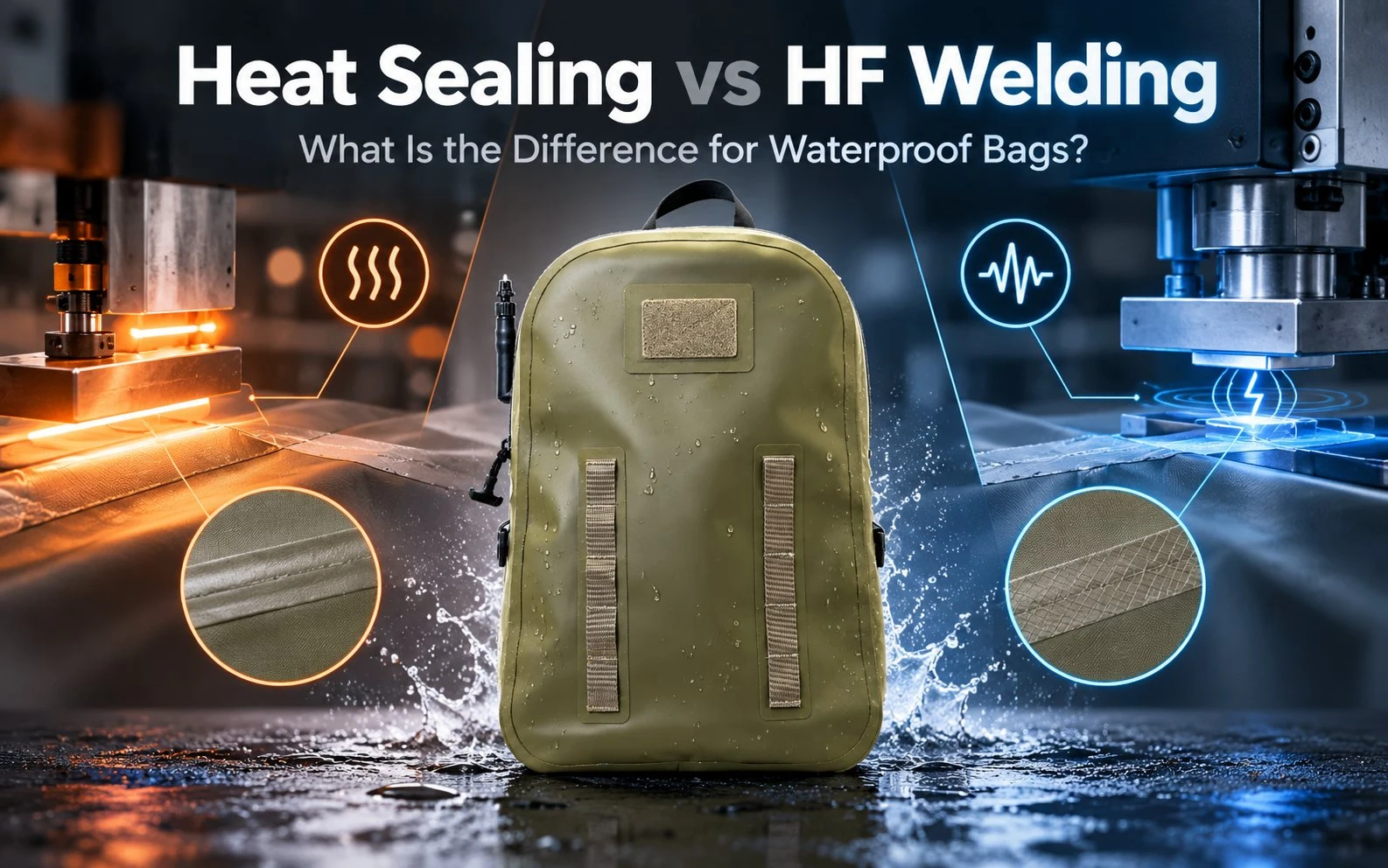
Heat sealing-sometimes called hot bar welding or impulse sealing-is the more straightforward of the two processes. A heated bar or element is pressed directly against the material surfaces to be joined. External heat softens or melts the thermoplastic layers at the interface, while pressure fuses them together. The material is then allowed to cool under pressure so that a solid seam forms.
There are two common variants used in waterproof bag manufacturing:
Constant-Heat Sealing
The sealing bar is maintained at a fixed temperature, typically around 150–220°C depending on the material, and pressed against the fabric for a controlled dwell time. This method is relatively simple, fast, and widely used for thinner thermoplastic films and straightforward waterproof seam sealing.
Impulse Sealing
With impulse sealing, the heating element remains relatively cool until the sealing cycle begins. A pulse of electrical current quickly brings the element to the required temperature, after which the heat is removed. This reduces the amount of time the surrounding material is exposed to elevated temperatures.
The defining characteristic of heat sealing is that heat moves from the outside inward. The heated tool warms the material surface first, and the energy must then conduct through the material thickness to reach the bonding interface.
For thin films, this can work very effectively. With thicker or multi-layer laminated fabrics, however, process control becomes more important because the outer surface may receive substantially more thermal exposure before enough heat reaches the inner bonding layers.
What Is HF Welding?
HF welding for waterproof bags, also called high-frequency welding, RF welding, radio-frequency welding, or dielectric welding, uses a different mechanism. Instead of relying primarily on an externally heated tool, HF welding generates heat within a compatible thermoplastic material.
The material is placed between an upper electrode or welding mold and a lower platen. A high-frequency alternating electric field is then applied, commonly using industrial ISM frequencies such as 27.12 MHz and 40.68 MHz.
When the electric field passes through a suitable polar thermoplastic such as many PVC or TPU formulations, the material's polar molecular groups repeatedly respond to the rapidly changing field. This dielectric loss generates heat throughout the region exposed to the field.
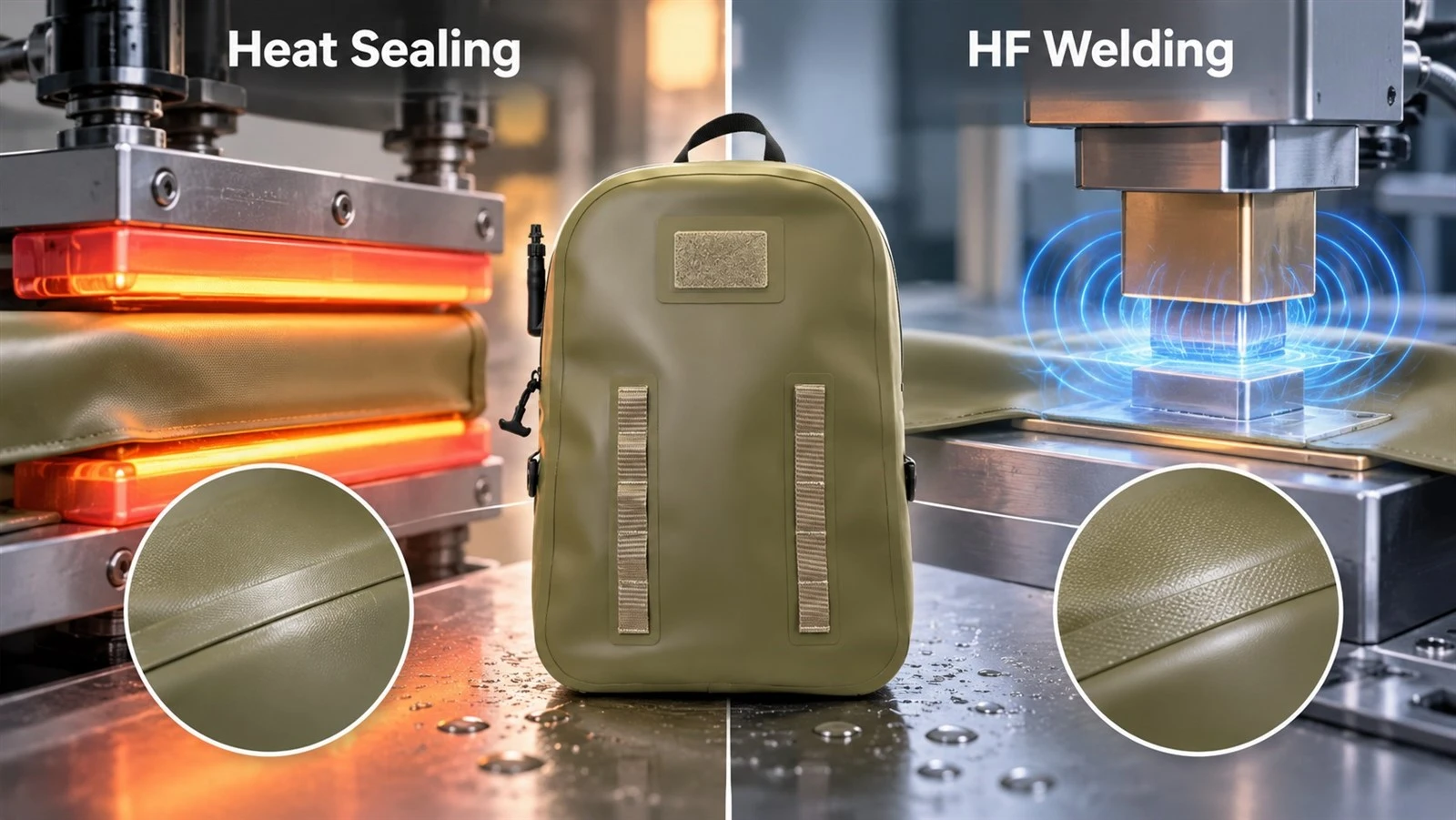
The key distinction is simple: heat sealing transfers heat inward from an external source, while HF welding generates heat within the material through dielectric heating.
Once the interface reaches the required welding temperature, pressure from the electrode fuses the material layers. The field is switched off, pressure is maintained during cooling, and a welded seam is formed.
For HF welding waterproof bags, the shape of the welding electrode can also define the weld geometry. This makes tooling and seam design an important part of product development rather than simply a production-stage decision.
Heat Sealing vs HF Welding: Key Differences
The table below compares the main factors that matter when selecting a waterproof bag welding process.
|
Parameter |
Heat Sealing |
HF Welding |
|
Heating mechanism |
External conduction-heated tooling transfers thermal energy from the surface inward |
Internal dielectric heating generates heat within a compatible material |
|
Energy source |
Resistive heating element or heated bar |
High-frequency electric field, commonly using industrial ISM frequencies |
|
Material compatibility |
Broad; works with many thermoplastics, including materials such as PE and PP |
Requires suitable dielectric properties; commonly used with PVC and many TPU formulations |
|
Material thickness |
Well suited to thin films and lightweight constructions; thicker laminates require careful thermal control |
Particularly useful for thicker or multi-layer compatible laminated fabrics |
|
Seam strength |
Can provide strong seams when material, temperature, pressure, and dwell time are properly matched |
Full-area fusion can produce very strong welded seams in compatible materials |
|
Seam appearance |
May show heat marks, press lines, or discoloration if parameters are not optimized |
Can produce clean and highly consistent weld lines with correctly designed tooling |
|
Weld cycle speed |
Depends on heating, dwell, cooling, and material conductivity |
Dielectric heating can reach welding temperature rapidly; some cycles may be completed in several seconds |
|
Equipment cost |
Generally lower |
Generally higher because RF generators, electrodes, shielding, and control systems are required |
|
Consistency |
Depends heavily on temperature, pressure, dwell time, tooling, and process control |
Controlled power, time, pressure, and tooling can provide high repeatability |
|
Waterproof integrity |
Suitable for many waterproof products when properly engineered |
Frequently selected for airtight, watertight, and higher-demand welded waterproof constructions |
Neither method should be judged only by the welding machine itself. Material formulation, coating or laminate structure, weld width, pressure, closure design, attachment points, and testing requirements all affect the finished waterproof performance.
When to Use Heat Sealing or HF Welding
Neither technology is universally better. The right process depends on the material, product construction, required level of waterproof performance, tooling requirements, and production economics.
In real waterproof bag manufacturing, the decision is also not always made bag by bag. A complex product may combine sewing, bonding, and welded structures, with the process selected according to the function of each area.
Choose Heat Sealing When
1. Thin-Film Products
Lightweight dry sacks, pack liners, and waterproof pouches made from relatively thin thermoplastic films can be good candidates for heat sealing. Because the material is thin, external heat can reach the bonding interface quickly and efficiently.
For thin TPU film around or below approximately 0.3 mm, for example, heat sealing can offer a practical combination of speed, simplicity, and cost efficiency when validated for the specific material.
2. Non-Polar Materials
If a product uses PE or PP-based materials, conventional HF welding is generally not suitable because these polymers do not provide the dielectric response required for reliable RF heating.
Heat sealing therefore remains an important welding option for these materials.
3. Budget-Sensitive Production
For products with relatively straightforward seam requirements, heat-sealing equipment and tooling can involve lower initial investment than an HF welding system.
This can make heat sealing appropriate for certain entry-level products, smaller production programs, and constructions where higher-cost RF tooling would not provide a meaningful performance advantage.
4. Simple Straight Seams
Long, relatively straight welds on flat panels can be well suited to hot-bar or continuous heat-sealing processes. Simple waterproof pouches, liners, and some basic dry-bag constructions may not require custom HF electrodes.
Choose HF Welding When
1. Thick or Multi-Layer Laminated Fabrics
Waterproof bags made from heavier TPU-coated or PVC-coated fabrics can benefit from HF welding because the energy is generated within compatible material rather than being transferred only from the outside surface.
For thicker laminates, this can make it easier to achieve consistent fusion without relying on heat conduction through the full material stack.
2. Airtight or High-Waterproof Constructions
For waterproof duffels, dry bags, rescue equipment, and other products that require reliable watertight or airtight seams, HF welding is frequently selected together with suitable coated fabrics and specialized closures.
FENGLINWAN's own product development experience includes a 100L waterproof travel bag using HF Welding with an airtight waterproof zipper, as well as larger waterproof supply-bag constructions developed around HF-welded and airtight structures.
The same engineering approach also applies to products such as an airtight waterproof expedition backpack, where the seam, material, zipper, and overall construction must work together.
These examples illustrate an important point: high waterproof performance comes from the entire product system, not from the weld alone.
3. Complex Seam Geometry
Waterproof backpacks and duffels may include curved seams, gusseted bottoms, reinforcement patches, attachment structures, or shaped weld areas. HF welding electrodes can be developed around these specific geometries.
This precision does require tooling. In FENGLINWAN's normal development workflow, a new HF Welding mold developed from the paper pattern and sample information commonly requires approximately 7–10 days, so seam geometry should be considered early in the product-development process.
4. High-Volume Consistency
For repeat production, HF welding allows key variables such as power, welding time, pressure, and cooling time to be controlled for a defined construction.
Once the material, tooling, and process parameters have been validated, this can provide consistent welded seams across larger production runs.
How PVC and TPU Affect Welding Process Selection
PVC and TPU are two important materials in the welded waterproof bag industry. Both can be suitable for HF welding, but actual weldability depends on the material formulation, coating structure, backing fabric, thickness, and additives.
|
Material |
Polarity |
HF Welding |
Heat Sealing |
|
PVC (polyvinyl chloride) |
High |
Excellent compatibility in many formulations and a traditional material for RF welding |
Workable with suitable temperature and process control |
|
TPU (thermoplastic polyurethane) |
Moderate to high |
Widely used for HF-welded waterproof products when the formulation is compatible |
Well suited to many thin-film heat-sealing applications |
|
EVA (ethylene-vinyl acetate) |
Depends on formulation and vinyl acetate content |
Some formulations can be RF welded |
Commonly heat sealable |
|
PE / PP |
Non-polar |
Conventional HF welding is generally not viable |
Commonly compatible with heat-sealing processes |
FENGLINWAN's waterproof product development supports both TPU and PVC options for heat-sealed constructions, while TPU is also used extensively in HF-welded airtight and fully waterproof products. A PVC/TPU waterproof duffel bag is one example of how material choice can be matched to the product concept and manufacturing process.
This is why waterproof fabric selection and welding-process selection should ideally happen together. Choosing a fabric first and attempting to adapt the welding process afterward can create avoidable restrictions in seam geometry, tooling, appearance, and performance.
For brands specifying TPU as a halogen-free alternative to PVC, HF welding can remain a strong option when the TPU formulation and laminate construction are designed for dielectric welding. The material should still be validated by actual welding trials rather than selected by polymer name alone.
How Welding Method Affects Waterproof Seam Strength
Seam strength is not merely a laboratory specification. It directly affects durability, leakage risk, field performance, and potentially the number of warranty claims a brand receives.
HF welding can create full-area fusion across compatible material layers without introducing stitch holes or a separate adhesive layer at the primary welded seam. Under a properly optimized process, the resulting weld can be extremely strong, and in some tensile tests failure may occur in the surrounding material rather than directly along the weld line.
For formal verification, methods such as ASTM F88/F88M seal strength testing can provide a standardized way to evaluate seal strength in applicable flexible barrier materials.
Heat-sealed seams can also perform very well when the material thickness and sealing parameters are appropriately matched. With thicker laminates, however, manufacturers need to control the balance between surface temperature and fusion at the internal interface. Repeated flexing, abrasion, and thermal cycling can expose weaknesses if fusion is incomplete.
More importantly, a waterproof bag is a system, not just a welded seam.
Its actual waterproof performance depends on:
- Main fabric and coating or laminate
- Welded seam construction
- Zipper or roll-top closure
- Reinforcement and attachment points
- Valve or hardware integration where applicable
- Production consistency
- Finished-product leakage testing
This is why visual inspection alone is not enough for high-waterproof or airtight products.
For waterproof products requiring airtight verification, FENGLINWAN uses Air Leakage Testing, where the bag is inflated and checked after a 24-hour holding period to determine whether it retains its form. Water Leakage Testing can also be performed by placing the closed product under water and checking for escaping air bubbles. Airtight products are subject to 100% airtight testing.
For a closer look at these methods, see this guide to waterproof bag leak testing.
The objective is therefore not simply to create an attractive weld line. It is to verify that the complete construction delivers the required waterproof or airtight result.
How We Choose a Welding Process for Waterproof Bags
As an OEM/ODM manufacturer of outdoor waterproof and functional bags, FENGLINWAN does not treat heat sealing and HF welding as competing technologies where one must always replace the other. They are manufacturing tools selected according to the product's material, structure, performance target, and production requirements.
Our product-development approach considers four main areas.
1. Material First
The starting point is the fabric specification: polymer type, coating or laminate structure, thickness, backing fabric, and weight.
For compatible PVC or TPU constructions, thicker laminates often make HF welding attractive because of its dielectric-heating mechanism. Thin films may remain excellent candidates for heat sealing.
Figures such as 0.3 mm or 0.4 mm can be useful reference points during early discussions, but there is no universal thickness cutoff. Actual weld trials on the selected laminate are more reliable than making a decision from thickness alone.
2. Waterproof Performance Requirements
The next question is not simply, "Which welding process do you want?"
A more useful question is:
What level of protection must the finished bag achieve?
A product designed primarily for rain or splash protection has different construction requirements from a waterproof bag intended for temporary submersion, an airtight backpack, or professional rescue and transport equipment.
If a project uses a formal ingress-protection claim, the requirement should be defined against the relevant IEC IP ratings rather than inferred from marketing terminology alone.
The required performance then influences the fabric, seam construction, welding process, zipper or roll-top closure, and testing method.
3. Construction Complexity
Simple flat-panel products with straight seams may not require the tooling investment associated with an HF welding mold.
For products with curved seams, gussets, reinforced attachment areas, specialized zipper interfaces, or other complex structures, custom HF tooling may offer greater control over the finished weld.
For some complex waterproof bags, the most effective solution is a hybrid construction rather than a single process throughout the product. Sewn components, bonding, and HF-welded sealing can be combined according to the structural and waterproof requirements of each area.
4. Production Volume and Economics
HF welding requires more specialized equipment and, in many applications, custom tooling. That means the initial setup cost can be higher.
At larger production volumes, however, controlled cycle times and repeatable process settings can help distribute the tooling investment across more units.
For small development runs and early prototypes, heat sealing may offer greater flexibility where the selected material and required waterproof performance permit it.
Regardless of the process, sampling should be used to validate the combination of material + seam geometry + welding parameters + closure system before mass production. Waterproof and airtight performance should then be confirmed through appropriate leakage testing rather than assumed from the welding method alone.
Common Misconceptions About Heat Sealing and HF Welding
"HF Welding Is Just a Faster Heat Sealer"
No. The underlying physics are different.
Heat sealing primarily transfers externally generated thermal energy into the material by conduction. HF welding uses a high-frequency electric field to generate dielectric heating within compatible material.
Both processes can create welded seams, but they do not produce that heat in the same way.
"HF Welding Works on All Plastics"
No. HF welding requires a material with suitable dielectric properties.
Many PVC and TPU formulations respond well to high-frequency welding, while common non-polar polymers such as polyethylene and polypropylene generally do not. For those materials, heat sealing or another suitable joining technology is normally required.
"Heat Sealing Always Means Lower Quality"
Not necessarily.
For thin films, simple seam geometries, and materials that cannot be conventionally HF welded, heat sealing can be the correct engineering solution rather than a compromise.
Quality depends on matching the material, process, seam design, product requirement, and quality-control method.
"You Can Tell Which Process Is Better by Looking at the Seam"
Not reliably.
Both heat sealing and HF welding can produce visually clean seams when properly controlled. The meaningful differences appear in weld strength, leakage testing, hydrostatic performance where applicable, repeated flexing, and long-term product durability.
A clean-looking seam is useful, but it is not proof of waterproof integrity.
How to Choose the Right Welding Process
The following selection guide provides a practical starting point for comparing heat sealing vs HF welding for waterproof bags.
|
If your product is... |
Recommended starting point |
Why |
|
Thin-film dry sack or pack liner, such as TPU below approximately 0.3 mm |
Heat sealing |
Fast and economical for many thin-film constructions |
|
Premium waterproof or submersion-oriented bag using a compatible TPU/PVC laminate |
HF welding |
Strong full-area fusion and good suitability for watertight or airtight construction |
|
Waterproof duffel or backpack with curved seams and gussets |
HF welding |
Custom electrodes can accommodate complex weld geometry |
|
Waterproof pouch using PE or PP laminate |
Heat sealing |
Non-polar materials are generally not suitable for conventional HF welding |
|
High-volume production of identical welded products |
HF welding if material and construction permit |
Controlled process parameters support production repeatability |
|
Prototype or small development run |
Heat sealing where performance requirements permit |
Lower tooling requirements can make iteration easier |
These recommendations are starting points rather than fixed rules. Material formulation, laminate design, zipper selection, load-bearing structure, intended use, and the required waterproof level all need to be evaluated together.
FAQ
Is HF Welding the Same as Heat Sealing?
No. Both processes can create waterproof welded seams, but they generate heat differently. Heat sealing applies heat externally and transfers it into the material, while HF welding uses a high-frequency electric field to generate dielectric heating inside a compatible thermoplastic.
Can Both TPU and PVC Be HF Welded?
Many PVC and TPU formulations are suitable for high-frequency welding, which is why both materials are widely used in welded waterproof bags. However, weldability depends on the exact formulation, coating or laminate structure, backing fabric, additives, and thickness. Production material should therefore be tested rather than assumed to be weldable based solely on the polymer name.
Which Process Is Better for Airtight or Submersion-Oriented Waterproof Bags?
HF welding is frequently preferred for compatible materials when the product requires airtight, watertight, or higher-demand waterproof seams. However, the welding process alone does not determine the finished rating. The fabric, zipper or closure, attachment points, seam geometry, and leakage testing must all support the same performance target.
Does HF Welding Require Custom Tooling?
Many HF-welded bag structures require electrodes or molds designed around the seam shape. Tooling requirements therefore need to be considered during product development. For FENGLINWAN projects requiring a new HF Welding mold, the normal mold-development period is approximately 7–10 days, depending on the product and tooling requirements.
Can One Waterproof Bag Use More Than One Manufacturing Process?
Yes. Complex waterproof bags can combine traditional sewing, bonding, heat sealing, and HF welding. Load-bearing components may require one construction method while the waterproof chamber or zipper interface uses another. In many cases, the best process is selected seam by seam rather than bag by bag.
Final Thoughts
The difference between heat sealing and HF welding is not simply that one process is cheaper and the other is more advanced. Heat sealing transfers externally generated heat into the material, while HF welding generates dielectric heat inside a compatible thermoplastic. Heat sealing can be an excellent choice for thin films, simple seams, and non-polar materials, while HF welding is particularly valuable for compatible TPU/PVC constructions, complex welded seams, and products requiring consistent watertight or airtight performance.
The best waterproof bag is therefore not created by choosing a welding technology in isolation. Material, seam geometry, closure system, tooling, intended use, and leakage testing should be engineered as one complete waterproof system.
FENGLINWAN is a custom waterproof bag manufacturer with OEM/ODM capabilities in TPU/PVC material selection, heat sealing, HF welding, airtight/watertight construction, custom tooling, and leakage testing. If you are developing a custom waterproof bag and need help selecting the right welding process, contact us to discuss your material, performance requirements, and project specifications.