

Roll-Top vs Waterproof Zipper: Which Closure Should Your Dry Bag Use?
Oct 20, 2026
Leave a message
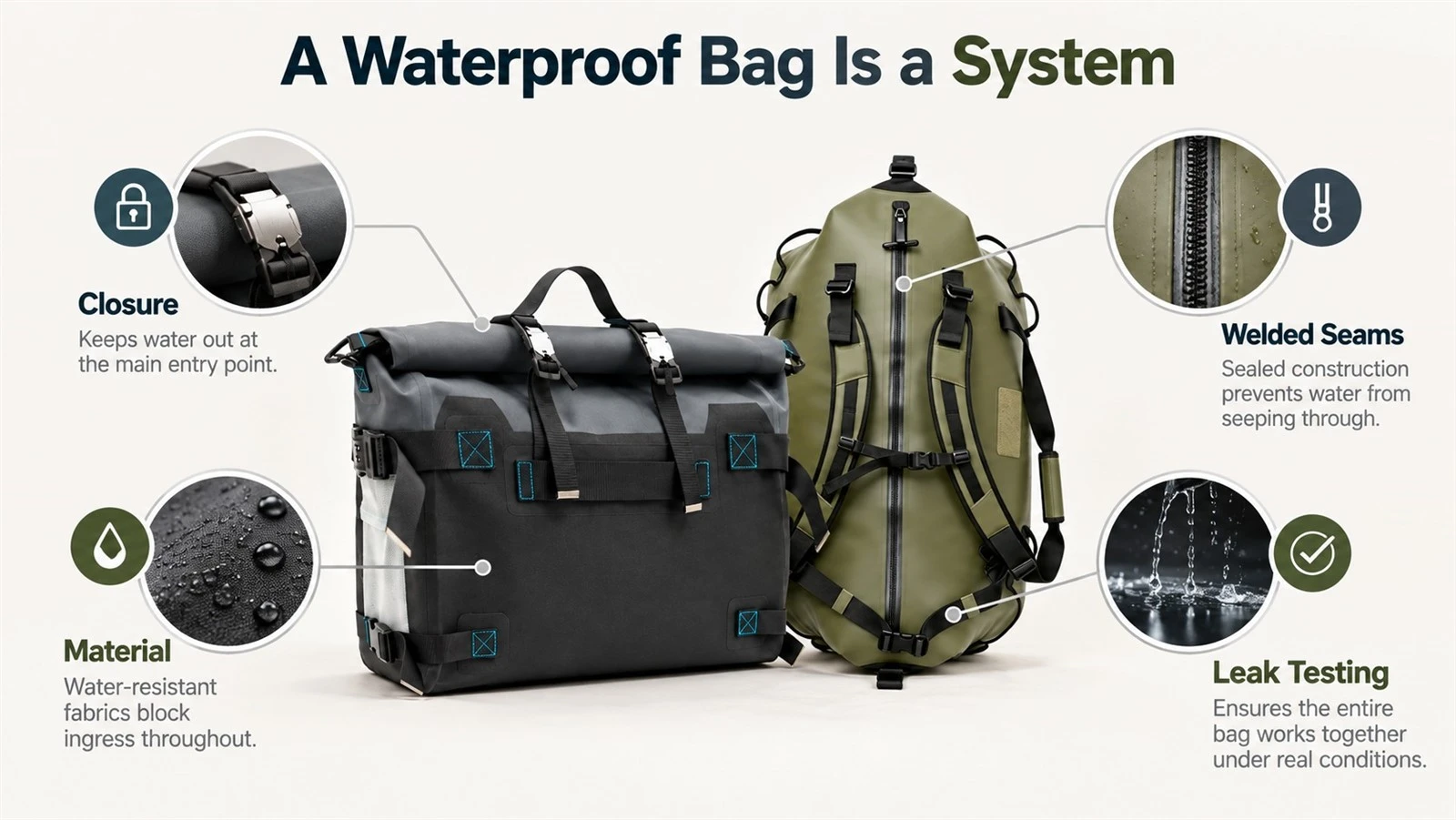
The closure is one of the most important parts of any dry bag, but it should never be evaluated in isolation. A reliable waterproof bag depends on the complete system: the closure, waterproof material, seam construction, welding method, and finished-product testing.
Yet when brands develop a new waterproof bag, the roll-top vs waterproof zipper decision often begins with appearance or price. It should begin with the intended use instead. Each dry bag closure works differently, creates a different user experience, and places different demands on manufacturing and quality control.
Choosing the right closure means balancing waterproof protection, access frequency, usable capacity, reliability, maintenance, and product positioning-not simply choosing the option that sounds more premium.

How a Roll-Top Dry Bag Closure Works
A roll-top dry bag uses a fold-and-buckle closure rather than a zipper. The top opening is typically rolled downward several times so that the waterproof material layers overlap and compress against each other, then the ends are secured with a buckle or clip.
The waterproofing effect comes from the folded construction rather than from zipper teeth or a separate sealing track. In welded waterproof bags, the roll-top closure is usually combined with waterproof materials such as TPU or PVC and sealed body seams. For a broader explanation of how fabric, seams, closures, and construction work together, see our guide to how waterproof bags work.
One additional advantage is easy to overlook: a roll-top closure can also function as a volume-management system. Depending on the bag design and load, the user can adjust how much of the upper section is rolled, giving the product some flexibility in usable volume.
The important distinction is that a roll-top is only one part of the waterproof system. A well-designed closure cannot compensate for leaking seams or unsuitable materials elsewhere in the bag.
Strengths of the Roll-Top
A roll-top has very few moving components in the closure itself. There is no zipper track to jam and no sealing surface that requires regular lubrication.
Its main advantages include:
- Simple and reliable closure construction
- Lower component cost
- Easy cleaning and field use
- Good tolerance of mud, sand, and demanding outdoor conditions
- Adjustable upper volume depending on bag design
- Straightforward buckle replacement
- Well suited to kayaking, rafting, paddle sports, travel, and general outdoor storage
Because of this simplicity, the roll-top waterproof bag remains a practical choice when users do not need constant access to the contents. Products such as a large roll-top waterproof duffel bag illustrate how this closure can be applied to larger-capacity outdoor and travel gear.
Limitations of the Roll-Top
The main trade-off is access speed. Every time the user needs something inside, the closure must be unrolled and then correctly rolled again.
The folded section also consumes part of the bag's nominal height-roughly 10–15 cm in many designs. Contents near the top may need to be repositioned before closing the bag.
A roll-top construction also should not automatically be described as submersible simply because the material itself is waterproof. The finished bag's protection depends on the number of rolls, closure geometry, seam construction, material, and validation method. For products marketed for immersion, it is useful to distinguish normal waterproof performance from the requirements discussed in submersible waterproof bags.
For products requiring frequent opening or a defined high-protection airtight or submersible system, another closure may be more appropriate.
How a Waterproof Zipper Dry Bag Closure Works
The phrase waterproof zipper is commonly used as a broad category, but from a product-development perspective it is not a complete specification.
Depending on the required protection level, a waterproof bag may use a:
- Water-resistant zipper
- Watertight zipper
- Submersible waterproof zipper
- Airtight zipper
These are not interchangeable. Our guide to waterproof zipper types explains the differences in more detail.
Higher-protection zipper systems typically use coated or specially engineered sealing surfaces that compress as the slider closes. Depending on the zipper construction and specification, the resulting seal can provide significantly greater resistance to water penetration than a conventional zipper, while specialized airtight or submersible systems can be designed for more demanding environments.
Certain specialized submersible zipper systems may be rated to approximately 10 m under specified test conditions, but the rating of a zipper component should never automatically be treated as the rating of the finished dry bag.
If a finished product is intended to carry an IP protection claim, brands should also understand that the widely referenced IP system comes from IEC 60529, and the applicable test method and product scope should be verified rather than inferred from an individual component.
A waterproof zipper dry bag provides another major advantage: access. Instead of rolling and unrolling the opening, users can open the bag directly and gain wide access to the interior.
That makes zipper closures particularly useful for waterproof backpacks, marine equipment bags, camera or electronics protection, medical equipment, commuting bags, and other products that may be opened repeatedly throughout the day.
Strengths of the Waterproof Zipper
The main advantages include:
- Fast opening and closing
- Wide access to the interior
- No bag height consumed by repeated folds
- Better suited to frequent-access applications
- Airtight, watertight, or submersible options available for higher-protection products
- Premium appearance and tactile experience
For a brand developing a high-end waterproof backpack or functional equipment bag, the zipper can become both a performance component and an important part of the user experience. An airtight waterproof expedition backpack is a good example of how a higher-sealing closure can be matched with a more demanding outdoor application.
Limitations of the Waterproof Zipper
The additional performance comes with trade-offs.
A specialized waterproof zipper generally costs substantially more than a simple roll-top buckle system. Some high-protection zipper constructions may cost several times more than the hardware required for a roll-top closure.
Depending on the zipper type, users may also need to keep the sealing surfaces clean and periodically apply suitable lubricant. Sand, salt, dirt, and other contaminants can affect smooth operation.
Some polyurethane-based zipper systems also become noticeably stiffer in cold weather.
From a manufacturing perspective, the zipper must also be correctly integrated into the surrounding waterproof structure. A premium zipper attached to a poorly sealed bag does not create a premium waterproof product.
Roll-Top vs Waterproof Zipper: Key Differences
The table below summarizes the main differences brands should consider when specifying a dry bag closure.
|
Dimension |
Roll-Top |
Waterproof Zipper |
|
Waterproof Level |
Strong rain/splash protection when properly closed; performance depends on complete construction |
Can range from water-resistant to watertight, submersible, or airtight depending on specification |
|
Access Speed |
Slower-requires unrolling and re-rolling |
Fast-open and close the zipper directly |
|
Component Cost |
Low |
High |
|
Field Reliability |
Excellent-few closure components |
Good, but sealing surfaces require more care |
|
Usable Capacity |
Fold consumes some height, but roll-top can also provide volume flexibility |
Full opening height remains available |
|
Cold-Weather Performance |
Generally less affected at the closure |
Some coated zipper systems become stiffer |
|
Maintenance |
Very low |
Cleaning and periodic lubrication may be required |
|
Best Use Cases |
Kayaking, rafting, paddle storage, outdoor and travel dry bags |
Marine equipment, frequent-access waterproof carry, higher-protection applications |
The most important point is that closure type alone does not define how waterproof a dry bag is.
A complete waterproof system may involve TPU or PVC materials, HF-welded seams, heat-sealed structures, watertight or airtight closures, and appropriate leakage testing. TPU is widely used in performance applications because its properties can be engineered for flexibility, abrasion resistance, and durability; technical material references such as Elastollan TPU provide useful background on the material family itself.
A high-specification zipper cannot compensate for leaking seams, just as welded seams cannot compensate for a closure that does not match the intended protection level.
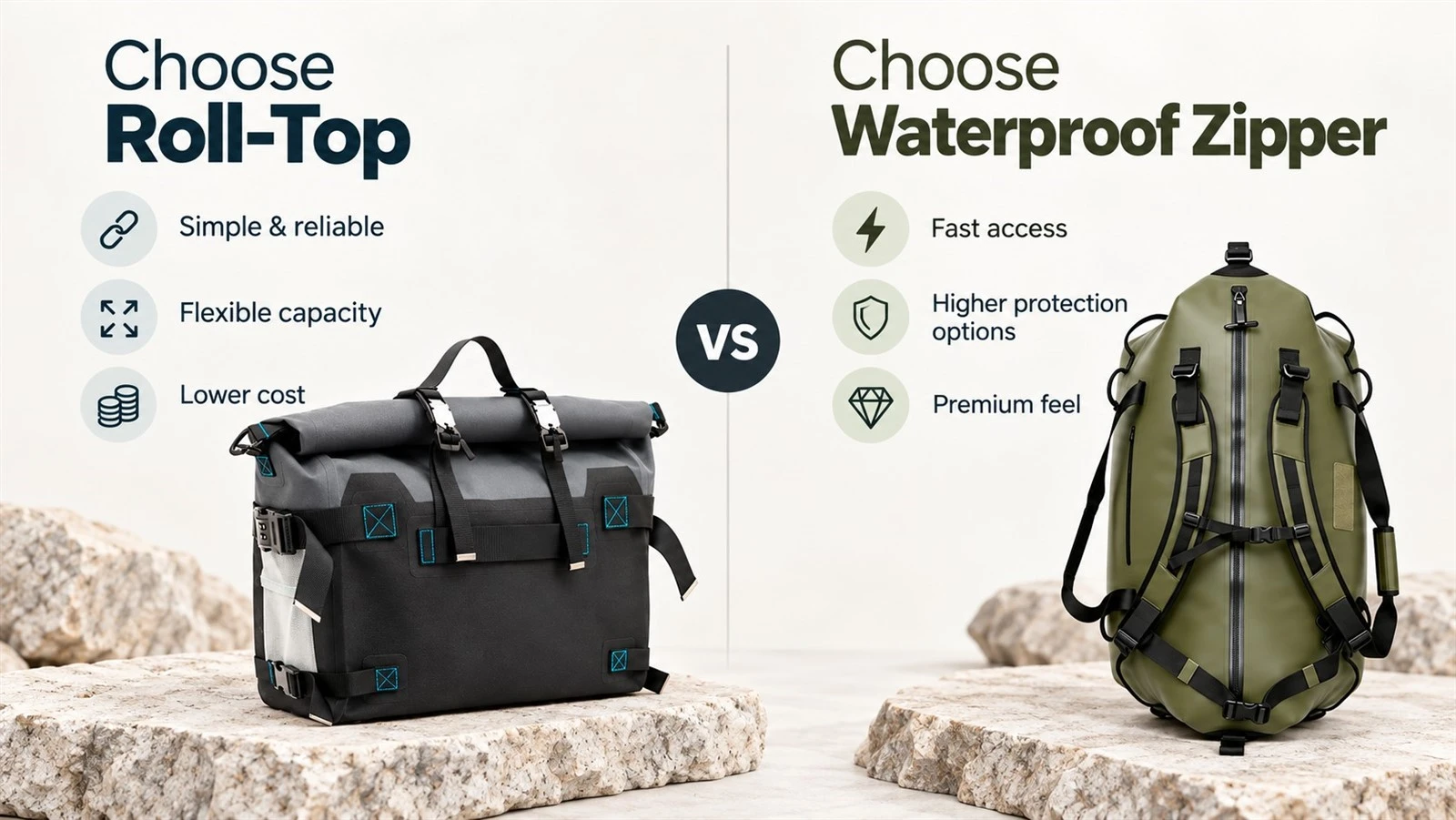
Which Closure Should Your Product Use?
The decision should be driven by the intended use scenario rather than by which closure sounds more advanced.
For product development, a useful sequence is:
Application → Required Protection Level → Access Frequency → Capacity Design → Closure Type → Material and Seam Construction → Prototype Testing
This approach prevents brands from selecting an expensive component before defining what the finished product actually needs to do.
Choose a Roll-Top When
A roll-top dry bag closure is usually a strong option when:
- The bag is intended for paddle sports, river trips, travel, or general outdoor storage
- Rain, splash, spray, and occasional water exposure are the primary concerns
- The user opens the main compartment relatively infrequently
- Simple field reliability is important
- Adjustable upper capacity is useful
- Component cost needs to remain controlled
- The product is positioned in the entry-to-mid or functional outdoor market
For these applications, adding a high-cost waterproof zipper may increase BOM cost without creating a meaningful improvement in the end-user experience.
Choose a Waterproof Zipper When
A waterproof zipper dry bag becomes more attractive when:
- Users need frequent, fast access
- A wide opening is important
- The bag carries electronics, camera equipment, medical supplies, or organized gear
- The application requires a specific watertight, airtight, or submersible closure
- The product is positioned as a premium waterproof backpack or equipment bag
- The retail price can support the higher component and manufacturing cost
The specification should go beyond simply requesting a "waterproof zipper." Brands should define what waterproof means for the intended product: rain protection, temporary water exposure, submersion, or airtight performance.
The right closure is not the one that sounds more advanced. It is the one that matches how the bag will actually be used.
When a Hybrid Roll-Top + Waterproof Zipper Design Makes Sense
Some dry bag and waterproof backpack designs combine both closure concepts in one product.
A typical configuration uses a roll-top main compartment for primary storage and a waterproof-zipper pocket for items that need quicker access, such as a phone, wallet, headlamp, map, or smaller accessory.
This arrangement separates two different requirements:
- The main compartment prioritizes simple, dependable protection and flexible storage.
- The accessory compartment prioritizes quick access.
There is another important engineering lesson here: not every compartment in the same bag needs the same closure specification.
A product may use a watertight closure for one compartment and an airtight closure for another if their functional requirements are different. FENGLINWAN's waterproof product development experience includes products in which different compartments are configured around different sealing requirements, reinforcing the idea that closure selection should be made at the compartment level rather than automatically applying one specification to the entire bag.
The hybrid approach adds additional component and assembly cost, but for premium waterproof backpacks it can provide a more useful user experience and support stronger product differentiation.
Manufacturing Differences for Roll-Top and Waterproof Zipper Dry Bags
The choice between a roll-top and waterproof zipper also affects product development, sourcing, assembly, testing, and quality control.
|
Factor |
Roll-Top |
Waterproof Zipper |
|
Closure Assembly |
Relatively simple-fold structure, reinforcement, buckle hardware |
More demanding-accurate zipper positioning and sealed integration |
|
QC Focus |
Roll geometry, buckle position, seam integrity |
Zipper seal, integration area, seam integrity and closure performance |
|
Lead-Time Impact |
Usually limited |
Specialized zipper sourcing and testing can add lead time; the original estimate is 5–10 days in some projects |
|
Tooling / Mold |
Closure itself may require little tooling; welded bag construction can still require HF tooling |
Depends on bag and zipper integration; HF-welded construction may require dedicated tooling |
|
MOQ |
Standard buckles are generally easier to source |
Specialized waterproof zippers may have supplier MOQs |
For an HF-welded dry bag, closure selection is only one part of production engineering. The material, pattern, welding geometry, reinforcement structure, and closure interface all need to work together. If you want to understand this production method in more detail, see our guide to HF welding for waterproof bags.
At FENGLINWAN, waterproof and airtight product development can involve TPU or PVC material selection, paper-pattern development, HF welding tooling, prototype production, and subsequent Air Leakage Testing and Water Leakage Testing. For airtight products, the documented process includes 100% airtight testing, while finished products also pass quality-control stages before packing.
For larger professional transport applications, a product such as the 100L waterproof travel bag shows why closure design, welded construction, capacity, and intended use must be evaluated together rather than separately.
This leads to a useful rule for brands:
Do not choose the closure first and decide how to test the bag later. Define the protection requirement and validation method during product development.
A finished waterproof bag should be treated as a system, not as a collection of individually waterproof components. Our overview of waterproof bag leak testing explains why air and water leakage checks are important during validation.
FAQ
Is a roll-top dry bag completely waterproof?
A properly designed roll-top dry bag can provide strong protection against rain, splashes, spray, and demanding outdoor conditions. However, a roll-top closure by itself does not automatically make the finished bag submersible. Performance depends on the material, number of rolls, seam construction, closure geometry, and testing standard.
Are all waterproof zippers submersible?
No. "Waterproof zipper" is a broad term. Products may use water-resistant, watertight, submersible waterproof, or airtight zippers. Brands should specify the required protection level before selecting the zipper.
Which dry bag closure is better for frequent access?
A waterproof zipper is usually more convenient when users need to open the bag repeatedly. A roll-top requires unrolling and re-rolling, while a zipper provides much faster access to the main compartment.
Can a dry bag use both a roll-top and waterproof zipper?
Yes. A hybrid design can use a roll-top main compartment and one or more waterproof-zipper pockets. This works particularly well when the main storage area prioritizes simple protection while smaller compartments require faster access.
What should brands specify before developing a custom dry bag?
Start with the application, required protection level, expected water exposure, access frequency, capacity, material, and test requirements. The closure should then be selected as part of the complete waterproof construction rather than as an isolated component.
conclusion
There is no universal winner in the roll-top vs waterproof zipper comparison.
A roll-top is generally the better choice when simplicity, field reliability, flexible capacity, and cost control are the priorities. A waterproof zipper is more suitable when fast access, a wide opening, premium positioning, or a defined watertight, submersible, or airtight requirement matters more. A hybrid design can make sense when different compartments need different levels of access and protection.
The most important decision is not simply roll-top or waterproof zipper. It is defining the protection level your users actually need and then designing the material, seams, closure, and testing method around that requirement.
FENGLINWAN is an OEM/ODM manufacturer specializing in outdoor waterproof and functional bags, with capabilities covering roll-top structures, airtight/watertight zipper construction, TPU/PVC materials, HF welding, prototype development, and waterproof testing. If you are developing a custom dry bag, waterproof backpack, or other OEM waterproof bag project, contact us to discuss the application, closure specification, materials, and testing requirements for your product.