


How Thickness and Fabric Construction Affect Waterproof Bag Performance
Oct 13, 2026
Leave a message
When you specify a waterproof bag, two measurements often dominate the conversation: the denier rating of the base fabric and the thickness of the waterproof coating or film. Yet those figures tell only part of the story. A 1000D fabric with a thin, poorly bonded coating can leak faster than a 500D fabric with a properly laminated TPU membrane. Real waterproof bag performance comes from the interaction between waterproof bag fabric thickness, fabric construction, coating or lamination type, and seam technology-and understanding that interaction is what separates a bag that survives a season from one that lasts for years.
For product developers and sourcing teams, the more useful question is not simply, "How thick should the fabric be?" It is, "Which combination of base fabric, waterproof layer, seam construction, and closure system best matches the intended application?" Thickness influences strength, weight, flexibility, and weldability, while the overall waterproof bag fabric construction determines how those characteristics perform together in actual use.
For a broader look at how these components come together in production, see our guide to waterproof bag materials and construction.
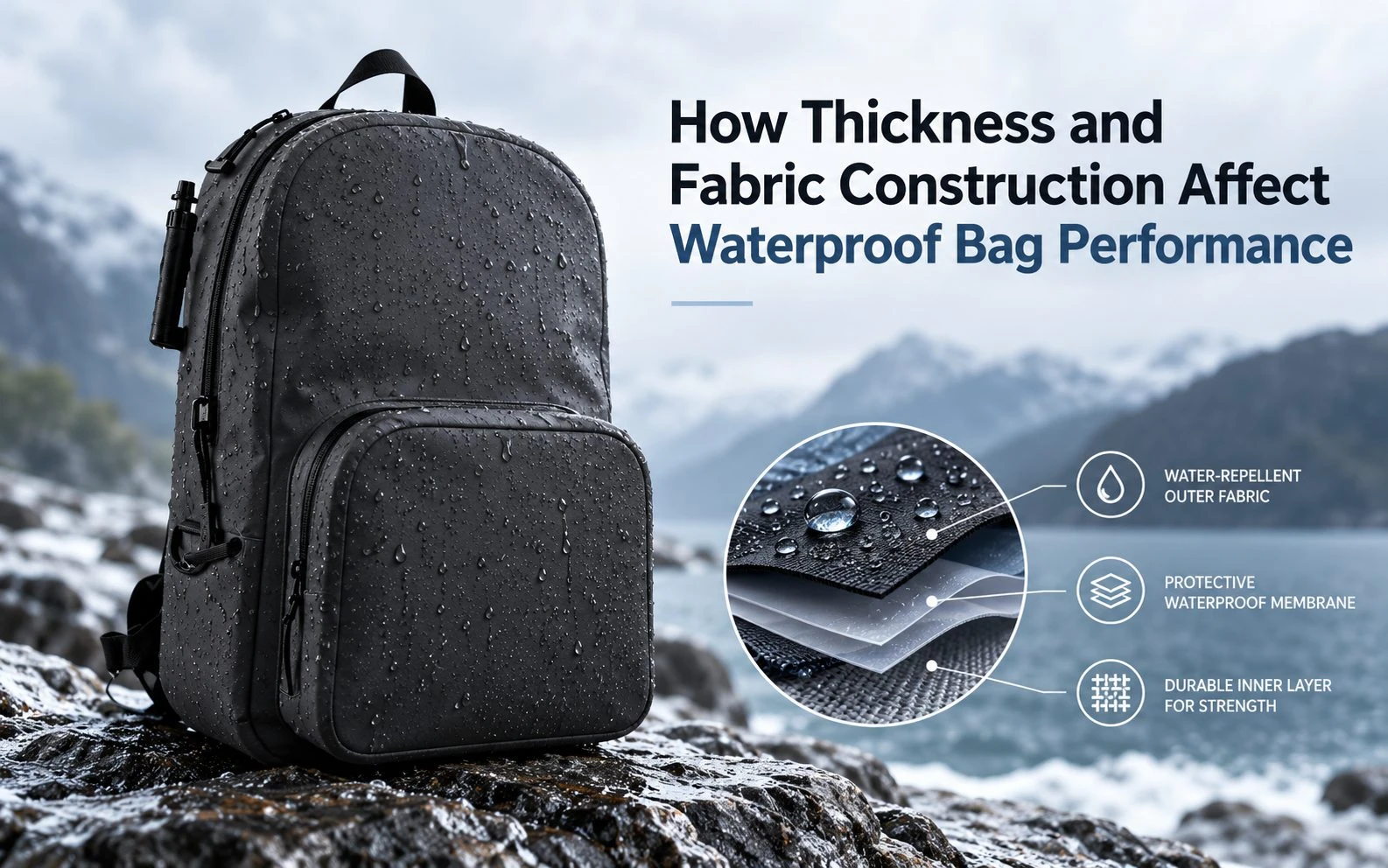
How Fabric Thickness Affects Strength, Weight, and Waterproofing
Thickness in waterproof bag materials is commonly discussed through two separate measurements: the denier (D) of the yarn used in the base fabric and the millimeter thickness of the coating or film layer. They are not the same measurement, and they affect different aspects of performance.
1.Denier: The Strength Foundation
Denier measures the weight-in grams per 9,000 meters-of a yarn filament. A higher denier generally means a heavier, more substantial yarn and usually contributes to greater tensile strength, tear resistance, and abrasion resistance when other construction variables are similar.
Common denier ratings for waterproof bag fabrics range from 210D at the lightweight end to 1000D and beyond for heavy-duty applications.
|
Denier Range |
Typical Use Case |
Key Characteristics |
|
40D–210D |
Ultralight dry sacks, pack liners |
Minimal weight, compact packing, moderate durability |
|
420D–600D |
General-purpose dry bags, daypacks |
Balanced strength-to-weight ratio, versatile |
|
840D–1000D+ |
Heavy-duty dry bags, expedition gear, military packs |
Maximum abrasion and tear resistance, heavier |
The relationship between denier and performance is not purely linear. A jump from 500D to 1000D roughly doubles abrasion resistance, but it also adds significant weight and reduces packability. For standardized abrasion testing of textile materials, buyers may also refer to ASTM D3884 abrasion resistance testing.
The art of specification lies in matching denier to the intended use environment: an ultralight pack liner does not need 1000D fabric, while a whitewater rafting dry bag should not be built around the same priorities as a lightweight liner.
This is also why denier should not be treated as a direct substitute for waterproof bag fabric thickness. Two fabrics with similar denier ratings can still behave differently if their yarn density, weave structure, coating, lamination, or backing construction differs.
2.Coating and Film Thickness: The Waterproof Barrier
The waterproof layer itself-whether applied as a coating or laminated as a film-has its own thickness, typically measured in millimeters. This layer forms the primary water-blocking barrier.
PU (polyurethane) coatings are the most common entry-level waterproof treatment. Applied as a liquid to the back of woven fabric, PU fills the interstices between yarns and creates a continuous barrier. Typical PU coating thicknesses range from 0.1mm to 0.3mm. A PU-coated fabric generally achieves a hydrostatic head of 1,000 to 3,000mm H₂O-sufficient for rain splash and brief exposure, but inadequate for sustained water pressure or submersion.
Testing requirements for coated fabrics can vary by product and application. ASTM D751 test methods for coated fabrics are one recognized reference for evaluating several properties of coated textile materials.
TPU waterproof material represents a significant step up in many demanding waterproof bag applications. TPU films are laminated to the base fabric rather than simply applied as a liquid coating. TPU films range from 0.05mm to 0.7mm in thickness. A single-layer TPU coating of approximately 0.08mm can achieve hydrostatic head ratings of 10,000 to 15,000mm H₂O. Thicker TPU films, combined with multi-layer lamination processes, can push ratings above 20,000mm H₂O-the threshold used for professional diving bags and specialized equipment protection.
PVC waterproof fabric remains widely used, particularly in value-oriented dry bag and heat-sealed product categories. PVC coating thicknesses typically range from 0.15mm to 0.45mm in dry bag applications. PVC offers stable waterproofing at a lower cost, but its performance degrades more rapidly under UV exposure and low temperatures. For more detail on the material itself, see our guide to PVC waterproof coating.
PVC formulations may contain plasticizers, and regulatory considerations can vary by market and application. The European Chemicals Agency provides background information on phthalates and plasticizers used in PVC materials.
For OEM/ODM development, however, the decision between TPU and PVC is not simply a matter of selecting a material and a thickness. FENGLINWAN supports TPU and PVC for heat-sealed waterproof products and combines material selection with the required product structure, welding process, zipper system, and intended use environment. A practical comparison can be seen in products such as a PVC/TPU waterproof duffel bag.
3.Why Thicker Is Not Always Better
A common misconception is that thicker fabric and a thicker waterproof layer always produce a better waterproof bag. In practice, excessive thickness introduces several trade-offs.
|
Factor |
Effect of Increasing Thickness |
|
Weight |
Rises proportionally-critical for backpacking and expedition use |
|
Flexibility |
Decreases-stiff fabric is harder to pack, seal, and handle |
|
Packability |
Reduced-thicker fabrics do not compress or fold as compactly |
|
Cost |
Increases-more material means higher per-unit cost |
|
Seam welding |
Becomes more demanding-thicker materials require more energy and precise process control |
The optimal thickness is always a function of the use case. A submersion-rated dive bag legitimately needs a thick TPU film on a high-denier base. A lightweight trail pack liner should prioritize minimal thickness and weight. Specifying thickness without reference to the application is one of the most costly mistakes in waterproof bag design.
The more useful engineering principle is simple: the best waterproof bag material is not necessarily the thickest material, but the construction that best balances waterproofing, abrasion resistance, flexibility, weight, and manufacturing requirements.
For buyers comparing different material families, our guide to the best waterproof fabrics for bags provides additional material-selection context.
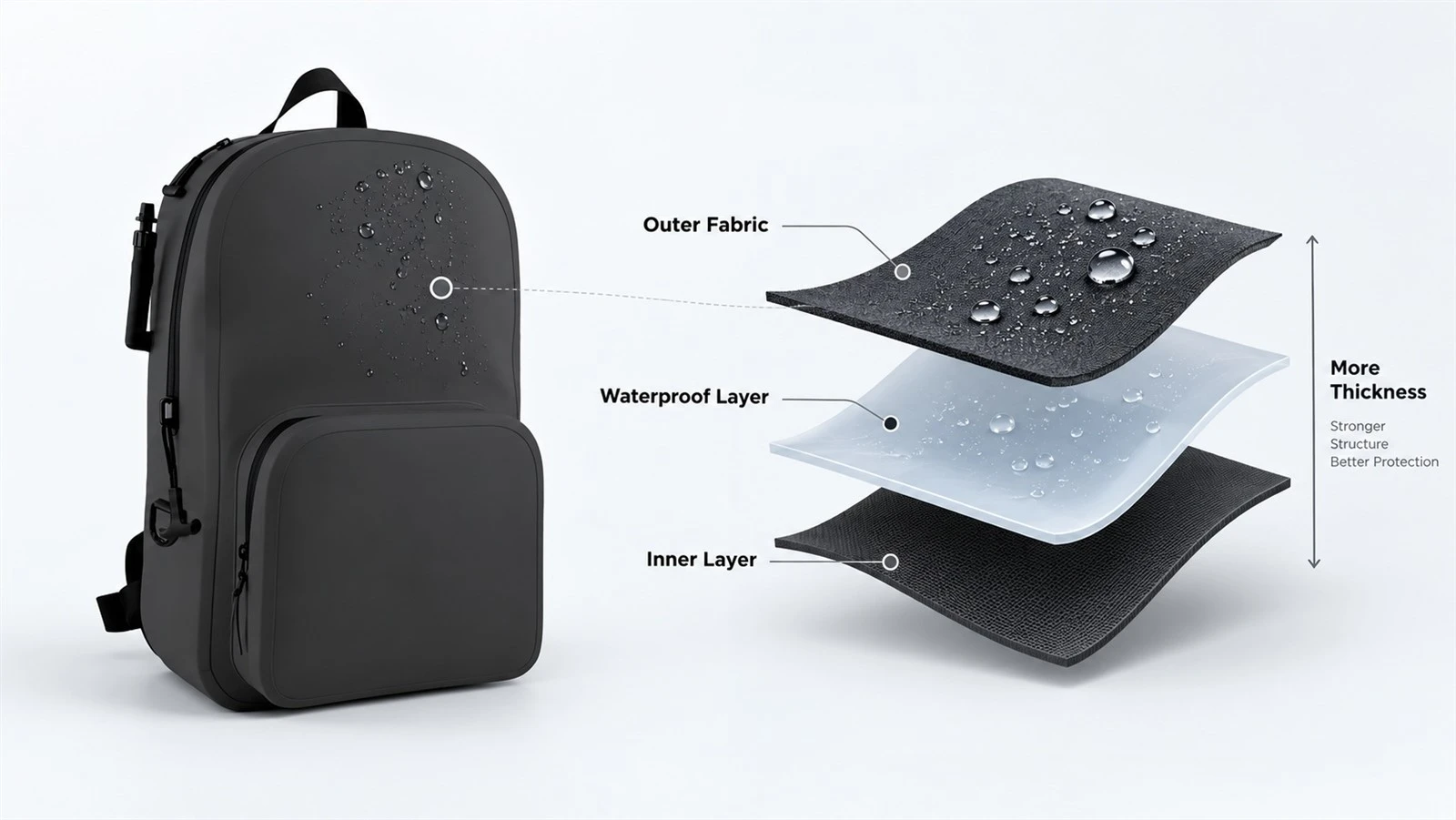
How Fabric Weave and Construction Affect Durability
If thickness defines how much material is present, fabric construction determines how that material responds to load, abrasion, flexing, and repeated use. The way yarns are woven together also affects how evenly a coating or film is supported and how the material behaves near welded or stitched areas.
1.Plain, Ripstop, and Oxford Weaves
Plain weave is the simplest construction-one yarn over, one yarn under, in both warp and weft directions. It produces a tight, uniform surface that accepts coatings evenly. Many coated waterproof fabrics use a plain-weave base. Its limitation is that a tear, once started, can propagate relatively easily along the yarn path.
Ripstop weave introduces thicker reinforcement yarns at regular intervals-typically every 5 to 8 millimeters-creating a visible grid pattern. This construction helps prevent tears from spreading beyond the reinforced grid square. Ripstop is particularly valuable in lightweight fabrics such as 210D and below, where the base yarns alone provide less resistance to tear propagation. The reinforcement grid adds minimal weight while significantly improving tear resistance.
Oxford weave is a basket-weave variant in which two or more yarns are grouped together in one or both directions. The result is a fabric with a distinctive textured appearance and high durability. Oxford weaves are commonly specified in 420D, 600D, 840D, and 1000D variants for bag exteriors. The grouped yarn structure provides high abrasion resistance, making Oxford construction suitable for bag bodies that will be dragged, scraped, or heavily loaded.
This is why two materials with similar nominal thickness can perform very differently. Base fabric construction, waterproof layer, reinforcement, and lamination structure all influence the finished waterproof bag, not the thickness number alone.
2.Yarn Density and Its Effect on Waterproofing
Yarn density-the number of yarns per inch in warp and weft-affects how completely the textile structure blocks water before the waterproof coating or film is considered. A tightly woven fabric with high yarn density has smaller interstices between yarns, meaning the coating or film has less void space to bridge.
This matters because coatings and films can degrade over time. A fabric with high yarn density retains more of its water resistance as the coating thins or wears because the physical textile structure itself provides a degree of water shedding. A loosely woven fabric, by contrast, depends more heavily on the integrity of its coating.
Typical yarn densities for waterproof bag fabrics range from approximately 120 to 280 yarns per inch, with higher densities generally correlating with improved structural waterproofing and coating adhesion.
For product developers, this reinforces an important point: waterproof bag fabric construction can matter just as much as nominal thickness. Thickness, yarn density, weave, and the waterproof layer must be evaluated as a system.

Coating vs. Lamination: How the Waterproof Layer Is Built
The method used to attach the waterproof layer to the base fabric has major implications for performance, durability, flexibility, and cost.
1.Coating: Liquid Applied and Chemically Bonded
In the coating process, a liquid polymer-PU, PVC, or silicone-is spread onto the back of the woven fabric and then cured. The coating penetrates the yarn structure and bonds mechanically and chemically to the fibers. Coating is generally the more economical process and is suitable for fabrics intended for light to moderate water exposure.
The limitation of coating is durability under flexing. When a coated fabric is repeatedly folded, creased, or flexed-as happens constantly in a bag-the coating can develop micro-cracks at the fold lines. Over time, those micro-cracks widen and can become pathways for water penetration. This is why coated fabrics may show reduced waterproof performance after extended use, particularly at high-stress areas.
2.Lamination: Film Bonded and Structurally Integrated
Lamination bonds a pre-formed film-typically TPU-to the base fabric using heat, pressure, and an adhesive layer. Because the film is already a continuous, uniform membrane before application, it provides more consistent waterproofing than a liquid coating. Laminated fabrics also tend to resist flex cracking better because the film's molecular structure is more uniform and elastic.
The trade-off is cost. Lamination requires more sophisticated processing, the film itself is more expensive than liquid coating materials, and the process demands tighter quality control. For premium waterproof bags, however, the performance advantage can justify the investment.
|
Attribute |
Coating (PU/PVC) |
Lamination (TPU Film) |
|
Waterproof rating |
1,000–5,000mm H₂O |
10,000–20,000+mm H₂O |
|
Flex resistance |
Moderate-prone to micro-cracking |
Excellent-elastic film maintains integrity |
|
Weight |
Slightly lighter |
Slightly heavier |
|
Cost |
Lower |
Higher |
|
Environmental impact |
PVC contains plasticizers; PU moderate |
TPU is recyclable, no plasticizers |
|
Cold-weather performance |
PVC brittle below -15°C; PU moderate |
Stable from -40°C to 80°C |
For a custom waterproof bag, the coating-versus-lamination decision should therefore be made alongside expected water exposure, service life, flexibility requirements, operating temperature, and seam technology-not as an isolated material choice.
How Seam Construction Affects Waterproof Performance
Even the most advanced waterproof fabric is only as effective as the way its panels are joined. In many waterproof bags, seams are among the most critical transition areas because they concentrate mechanical stress and, if poorly constructed, can become direct leakage paths.
1.Welded Seams for TPU and PVC Waterproof Bags
For TPU and PVC fabrics, radio-frequency (RF) welding-also called high-frequency or HF welding-is widely used for high-performance waterproof bag construction. RF welding uses electromagnetic energy to excite the polar molecules in the thermoplastic coating or film, causing adjoining layers to soften and fuse.
For a more detailed explanation of the process, see our buyer's guide to HF welding for waterproof bags.
The quality of an HF-welded waterproof bag seam depends on several factors, including energy, dwell time, pressure, material compatibility, and surface cleanliness. Under-welding produces a weak bond that may separate under stress; over-welding can damage the material and create brittleness.
FENGLINWAN uses HF Welding for waterproof bag body seams, zipper areas, and other structures that require sealed connections. Its manufacturing capability also includes heat-sealed seamless construction, airtight and watertight structures, and roll-top waterproof designs.
This also explains why weldability should be considered during waterproof bag material selection. A material may look ideal on a technical data sheet but still require changes in thickness, structure, overlap, or process settings to achieve a stable production seam.
2.Stitched and Taped Seams for Coated Fabrics
For coated fabrics that cannot be welded-typically PU-coated nylon or polyester-seams are sewn and then sealed with waterproof seam tape. The tape is heat-activated and bonds over the stitch line, covering the needle holes that would otherwise allow water to penetrate.
Taped seams are effective, but they are inherently different from welded thermoplastic seams. Tape can peel over time, particularly at corners and curves where adhesion is repeatedly stressed. Stitch holes also create permanent perforations in the fabric that can widen under load.
For bags intended for submersion or heavy water exposure, welded seams are therefore strongly preferred over conventional stitched-and-taped construction when the selected material supports welding.
For a deeper comparison of these approaches, see TPU waterproof bag seam construction.
3.Seam Width and Overlap
The width of a welded or taped seam affects both strength and waterproof margin. Narrow seams under 10mm are lighter and less bulky but provide less bonding surface. Wider seams of 15mm and above offer greater peel strength and a longer path for water to travel, improving reliability under pressure.
For bags rated for submersion, seam widths of 15mm or greater are standard. For splash-resistant bags, 10mm seams may be sufficient. Specifying seam width is therefore just as important as specifying fabric thickness, yet it is frequently overlooked during early product development.
The practical lesson is that waterproof fabric does not automatically create a waterproof bag. Seams, corners, zipper interfaces, attachment points, and closure systems all influence finished-product performance.

How Thickness, Construction, and Seams Work Together
Waterproof bag performance is not the sum of isolated specifications. It depends on how those specifications work together.
The weakest link governs overall performance. A 20,000mm-rated TPU-laminated fabric with a poorly executed stitched seam will leak at the seam long before the center of the fabric panel is challenged. Investing in high-performance waterproof fabric without matching seam technology wastes much of the material's potential.
Thickness and construction must be matched. A thick coating on a loosely woven fabric may bridge large gaps but can flex and crack more readily because the underlying structure provides uneven support. A thinner film on a tightly woven fabric can sometimes deliver superior waterproofing because the dense textile structure supports the film more uniformly.
Closure design must also match the protection target. Increasing fabric thickness cannot compensate for a closure system that is unsuitable for the intended water exposure. A roll-top structure, water-resistant zipper, watertight zipper, and airtight zipper address different protection requirements.
The use environment dictates the specification matrix. Different applications require different combinations of waterproof bag material, fabric thickness, coating or film construction, and seam method.
|
Application |
Base Fabric |
Waterproof Layer |
Seam Method |
Target Rating |
|
Lightweight pack liner |
70D–210D ripstop nylon |
PU coating, 0.1–0.2mm |
Stitched + taped |
IPX4–IPX5 |
|
General-purpose dry bag |
500D Oxford polyester |
TPU lamination, 0.15–0.25mm |
RF welded, 10mm |
IPX6 |
|
Whitewater / expedition |
840D–1000D Oxford |
TPU lamination, 0.25–0.4mm |
RF welded, 15mm+ |
IPX7 |
|
Submersion / dive bag |
1000D+ Oxford or TPU-only |
Multi-layer TPU, 0.4mm+ |
RF welded, 15mm+ |
IPX8 |
The IPX terminology used in waterproof product specifications is defined within IEC 60529 ingress protection ratings. However, a claimed product rating should always correspond to the applicable test setup and finished-product design rather than simply being inferred from the fabric specification.
This systems approach is particularly important in professional and large-capacity products. FENGLINWAN's waterproof product range includes HF-welded large waterproof duffels and airtight constructions for demanding outdoor use. An airtight waterproof expedition backpack, for example, requires the body material, welded seams, zipper interface, and overall structure to work as a single system.
The demands on these products are very different from those of a lightweight personal dry bag, which is why there is no single "best" waterproof bag fabric thickness for every application. Buyers comparing different configurations can also browse our broader waterproof bag range.
How to Select Materials for Long-Term Durability
Beyond the initial waterproof rating, long-term durability depends on how the material ages under actual use. Three environmental factors dominate the aging of waterproof bag fabrics.
UV exposure breaks down polymer chains in both coatings and films. PVC is particularly vulnerable: UV exposure causes dehydrochlorination, which produces conjugated double bonds that degrade mechanical properties and cause discoloration. TPU is significantly more UV-resistant, although it will also eventually degrade under sustained exposure. For bags used in high-UV environments such as marine, desert, or high-altitude conditions, UV stabilizers in the coating or film formulation are essential.
Low-temperature flexibility determines whether a waterproof bag remains functional in winter conditions. PVC becomes brittle below approximately -15°C, developing cracks at fold lines and seams. TPU maintains flexibility from -40°C to 80°C, making it the clear choice for many cold-weather applications. This is not a minor consideration: a bag that cracks at -20°C fails precisely when the user needs it most.
Abrasion and flex fatigue accumulate over the product's service life. Every time a bag is loaded, set down, compressed, or folded, the material experiences mechanical stress. Coatings develop micro-cracks at stress concentration points. Films maintain integrity longer, but even laminated fabrics eventually show wear at high-friction areas such as the bottom and corners.
One effective design strategy is to reinforce only high-wear areas with higher-denier material or an additional layer rather than increasing the thickness of the entire bag. This can extend service life significantly without imposing unnecessary weight across every panel.
For custom waterproof bag development, this again favors application-specific material engineering rather than simply selecting the heaviest available material. A TPU waterproof backpack provides one example of how thermoplastic waterproof material can be combined with a backpack structure rather than treated as a standalone material specification.
How FENGLINWAN Matches Materials to Waterproof Bag Applications
In waterproof bag manufacturing, the most successful products are generally those in which every material and construction variable has a clear purpose.
FENGLINWAN develops outdoor waterproof and functional bags through an OEM/ODM process that can begin with a customer's drawing, reference sample, functional requirements, or an existing product concept. Material preparation is followed by paper-pattern development, HF welding mold development where required, sample making, testing, quotation, and production preparation.
For waterproof projects, this means fabric denier, material type, waterproof layer, product geometry, zipper or roll-top structure, and seam technology can be considered together rather than selected independently. Depending on the application, FENGLINWAN works with TPU and PVC waterproof materials and combines them with HF Welding, heat sealing, airtight/watertight construction, or roll-top designs.
Finished-product validation is equally important. FENGLINWAN's documented waterproof testing includes air leakage testing-where an inflated product is closed and checked after 24 hours for loss of form-and water leakage testing, where the closed product is submerged and observed for bubbles. Airtight products are specified for 100% airtight testing, while quality control also covers IQC, IPQC, FQC, and OQC, with 100% FQC before packing.
That leads to a practical engineering rule for waterproof bag buyers: material specifications should be validated at the finished-product level. A data sheet can describe a fabric, but the completed bag still has to prove that its material, seams, corners, zipper interfaces, and closure structure work together.
FAQ
What is the best fabric thickness for a waterproof bag?
There is no universal best thickness. The correct waterproof bag fabric thickness depends on the product's intended water exposure, load, abrasion risk, flexibility requirement, target weight, and seam construction. Lightweight pack liners may use relatively thin fabrics, while expedition, rescue, or submersion-oriented bags normally require more robust material systems.
Does a higher denier mean a bag is more waterproof?
Not necessarily. Denier describes yarn weight rather than waterproof performance itself. A higher-denier base fabric can improve abrasion and tear resistance, but waterproofing also depends on the coating or laminated film, seam construction, zipper or closure system, and manufacturing quality.
Is TPU better than PVC for waterproof bags?
TPU waterproof fabric generally offers stronger flexibility, low-temperature performance, and resistance to repeated flexing, while PVC waterproof fabric can provide reliable waterproofing at a lower material cost. The better choice depends on the application, performance target, budget, and manufacturing method.
Are welded seams more waterproof than sewn seams?
For compatible TPU and PVC materials, HF- or RF-welded seams are generally preferred for high-water-exposure products because they join thermoplastic layers without creating stitch holes. Sewn-and-taped seams remain suitable for many coated nylon and polyester products, particularly where full submersion protection is not required.
What should brands evaluate when choosing waterproof bag fabric?
Brands should evaluate the complete construction rather than one specification. Key factors include denier, yarn density, weave type, coating or lamination, film thickness, abrasion resistance, flexibility, weldability, seam width, closure type, operating environment, and finished-product leakage testing.
Conclusion
Waterproof bag performance is determined by far more than fabric thickness alone. Thickness influences strength, weight, flexibility, and processing, while waterproof bag fabric construction, coating or lamination, seam technology, and closure design determine whether those material properties translate into reliable real-world protection. The most effective specification is therefore not the thickest fabric, but the material-and-construction system that best matches the intended application.
FENGLINWAN is a custom waterproof bag manufacturer providing OEM/ODM development for TPU/PVC waterproof bags, HF-welded constructions, airtight and watertight structures, prototyping, and leakage testing. If you are developing a new waterproof bag and want to discuss fabric thickness, material construction, seam design, or a specific performance target, contact us to review your project requirements.