

How Waterproof Bags Are Leak-Tested Before Mass Production
Oct 28, 2026
Leave a message
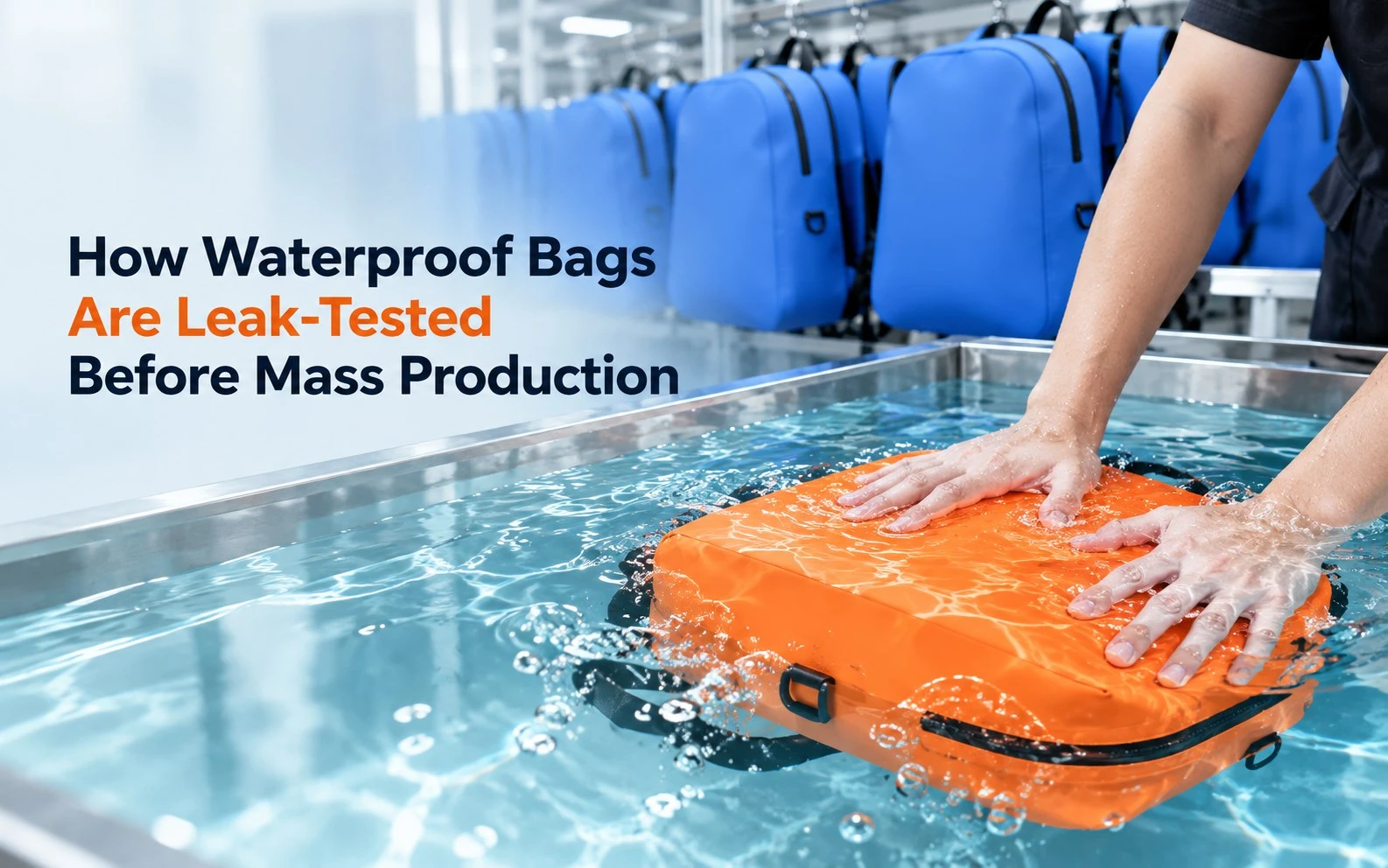
A waterproof bag's reputation lives or dies on its sealing system. A single failed seam or closure on a rafting trip, river crossing, or in heavy rain can expose valuable gear to water. That is why waterproof bag leak testing should take place before mass production begins-not after thousands of units have already been made.
Pre-production testing is not simply a final pass/fail check. It is used to identify whether the material, welded seams, zipper or roll-top closure, attachment points, and finished bag work together as one waterproof system. For readers who want a closer look at the actual production sequence, our guide to the waterproof bag manufacturing process explains how materials, construction methods, welding, and assembly come together before final validation.
The Purpose and Timing of Pre-Production Leak Testing
Pre-production testing serves two main purposes: validating the product design-including fabric, seam construction, and closure mechanism-and confirming that the intended manufacturing process can reproduce that design consistently. Welding parameters, tooling, operator procedures, material batches, and assembly tolerances can all affect the waterproof performance of the finished product.
This is especially important for TPU waterproof bags, PVC waterproof bags, airtight backpacks, waterproof duffel bags, and other products made with HF welding for waterproof bags or heat-sealed seams. A material may be waterproof by itself while the finished bag can still leak through a seam, zipper end, valve, attachment point, or transition between different construction methods.
At FENGLINWAN, the development process for waterproof products moves from requirement confirmation and material preparation through paper patterns, HF welding molds and sample making before Air Leakage Testing and Water Leakage Testing are performed. Customer-approved samples then move into production preparation, including a pre-production meeting and first-finished-product verification. This workflow is also part of the broader process described in our guide to custom bag development from idea to mass production.
This reflects an important manufacturing principle:
Leak testing is most valuable before a defect can be multiplied by mass production.
The Three Levels of Waterproof Bag Testing
A practical waterproof bag testing program can be viewed as three layers. Each one addresses a different potential failure mode.
|
Testing Layer |
Validation Focus |
Target Failure Mode |
|
Material-level |
Fabric water resistance |
Base fabric penetration |
|
Component-level |
Seam and closure integrity |
Welded seam or zipper failure |
|
Whole-bag |
Finished product submersion |
Structural or assembly leaks |
Material testing tells a manufacturer whether the base fabric can withstand water pressure. Component testing focuses on areas such as welded seams and closures. Whole-bag testing determines whether all of those elements still perform correctly after they have been assembled into a finished product.
That distinction matters because waterproofness is a system property, not simply a fabric property. A high-performance waterproof fabric does not automatically make a finished bag waterproof.
How Fabric Water Resistance Is Checked with Hydrostatic Head Testing
Hydrostatic Head Testing Principle
One of the established methods for evaluating waterproof fabric is the hydrostatic head test. Internationally, one of the key references is ISO 811:2018 - Textiles: Resistance to Water Penetration by Hydrostatic Pressure. In North America, AATCC TM127 - Water Resistance: Hydrostatic Pressure Test is another widely recognized method.
In the test described in the original technical references, a 100 cm² fabric specimen is clamped against a water-filled chamber. Distilled water at 20 ± 2°C is applied against one side of the specimen at a controlled pressure-increase rate of 1.0 kPa/min or 6.0 kPa/min.
Testing continues until three distinct seepage points appear on the opposite side of the fabric. The pressure at that point is recorded in kPa or mmH₂O as the material's hydrostatic head rating. A minimum of three specimens are tested and the results averaged.
For waterproof bag manufacturers, this type of fabric test answers an important but limited question:
Can the material itself resist water penetration at the required pressure?
It does not determine whether the completed bag will remain leak-free at its seams, zipper, roll-top closure, or other structural interfaces.
Hydrostatic Head Ratings and Typical Applications
Hydrostatic head values provide useful context when comparing waterproof materials.
|
Hydrostatic Head (mmH₂O) |
Water Resistance Level |
Typical Application |
|
100–1,000 |
Splash / rain resistant |
Light rainwear, everyday items |
|
1,500–5,000 |
High-performance waterproof |
Outdoor apparel, military gear |
|
3,000–10,000 |
Heavy-duty waterproof |
Tent fabrics, expedition gear |
|
10,000+ |
Extreme environment |
Premium dry bags, special protection |
The original reference material also cites GB/T 32614-2016 outdoor hardshell apparel benchmarks of ≥13 kPa for qualified products and ≥20 kPa for premium-grade products.
These values can provide comparison points, but apparel requirements should not automatically be treated as finished-bag specifications. For an OEM waterproof bag project, the relevant material target should be defined according to the product construction, expected environment, required waterproof level, and customer specification.
A product such as a Lightweight Waterproof TPU Backpack, for example, depends on more than TPU fabric performance alone. The quality of the seam construction, closure system, and assembly process also determines how the finished bag performs.
How Waterproof Bag Seams and Closures Are Checked for Leaks
Air Leakage and Welded Seam Testing
In finished waterproof bags, seams and closures are among the most critical areas to verify. TPU materials, including the 0.15–0.3 mm range referenced in the original draft, may be joined through welding or heat-sealing processes that avoid the needle holes created by conventional stitching in the sealed area.
For HF-welded waterproof bags, the quality of the bond depends not only on the material itself but also on factors such as welding parameters, tooling, seam geometry, alignment, and construction consistency.
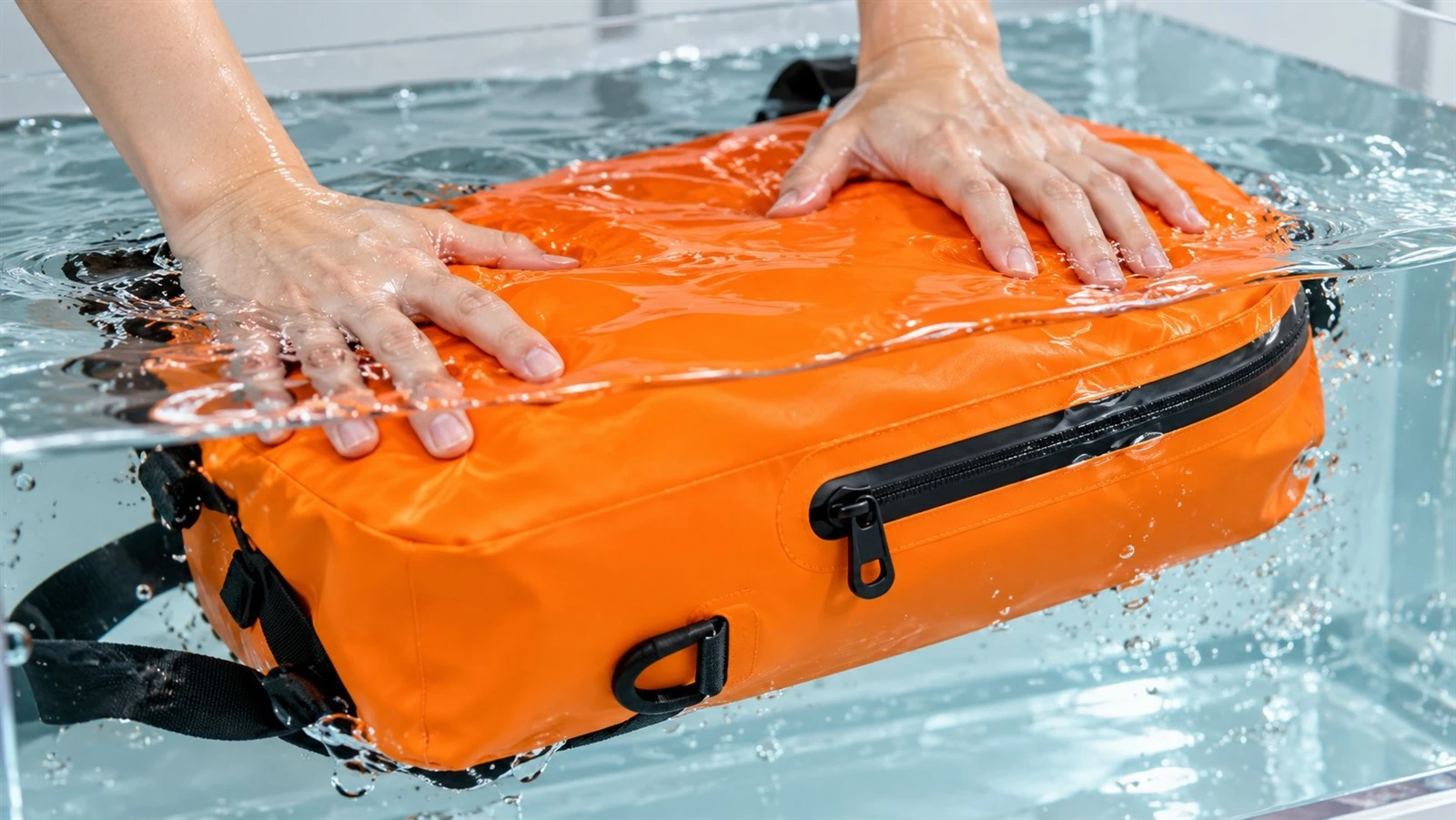
One common waterproof seam testing method is to inflate the sealed product and place it in water. Escaping air produces visible bubbles, which can reveal small leak paths around welds, zipper interfaces, valves, or other sealed areas. The underlying bubble-emission principle is also reflected in standardized leak-detection methods such as ASTM D3078 - Determination of Leaks in Flexible Packaging by Bubble Emission, although the exact fixture, pressure, and acceptance criteria for a waterproof bag must be defined for the product being tested.
FENGLINWAN uses both Air Leakage Testing and Water Leakage Testing in its documented waterproof product development process. For air leakage testing, the bag is inflated and the waterproof closure is closed; after 24 hours, its shape is checked for evidence of air loss. For water leakage testing, the closed bag is pressed into water and observed for bubbles that indicate leakage. The documented process specifies 100% air leakage testing for applicable airtight products.
The distinction is useful:
Air leakage testing helps verify sealing integrity over time, while an immersion bubble test can help identify where a leak is occurring.
A product such as an Airtight Waterproof Expedition Backpack illustrates why airtight construction requires attention to the entire sealing system rather than the fabric alone.
For readers who want a more focused explanation of these inspection methods, our guide to air and water leakage checks for waterproof bags covers the difference between the two approaches in more detail.
For quantitative seam-strength evaluation, the original draft also describes a heat-seal test in which 15 mm-wide specimens are pulled until failure, with a pharmaceutical-grade reference benchmark of ≥12 N/15 mm. That figure is best treated as a reference benchmark rather than a universal acceptance requirement for waterproof bags; the actual seam-strength specification should be defined for the product and material system being developed.
Testing Roll-Top and Waterproof Zipper Closures
Closure design directly affects the level of water protection a bag can provide.
Roll-top dry bags typically rely on multiple folds to create a longer and more difficult path for water to enter. The original draft describes a field-level paper-towel submersion check in which the bag is submerged for 30 minutes and the internal towel is expected to remain completely dry.
A Large Roll Top Waterproof Duffel Bag is a useful example of a design where closure geometry and welded body construction need to work together to achieve the intended water protection.
Airtight and watertight zipper products require a different approach. The zipper body, zipper ends, attachment area, and the transition between the zipper and welded bag panel can all become potential leak paths. Our guide to waterproof zipper types explains the differences between water-resistant, watertight, and airtight zipper solutions.
FENGLINWAN's waterproof product system includes TPU and PVC material options, HF welding, heat-sealed construction, roll-top designs, and airtight or watertight zipper solutions. This is why the leak-test method should be selected according to the product's actual construction rather than applying one identical procedure to every waterproof bag.
Typical seam and closure test methods include:
|
Test Method |
What It Checks |
Standard / Reference |
Destructive? |
|
Inflation / air-pressure bubble test |
Seam and weld integrity, micro-leaks |
Manufacturer protocol |
No |
|
Heat-seal strength test |
Force required to break a welded seam |
QB/T 2358; ASTM F88 |
Yes, sample test |
|
Paper-towel submersion test |
Closure performance after 30-minute soak |
Field / production check |
No |
|
Vacuum decay method |
Quantitative micro-leak performance |
GB/T 15171; ASTM D3078 |
No |
No single method answers every waterproofing question. The appropriate combination depends on whether the product is intended to resist rain, temporary immersion, sustained immersion, internal air pressure, or another defined exposure condition.
How IPX Ratings and Full-Submersion Tests Apply to Waterproof Bags
Understanding the IEC 60529 IPX Framework
Whole-product water-ingress testing may also be specified using the IPX framework defined in IEC 60529 - Degrees of Protection Provided by Enclosures (IP Code).
Typical water-protection levels referenced in the original draft include:
|
IPX Rating |
Test Condition |
What It Demonstrates |
|
IPX4 |
Splash from any direction |
Rain and spray resistance |
|
IPX6 |
Powerful water jets |
Heavy spray / storm conditions |
|
IPX7 |
1 m depth for 30 minutes |
Short-term immersion |
|
IPX8 |
Continuous immersion under agreed conditions |
Protection under conditions more severe than IPX7 |
|
IPX9K |
80°C water at 8–10 MPa, multi-angle jets |
Extreme high-pressure hot-water exposure |
For waterproof bags, these ratings should not be treated as interchangeable marketing terms. A roll-top bag designed primarily for rain and splashing may require a very different validation approach from an airtight backpack or specialized waterproof transport bag intended for submersion.
FENGLINWAN's documented technical portfolio includes IPX8-level airtight waterproof technology together with HF-welded seams and airtight/watertight constructions. This does not mean that every FENGLINWAN waterproof bag automatically carries the same IPX8 specification; the required protection level and test conditions should be defined for each product and project.
Why IPX8 Does Not Mean One Fixed Depth or Duration
A frequent misunderstanding is that every IPX8 product must survive exactly the same depth and time.
IEC 60529 does not prescribe one universal depth and duration for all IPX8 tests. Instead, the relevant conditions are agreed between the parties involved and documented for the product.
The original draft gives examples of negotiated conditions such as:
- 20 metres, approximately 0.2 MPa gauge pressure
- 50 metres, approximately 0.5 MPa
- Hold periods of 30 minutes, 1 hour, 2 hours, or longer-duration endurance testing
These are examples rather than universal requirements.
For buyers sourcing an IPX8 waterproof bag, simply asking whether the product is "IPX8" is therefore incomplete. More useful questions include:
- What depth or equivalent pressure was specified?
- How long was the exposure maintained?
- Was the finished bag or only a component tested?
- What closure configuration was used?
- What constituted a pass or failure?
- Is the same construction controlled during mass production?
This makes the test condition itself just as important as the rating label.
Pressure-Vessel Submersion Testing
For simulated deep-water exposure, a sealed pressure vessel can be used instead of a physically deep tank.
The sample is submerged in water inside the vessel while pressure is applied to simulate the hydrostatic conditions associated with greater water depth. The original draft describes water temperatures of 15–35°C and keeping the temperature difference between sample and water within 5 K to reduce condensation-related artifacts.
After the required exposure period, the sample is removed, dried, function-checked, and inspected internally for water ingress.
For products exposed to unusually harsh spray environments, the original draft also references IPX9K testing using 80 ± 5°C water at 8–10 MPa, applied from multiple angles at a flow rate of 14–16 L/min. This is a specialized test and is not a routine requirement for every waterproof bag.
The same principle applies to waterproof bag pre-production testing in general: the test should match the intended use case and failure risk rather than simply selecting the most severe test available.
FAQ
What is the most common leak test for waterproof bags before mass production?
There is no single universal test for every waterproof bag. Air leakage testing, immersion or bubble testing, hydrostatic head testing, seam-strength testing, and full-product submersion testing address different risks. Airtight HF-welded products commonly benefit from air leakage and water leakage testing before the design is released for mass production.
Is air leakage testing the same as water leakage testing?
No. Air leakage testing evaluates whether the sealed product loses air over time, while immersion-based water leakage testing can reveal escaping bubbles and help locate potential leak points. Manufacturers may use both because they provide different information about seam, zipper, valve, and structural integrity.
Does waterproof fabric guarantee that a finished bag will not leak?
No. Waterproof fabric only addresses one part of the system. Welded seams, zipper installations, roll-top closures, valves, accessory attachment points, and manufacturing consistency can all affect the final waterproof performance.
Does IPX8 always mean the same water depth and test duration?
No. IPX8 conditions are defined for the specific product and must be more severe than the IPX7 requirement. The agreed depth or pressure and exposure duration therefore need to be reviewed together with the rating.
Are waterproof bags tested again after the prototype is approved?
For a robust manufacturing program, prototype approval should be followed by production controls that help reproduce the validated construction. At FENGLINWAN, new-product preparation includes engineering data such as standard samples, BOMs, specifications, product drawings and material information; new orders also go through a pre-production meeting and first-finished-product inspection. IQC, IPQC, FQC and OQC are used across production, with 100% FQC specified before packaging.
Final Thoughts
Waterproof bags are leak-tested before mass production by checking more than the material alone. A reliable validation process connects fabric water resistance, welded seam integrity, closures, air leakage testing, water leakage testing and-where required-defined whole-product immersion conditions. The real objective is not simply to prove that one prototype can pass a test, but to convert that validated construction into a repeatable manufacturing standard.
As a waterproof bag manufacturer, FENGLINWAN develops OEM/ODM waterproof and functional bags using TPU/PVC material selection, HF welding, airtight or watertight closures, sample validation, and production quality control. If you are developing a waterproof backpack, dry bag, waterproof duffel, rescue/transport bag, or another sealed product, contact us to discuss the construction, leak-testing requirements, and production plan for your project.