


Is Polyester Waterproof? Everything You Need to Know
May 09, 2026
Leave a message
Polyester is naturally water-resistant, but it is not fully waterproof by itself.
Polyester fibers absorb little moisture, so water often beads on the surface and rolls away. This makes polyester useful for outdoor bags, backpacks, cooler bags, beach bags, and travel gear. But untreated woven polyester still has tiny gaps between yarns. Under heavy rain, pressure, or long exposure, water can pass through.
A waterproof polyester bag needs more than polyester fabric. It needs the right coating, lamination, seam treatment, zipper choice, closure design, and manufacturing process.
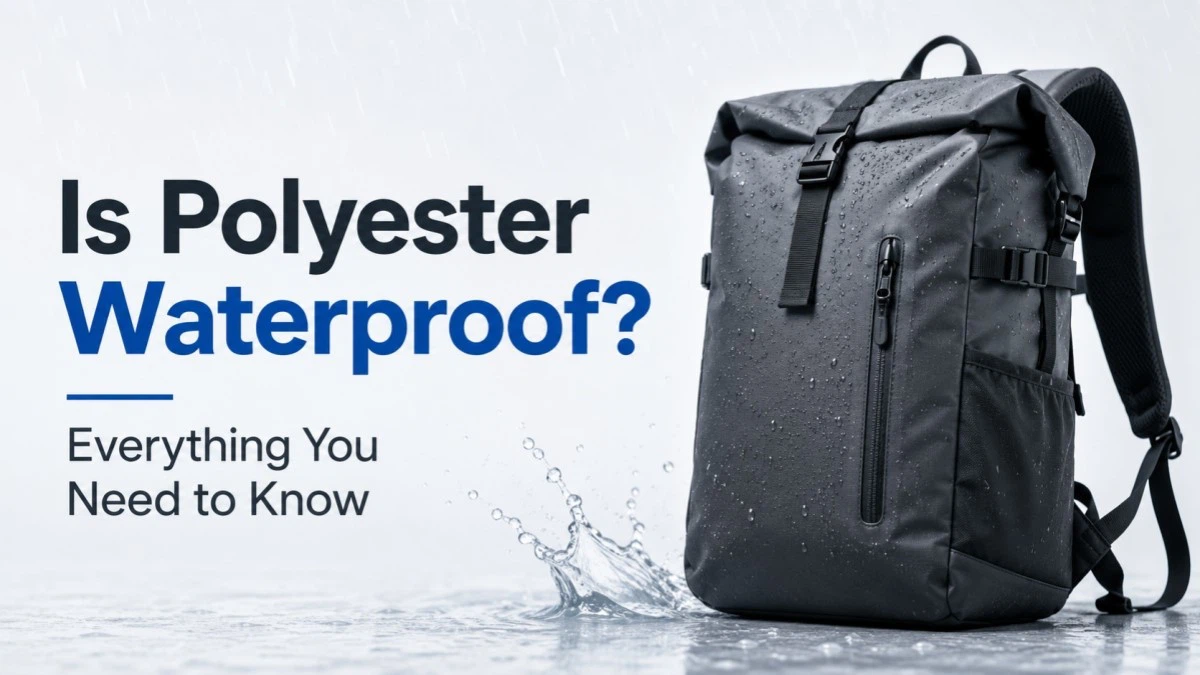
Is Polyester Waterproof?
Polyester is usually made from PET, a synthetic fiber with low moisture absorption. In fabric terms, polyester is often described as hydrophobic, which means it does not attract or absorb water easily.
That is why polyester often dries faster than cotton and performs better in light rain or damp outdoor environments.
But hydrophobic does not mean waterproof.
Most polyester used in bags is woven. A woven polyester fabric is made from yarns crossing over and under each other. Between those yarns are microscopic gaps. When rain is light, water may stay on the surface for a while. When rain is heavy, pressure builds, or the fabric is exposed for a long time, water can work through those gaps.
This is why a plain polyester backpack may handle a short walk in drizzle but fail during a long downpour.
Why Polyester Repels Water
Polyester fibers do not absorb much water compared with natural fibers like cotton. When water lands on polyester, it is more likely to sit on the surface instead of soaking quickly into the fiber.
This gives polyester a useful baseline of water resistance.
For outdoor bag manufacturing, this is one reason polyester is widely used. It has good dimensional stability, reasonable UV resistance, broad availability, and cost control. A 600D polyester fabric, for example, is common in backpacks, cooler bags, promotional outdoor bags, and general travel storage products.
But the fiber alone is only the starting point.
Why Untreated Polyester Can Still Leak
Untreated polyester leaks because water does not need to enter the fiber itself. It can enter through the fabric structure.
A loose weave leaks faster. A worn surface leaks faster. A stitched seam leaks faster because every needle hole creates a possible water path.
Untreated polyester can resist light moisture, but water can still pass through the gaps in woven fabric under heavy rain, pressure, or long exposure.
That is the line buyers should remember.
Water-Resistant vs. Waterproof Polyester: What Is the Difference?
These terms are often used carelessly in product listings. In manufacturing, they mean different things.
Water-repellent polyester means the surface helps water bead and roll off.
Water-resistant polyester means the fabric slows water penetration for a limited time.
Waterproof polyester means the material or finished product is designed to block water under defined conditions.
The last phrase matters: under defined conditions.
No serious manufacturer should call a product waterproof without considering the use case. Light rain, heavy rain, water pressure, immersion, and marine use are not the same problem.
Water-Repellent Polyester
Water-repellent polyester usually has a surface finish, often DWR, which stands for Durable Water Repellent.
DWR helps water form droplets on the fabric surface. It is useful for light rain, splashes, jackets, backpack shells, and casual outdoor bags. But DWR is a surface treatment, not a waterproof barrier.
It can wear down through abrasion, dirt, washing, folding, and long-term use.
DWR improves surface water repellency, but it does not make polyester fully waterproof by itself.
Water-Resistant Polyester
Water-resistant polyester can slow water penetration, but it does not completely block water.
Many everyday backpacks, gym bags, school bags, and light outdoor bags are water-resistant rather than waterproof. They may use polyester with DWR, light PU backing, or a tight weave. This is usually enough for short exposure to light rain.
But if the bag sits in wet grass, rides on a boat, or spends hours in heavy rain, water may enter through the fabric, seams, zipper, or bottom panel.
Waterproof Polyester
Waterproof polyester usually requires a stronger barrier. This may come from PU coating, PVC coating, TPU lamination, or another waterproof membrane.
For fabric, waterproof performance is often tested using water pressure or hydrostatic head. For bags, that is not enough. The finished product must also control seam leakage, zipper leakage, closure leakage, and stress-point leakage.
Water-resistant polyester slows water penetration. Waterproof polyester is designed to block water under specific exposure conditions.
Why This Difference Matters for Bag Buyers
For a bag brand, this difference affects more than material choice. It affects product claims, customer expectations, warranty risk, and price.
A water-resistant beach tote can use a lighter polyester fabric and standard stitching. A waterproof fishing bag needs stronger coated or laminated fabric, sealed seams, and a closure that can handle wet use. A roll-top dry bag may need PVC-coated polyester or TPU-laminated fabric with high-frequency welded seams.
If a bag is only water-resistant, do not market it as fully waterproof.
That mistake creates returns.
What Makes Polyester Waterproof?
Polyester becomes waterproof when the fabric structure receives a barrier treatment or when the finished product is built to stop water at all weak points.
The common methods are DWR finishing, PU coating, PVC coating, TPU lamination, and tighter fabric construction. For bags, these must be matched with seam sealing, welding, and proper closure design.
DWR-Treated Polyester
DWR-treated polyester is common in outdoor textiles. It makes water bead on the surface instead of spreading and soaking quickly.
DWR is useful, but it is not enough for a true waterproof bag. It works best as a surface-level defense for light rain and splashes. Over time, the finish loses performance, especially in areas that rub against clothing, hands, straps, or rough surfaces.
For a commuter backpack or casual travel pouch, DWR may be acceptable. For a dry bag or cooler bag that may sit on wet ground, DWR alone is too weak.
PU-Coated Polyester
PU-coated polyester uses polyurethane coating on the fabric surface or backside. It is one of the most common solutions for water-resistant and moderately waterproof bag materials.
PU is popular because it balances cost, flexibility, hand feel, and production availability. You will see it in backpacks, drawstring bags, outdoor storage bags, rain covers, and many general-purpose water-resistant bags.
But PU has limits. Low-quality PU can hydrolyze in humid storage, peel after repeated folding, or weaken after abrasion. For export products, coating quality and storage conditions matter.
PU-coated polyester is practical for many bag projects, but it should be matched to the actual water exposure.
PVC-Coated Polyester
PVC-coated polyester creates a stronger waterproof barrier. The material is usually thicker, heavier, and more rigid than PU-coated polyester.
This makes PVC-coated polyester common in products such as:
- dry bags
- cooler bags
- fishing bags
- tool bags
- waterproof storage bags
- outdoor utility bags
- heavy-duty promotional waterproof bags
PVC also works well with high-frequency welding, which is widely used in waterproof bag production. Welded seams can reduce leakage risk compared with stitched seams.
The trade-offs are clear. PVC may feel stiffer, especially in cold weather. Odor, environmental requirements, low-temperature flexibility, and compliance standards should be checked before mass production.
TPU-Laminated Polyester
TPU-laminated polyester is often used for higher-end waterproof bags and flexible waterproof pouches.
TPU is valued for flexibility, cold resistance, cleaner hand feel, and better performance in products that need folding or repeated movement. It is often selected when the buyer wants a more premium feel than PVC and stronger waterproof performance than light PU coating.
The cost is higher. Production control also becomes more demanding. Welding temperature, bonding strength, material thickness, and edge sealing need tighter management.
TPU-laminated polyester is not automatically the best choice for every project, but it is often the better choice for premium waterproof bag lines.
Coated vs. Laminated Polyester
Coated polyester and laminated polyester are not the same.
Coated polyester has a liquid coating applied to the surface or backside of the fabric. PU and PVC are common examples.
Laminated polyester bonds polyester with a waterproof film or membrane, such as TPU film. The laminated structure can give stronger water protection, better flexibility, or better long-term performance depending on the material and process.
For waterproof bags, the choice is not only about water resistance. Buyers should also check bonding strength, abrasion resistance, flexibility, cold-crack resistance, welding compatibility, odor, and compliance.
Coated polyester adds a waterproof barrier to the fabric surface, while laminated polyester bonds polyester with a waterproof film or membrane for stronger and more flexible water protection.
Does a Tight Weave Make Polyester Waterproof?
A tight weave improves water resistance, but it does not make polyester fully waterproof.
When yarns are packed more tightly, water has fewer open paths through the fabric. That helps in light rain and short exposure. This is why high-density polyester often performs better than loose, thin polyester.
But water pressure changes the result.
If the bag is pressed against wet ground, exposed to long rain, or packed in a wet boat compartment, water can still move through the fabric. Tight weave can delay leakage, but it rarely replaces coating, lamination, or sealed construction.
A tight weave improves water resistance, but it should not be treated as a substitute for waterproof coating, lamination, or sealed construction.
Is 600D Polyester Waterproof?
600D polyester is not automatically waterproof.
The "D" stands for denier, a unit related to yarn thickness. In bag production, 600D polyester is popular because it gives a good balance of durability, cost, weight, and printability. It is used in backpacks, cooler bags, school bags, travel bags, and promotional outdoor bags.
But 600D only tells you part of the story. It does not tell you whether the fabric has PU coating, PVC backing, TPU lamination, DWR finishing, or seam sealing.
A plain 600D polyester fabric may only be water-resistant. A 600D polyester fabric with PU backing may resist more rain. A PVC-coated or TPU-laminated 600D polyester can offer much stronger water protection.
600D polyester is not automatically waterproof. A 600D polyester fabric without coating may only be water-resistant, while 600D polyester with PU, PVC, or TPU backing can offer much stronger water protection.
600D vs. 900D vs. 1680D Polyester
Higher denier usually means a heavier or thicker yarn, but it does not directly mean higher waterproof performance.
| Fabric Type | Common Bag Use | Typical Strength Positioning | Waterproof Meaning |
|---|---|---|---|
| 600D polyester | Backpacks, cooler bags, promo bags | Balanced cost and durability | Needs coating or lamination for stronger water protection |
| 900D polyester | Outdoor bags, tool bags, heavier storage bags | More rugged than 600D in many constructions | Still depends on coating and seams |
| 1680D polyester | Heavy-duty bags, business bags, reinforced panels | Stronger look and higher abrasion positioning | Not waterproof unless treated |
Higher denier can make polyester stronger or heavier, but it does not automatically make the fabric waterproof.
For real product development, ask two questions: what is the fabric construction, and what is the waterproof treatment?
Fabric Waterproofing Is Not the Same as Bag Waterproofing
This is where many product claims fail.
A fabric sample can be waterproof, but a finished bag can still leak if the seams, zippers, corners, and handle attachment points are not properly sealed.
A roll of PVC-coated polyester may block water well. Once it is cut, stitched, folded, punched, riveted, zipped, and assembled into a bag, many new leakage points appear.
Water does not care that the fabric is waterproof. It finds the weakest opening.
Stitch Holes and Seams
Stitching creates needle holes. Every needle hole can become a water path.
For water-resistant bags, normal stitching may be acceptable. For waterproof bags, seams need extra treatment. This may include seam tape, seam sealing, binding with waterproof layers, or welding instead of stitching.
A stitched cooler bag with waterproof fabric can still leak at the seams if the construction is not sealed.
That is a production issue, not a fabric issue.
Zippers, Openings, and Closures
Ordinary zippers are not waterproof. Even many "water-resistant zippers" are designed to slow water entry, not block water under pressure.
For waterproof polyester bags, closure choice depends on the product:
| Closure Type | Water Protection | Common Use |
|---|---|---|
| Standard zipper | Low to medium | Daily backpacks, light bags |
| Zipper with flap | Medium | Outdoor backpacks, travel bags |
| Water-resistant zipper | Medium to high | Premium outdoor bags, pouches |
| Waterproof zipper | High, but costly | Technical waterproof bags |
| Roll-top closure | High when designed well | Dry bags, fishing bags, boating bags |
For many dry bag applications, a roll-top closure is more reliable than a standard zipper. It is simple, easy to seal, and compatible with welded construction.
Welding and Heat Sealing
For higher waterproof performance, welding often works better than stitching.
Common waterproof bag manufacturing methods include:
- High-frequency welding
- Heat sealing
- Ultrasonic welding
- Seam taping
- Hot-air seam sealing
PVC-coated polyester is often suitable for high-frequency welding. TPU-laminated polyester can also work well with heat sealing or welding, but the process window must be controlled.
The equipment matters. The operator matters. The material thickness matters.
A poor weld can fail even if the fabric is expensive.
Corners, Bottoms, and Handle Attachment Points
Waterproof bags often fail at stress points, not flat panels.
Common weak points include bottom corners, side seam intersections, handle stitching areas, shoulder strap anchors, rivet holes, zipper ends, and folded edges. These areas carry load, bend frequently, or create overlapping material layers.
A waterproof bag design should identify these leakage points before sampling.
A waterproof bag is not decided by fabric alone. Even good waterproof polyester can fail if the seams, zippers, corners, and construction are poorly designed.
When Does Polyester Start to Leak or Lose Water Resistance?
Polyester water resistance changes over time. A new coated fabric may pass a basic water test. After months of folding, rubbing, loading, and outdoor use, performance can drop.
This is normal. The question is how fast it drops and whether the selected material fits the use case.
Heavy Rain, Pressure, and Long Exposure
Light rain is easy. Pressure is harder.
A backpack in drizzle may stay dry. The same backpack pressed against a wet boat deck or left in heavy rain for two hours may leak. Water pressure pushes moisture through weak points faster.
Immersion is another category. A bag used near water is not the same as a bag designed to be submerged.
Abrasion, Folding, and Repeated Use
Coatings weaken when they are rubbed, folded, scratched, or compressed repeatedly.
This matters for cooler bags, dry bags, and outdoor storage bags because they are often folded flat, dragged, loaded with hard objects, or placed on rough ground. Once the coating cracks or wears thin, water protection drops.
For tool bags and fishing bags, abrasion resistance should be checked early. A waterproof coating that cannot survive the product's normal use is not a good solution.
UV, Heat, Humidity, and Saltwater
Outdoor bags face more than water.
UV exposure can age materials. Heat and humidity can affect coating stability. Saltwater can speed up corrosion on metal parts and stress fabric coatings. Low temperature can make some materials stiff or brittle.
Waterproof performance is not permanent. Coatings and finishes can weaken due to abrasion, folding, sunlight, humidity, saltwater, washing, and repeated use.
For long-life outdoor products, material testing should include more than one splash test.
Polyester vs. Nylon vs. Cotton: Which Is Better for Waterproof Use?
Polyester, nylon, and cotton behave differently around water. The right choice depends on the product type, target cost, strength requirement, and waterproof structure.
Polyester vs. Nylon
Polyester and nylon are both common in outdoor bags.
Polyester usually offers better UV resistance, lower moisture absorption, good dimensional stability, and cost control. It is widely used for backpacks, cooler bags, beach bags, and promotional outdoor products.
Nylon often offers higher tear strength, better abrasion resistance, and a softer hand feel. It is common in lightweight technical bags, travel gear, and products where strength-to-weight ratio matters.
For waterproof bags, coating and construction usually matter more than whether the base fabric is polyester or nylon.
A poorly coated nylon bag can leak. A well-designed PVC-coated polyester dry bag can perform very well.
Polyester vs. Cotton
Cotton absorbs water quickly and dries slowly. It becomes heavy when wet and is not a good base material for waterproof bags unless it is heavily treated or combined with another barrier material.
Polyester is a better choice for most outdoor water-resistant or waterproof bag applications because it resists moisture, dries faster, and keeps its shape better.
Cotton may look natural, but it is not the practical choice for wet outdoor bag use.
Polyester Blends
Some fabrics combine polyester with cotton, rayon, spandex, or other fibers. These blends may improve softness, appearance, or stretch, but they do not automatically improve waterproof performance.
Fiber content alone does not define waterproof performance; a 100% polyester fabric can still leak if it is untreated or poorly constructed.
For bag projects, the coating, lamination, and construction method matter more than the label that says "100% polyester."
When Is Polyester a Good Choice for Waterproof Bags?
Polyester is a strong base material for many waterproof and water-resistant bags. It is available in many weights, coatings, colors, textures, and price levels. It works well for mass production and custom bag programs.
But it must be matched to the product's real use.
Good Applications for Waterproof or Water-Resistant Polyester
Polyester is a good choice for:
- cooler bags
- waterproof backpacks
- beach bags
- camping storage bags
- fishing bags
- outdoor tool bags
- travel storage bags
- picnic bags
- waterproof pouches
- promotional waterproof bags
- PVC-coated dry bags
- TPU-laminated waterproof bags
For a cooler bag, polyester may be used as an outer shell with PE foam and aluminum foil or PEVA lining inside. For a dry bag, PVC-coated polyester or TPU-laminated polyester may be welded into a roll-top structure. For a beach tote, coated 600D polyester may be enough if the product only needs splash resistance.
Different bag, different answer.
Applications Where Untreated Polyester Is Not Enough
Untreated polyester should not be used alone for products exposed to:
- long-term immersion
- heavy rain
- boating
- kayaking
- marine storage
- high water pressure
- wet ground contact for long periods
- professional dry storage
- airtight or fully sealed requirements
In these cases, the product needs stronger waterproof fabric and sealed construction.
Polyester can be a strong base material for waterproof bags, but only when it is matched with the right coating, sealing method, and product structure.
How to Choose Waterproof Polyester Fabric for Bags
A good material choice starts with the application, not the fabric name.
Too many projects begin with "We want 600D polyester." That is not enough. A factory still needs to know how the bag will be used, how much water exposure it will face, what price level the brand wants, and what claim will appear on the product page.
Start with the End Use
Before selecting fabric, define the exposure:
| Use Case | Water Exposure | Suggested Direction |
|---|---|---|
| Daily backpack | Light rain, short exposure | DWR or PU-coated polyester |
| Cooler bag | Wet ground, condensation, spills | PU/PVC-coated polyester outer, sealed lining where needed |
| Beach bag | Sand, splash, wet towels | Coated polyester or mesh/polyester mix depending on design |
| Fishing bag | Splash, mud, wet gear | PVC-coated or TPU-laminated polyester |
| Dry bag | Heavy water exposure | Welded PVC or TPU structure with roll-top closure |
| Boating storage | High splash and wet deck | Strong coated fabric, welded seams, sealed closure |
Polyester selection should start with the end use, not only the fabric name.
Choose the Right Coating or Lamination
For light water resistance, DWR or light PU backing may be enough.
For stronger water protection, PVC-coated polyester or TPU-laminated polyester may be a better choice. For premium products, TPU may justify the higher material cost because of flexibility and cleaner hand feel. For rugged cost-sensitive dry bags, PVC-coated polyester may be more practical.
The right answer depends on target price, usage, compliance, production method, and expected product life.
Check Waterproof Rating and Testing
If waterproof performance matters, ask for test data.
Useful tests may include:
- hydrostatic head testing
- spray rating
- water pressure testing
- seam leakage testing
- abrasion resistance testing
- tear strength testing
- cold-crack testing
- color fastness testing
For bag production, seam leakage testing is especially important. A fabric test alone does not prove the finished bag is waterproof.
Match the Fabric with the Right Construction
A waterproof fabric needs compatible construction.
That means checking:
- seam sealing
- welding method
- waterproof zipper or roll-top closure
- bottom reinforcement
- handle attachment design
- zipper end treatment
- corner sealing
- stress-point reinforcement
A good waterproof bag is a system. The fabric, seam, closure, and load-bearing structure must work together.
Consider Durability and Outdoor Conditions
Waterproof fabric must survive the actual use environment.
For outdoor bags, check abrasion, folding, UV exposure, humidity, saltwater contact, low temperature, and coating aging. For cooler bags, also consider condensation, cleaning, odor, and lining compatibility. For dry bags, welding strength and repeated roll-top folding are key.
A material that looks good in a sample room may not survive one season of real outdoor use.
Check Compliance and Market Requirements
For export programs, compliance cannot be treated as an afterthought.
Depending on market and product category, buyers may need to consider REACH, RoHS, CA65, PFAS or PFC-free requirements, recycled polyester options, odor control, and safety expectations for consumer products.
For B2B waterproof bag projects, polyester selection should consider waterproof rating, coating durability, welding compatibility, abrasion resistance, compliance requirements, and target price.
Quick Comparison: Types of Waterproof Polyester for Bags
| Polyester Type | Water Protection | Flexibility | Cost Level | Best For |
|---|---|---|---|---|
| Untreated polyester | Low to medium | Good | Low | Casual bags, light indoor/outdoor use |
| DWR-treated polyester | Light rain and splashes | Good | Low to medium | Backpacks, travel bags, light outdoor bags |
| PU-coated polyester | Medium | Good | Medium | Backpacks, storage bags, water-resistant bags |
| PVC-coated polyester | High | Medium to low | Medium | Dry bags, cooler bags, tool bags, fishing bags |
| TPU-laminated polyester | High | Good | Higher | Premium waterproof bags, flexible waterproof pouches |
The best waterproof polyester is not always the thickest one. It is the material that matches the product's water exposure, construction method, target price, and durability requirement.
Water-Resistant Polyester Bag vs. Waterproof Polyester Bag
A water-resistant polyester bag and a waterproof polyester bag should not be sold as the same product.
| Feature | Water-Resistant Polyester Bag | Waterproof Polyester Bag |
|---|---|---|
| Fabric | DWR or light PU coating | PVC, TPU, or stronger waterproof coating |
| Seams | Usually stitched | Sealed, taped, or welded |
| Closure | Standard zipper, flap, drawstring | Waterproof zipper, roll-top, sealed opening |
| Best Use | Light rain, daily carry, short outdoor use | Heavy rain, fishing, boating, wet storage |
| Cost | Lower | Higher |
| Risk if Misused | Water may seep through seams or zipper | Better protection if structure is properly sealed |
A water-resistant polyester bag is designed to slow water entry. A waterproof polyester bag must be designed as a complete system, including fabric, seams, zipper, closure, and construction.
FAQ
Is polyester waterproof or water-resistant?
Polyester is naturally water-resistant, not fully waterproof. It can resist light moisture because the fiber absorbs little water, but untreated woven polyester can still leak under heavy rain, pressure, or long exposure.
Is 100% polyester waterproof?
No. "100% polyester" describes fiber content, not waterproof rating.
A 100% polyester fabric may be untreated, DWR-treated, PU-coated, PVC-coated, or TPU-laminated. The waterproof performance depends on the treatment and construction, not only the fiber content.
Does polyester absorb water?
Polyester absorbs little moisture compared with many natural fibers. This helps it dry quickly and resist light splashes. But woven polyester fabric can still allow water to pass through gaps between yarns.
Is 600D polyester waterproof?
600D polyester is not automatically waterproof. A plain 600D polyester fabric may only be water-resistant. With PU coating, PVC coating, or TPU lamination, it can provide much stronger water protection.
What coating makes polyester waterproof?
Common options include PU coating, PVC coating, TPU lamination, and DWR finishing. DWR mainly improves surface water repellency. PU, PVC, and TPU create stronger barriers against water penetration.
Is PVC-coated polyester waterproof?
PVC-coated polyester can provide strong waterproof performance and is widely used in dry bags, cooler bags, tool bags, fishing bags, and outdoor waterproof storage products. The finished bag still needs proper welding, seam design, and closure construction.
Is TPU-laminated polyester better than PU-coated polyester?
TPU-laminated polyester often gives better flexibility, cold resistance, and premium feel. It also works well for high-end waterproof bag projects. PU-coated polyester is more common and cost-effective for general water-resistant bags.
The better choice depends on price, product positioning, use environment, and production method.
Can polyester bags be fully waterproof?
Yes, but only when waterproof fabric is combined with the right construction. A fully waterproof polyester bag may need welded seams, sealed corners, waterproof zippers, roll-top closure, or other waterproof structures.
Fabric alone is not enough.
Can waterproof polyester lose its waterproofing?
Yes. DWR can wear off. Coatings can crack, peel, or weaken. Seams can leak if sealing fails. Abrasion, folding, UV exposure, humidity, saltwater, washing, and repeated use can reduce waterproof performance.
Is polyester better than nylon for waterproof bags?
Not always. Polyester often offers lower moisture absorption, good UV resistance, dimensional stability, and cost control. Nylon often offers higher strength and abrasion resistance.
For waterproof bags, coating and construction usually matter more than whether the base fabric is polyester or nylon.
How do I choose polyester for a waterproof bag project?
Start with the product's use case. Then define water exposure, fabric weight, coating type, seam construction, zipper or closure design, durability requirements, compliance needs, target price, and production method.
A waterproof beach pouch, cooler bag, fishing bag, and dry bag should not use the same material plan.
conclusion: So, Is Polyester Waterproof?
Polyester is not fully waterproof by itself. It is naturally water-resistant because it absorbs little moisture, but untreated woven polyester can still leak under heavy rain, pressure, or long exposure.
To make polyester waterproof, manufacturers usually use PU coating, PVC coating, TPU lamination, DWR finishing, or a sealed product structure. For bags, the final waterproof performance depends on much more than fabric. Seams, zippers, welding, closure design, bottom corners, and handle attachment points all affect whether the finished bag can truly keep water out.
FENGLINWAN is committed to developing and manufacturing outdoor waterproof backpacks in a wide range of materials. If you are looking for high-quality waterproof bag OEM services, we can help you evaluate material options, bag structure, sample feasibility, and cost balance before production.