


What Is the Best Material for Travel Vacuum Compression Bags?
Nov 23, 2026
Leave a message
Travel vacuum compression bags work by removing trapped air from soft goods-jackets, sleeping bags, base layers-so they occupy a fraction of their original volume in a backpack or duffel. The bag itself is a flexible barrier film that must hold a near-vacuum under external atmospheric pressure (approximately 101 kPa at sea level), resist punctures from zippers and buckles packed alongside, and remain flexible across temperature swings from airline cargo holds to desert trailheads. Choosing the best material for travel vacuum compression bags determines whether the bag survives one trip or thirty.
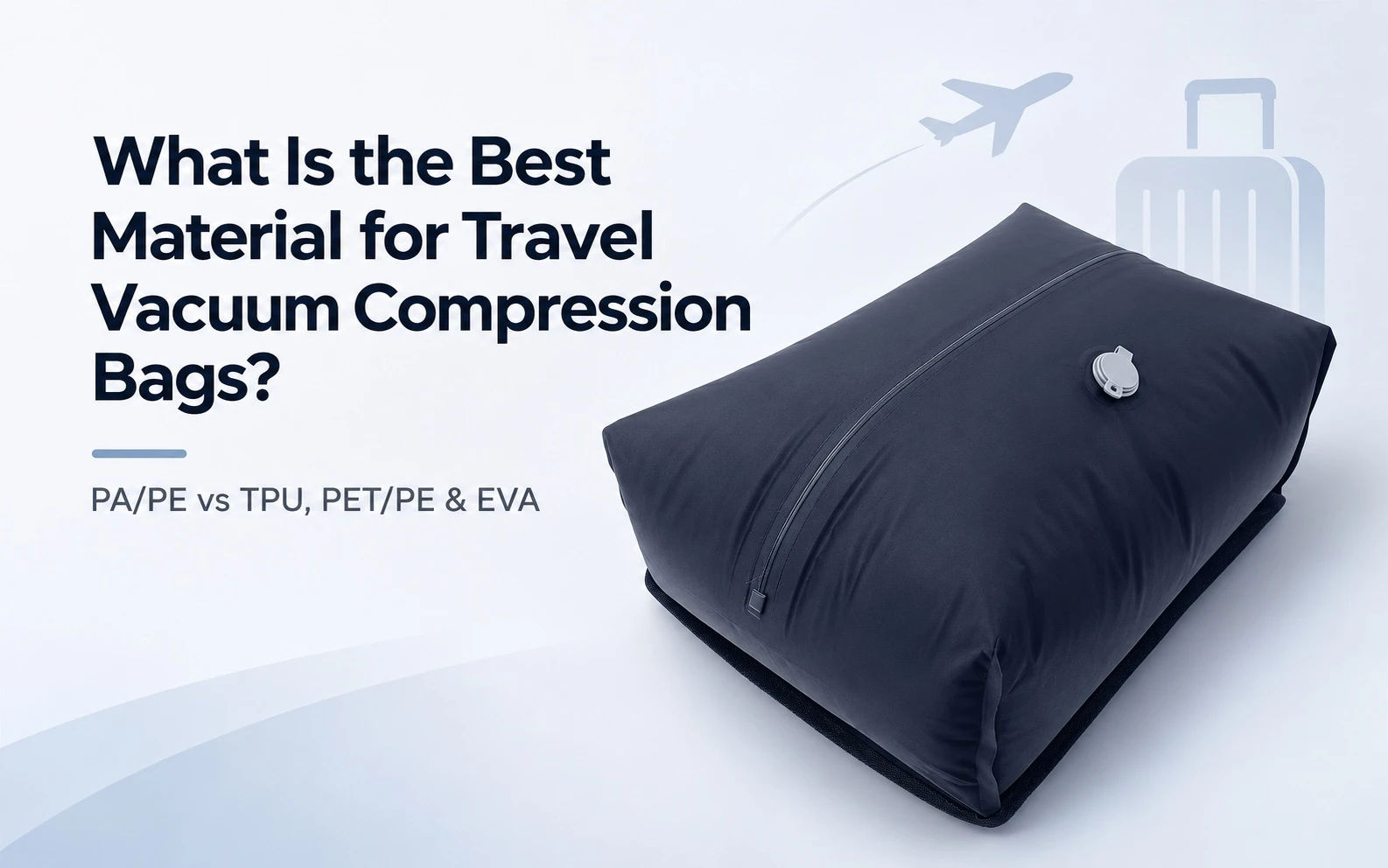
A travel vacuum compression bag is a re-sealable flexible pouch fitted with a one-way air valve or a roll-top closure. After loading clothing or bedding, the user removes internal air-either with a hand pump, an electric pump, or by rolling the bag from the bottom-until atmospheric pressure collapses the contents. The result is a dense, flat package that typically reduces volume by 50 to 75 percent for lofted items like down jackets and fleece.
The bag's performance is not a function of thickness alone. It depends on the multilayer film structure: which polymers are used, how they are combined, and how the seal is engineered. Two bags stamped "0.08 mm" can behave completely differently if one is made of a co-extruded PA/PE composite and the other of a single-layer PE film.
Which Materials Are Used in Travel Vacuum Compression Bags?
PA/PE Co-Extruded Multilayer Film
PA (polyamide, commonly called nylon) paired with PE (polyethylene) through co-extrusion is the dominant material in mid-to-high-end vacuum compression bags. In a co-extrusion process, multiple polymer layers are extruded through a single die simultaneously, fusing without adhesives. The PA layer provides tensile strength, puncture resistance, and an oxygen barrier; the PE layer provides flexibility, heat-seal reliability, and moisture resistance.
Travel-specific PA/PE vacuum storage bags typically use a five- or seven-layer structure (for example, PA/TIE/PA/TIE/PE/PE/PE, where TIE is a tie-layer adhesive that bonds dissimilar polymers). Total thickness commonly ranges from 60 to 100 micrometers (roughly 6 to 10 "si" in the Chinese industry unit, where 1 si = 0.01 mm). According to manufacturer technical data, PA/PE co-extruded films can achieve oxygen transmission rates below 2 cm³/m²·24h·0.1 MPa and puncture resistance of 35 N or higher-enough to shrug off contact with zipper teeth and gear hardware.
The defining advantage for travel use is low-temperature flexibility. PA/PE film remains pliable at temperatures down to approximately -40 °C, which matters when a bag rides in an unheated cargo hold or a winter pack. It does not turn brittle and crack the way some alternative materials do.
PET/PE Composite Film
PET (polyethylene terephthalate, the same polyester used in water bottles and fleece fabric) laminated with PE is the other common composite. PET offers high transparency, good stiffness, and respectable oxygen barrier properties. However, it is noticeably less flexible than PA and becomes rigid-and prone to cracking-at low temperatures.
From multiple product review and technical comparison sources, PET/PE bags tend to fail earlier in cold conditions. The film can split along fold lines after repeated compression cycles in winter use. PET/PE also generally shows lower puncture resistance than PA/PE in comparative testing, meaning sharp items packed inside are more likely to create pinhole leaks.
For travel applications where the bag may be compressed and decompressed repeatedly across a multi-week trip, PET/PE is a step down.
EVA (Ethylene-Vinyl Acetate)
EVA is a soft, rubbery copolymer sometimes used in budget travel compression bags and waterproof pouches. It is pleasant to the touch, highly flexible, and inexpensive. But EVA's oxygen and moisture barrier properties are inferior to both PA/PE and PET/PE composites. Under sustained vacuum, EVA bags tend to allow slow air re-infiltration, meaning the bag gradually re-inflates over days rather than holding its compressed state.
EVA finds its niche in roll-top waterproof dry bags where the goal is water exclusion, not sustained vacuum compression. For a travel vacuum compression bag expected to stay flat for the duration of a trip, EVA is not the right choice.
TPU (Thermoplastic Polyurethane)
TPU is a premium elastomer used in high-end outdoor gear-dry bags, phone pouches, inflatable sleeping pads. It offers excellent abrasion resistance, puncture resistance, and flexibility across a wide temperature range, and it is free of plasticizers that can migrate over time.
For TPU vacuum compression bags, the trade-off is cost. TPU film is significantly more expensive than PA/PE co-extruded film-often several times the price per square meter for comparable thickness. For a product whose primary job is holding air out of a clothing bundle, TPU's abrasion and elongation advantages are largely overspecified. TPU makes sense when the bag is also a structural element (for example, a dry bag that gets dragged across rocks), but for a compression bag that lives inside a suitcase or backpack, the performance-to-cost ratio does not justify it.
PA/PE vs PET/PE vs EVA vs TPU: Material Comparison
The table below summarizes the key performance differences across the four material families for travel vacuum compression bag applications.
Table 1. Travel Vacuum Compression Bag Material Comparison
|
Property |
PA/PE Co-extruded |
PET/PE Composite |
EVA |
TPU |
|
Puncture resistance |
High (≥35 N typical) |
Moderate |
Low–Moderate |
Very High |
|
Low-temp flexibility |
Good (to approx. -40 °C) |
Poor (brittle in cold) |
Good |
Excellent |
|
Oxygen barrier (OTR) |
Low (<2 cm³/m²·24h) |
Low–Moderate |
High (poor barrier) |
Moderate |
|
Seal reliability |
Excellent (heat-sealable PE layer) |
Good |
Moderate |
Good |
|
Reusability |
30–40+ cycles (quality grades) |
10–20 cycles |
5–15 cycles |
50+ cycles |
|
Relative cost |
Moderate |
Low–Moderate |
Low |
High |
|
Best fit for travel |
Yes-balanced performance |
Budget home storage |
Waterproof pouches, not vacuum |
Overspecified for compression |
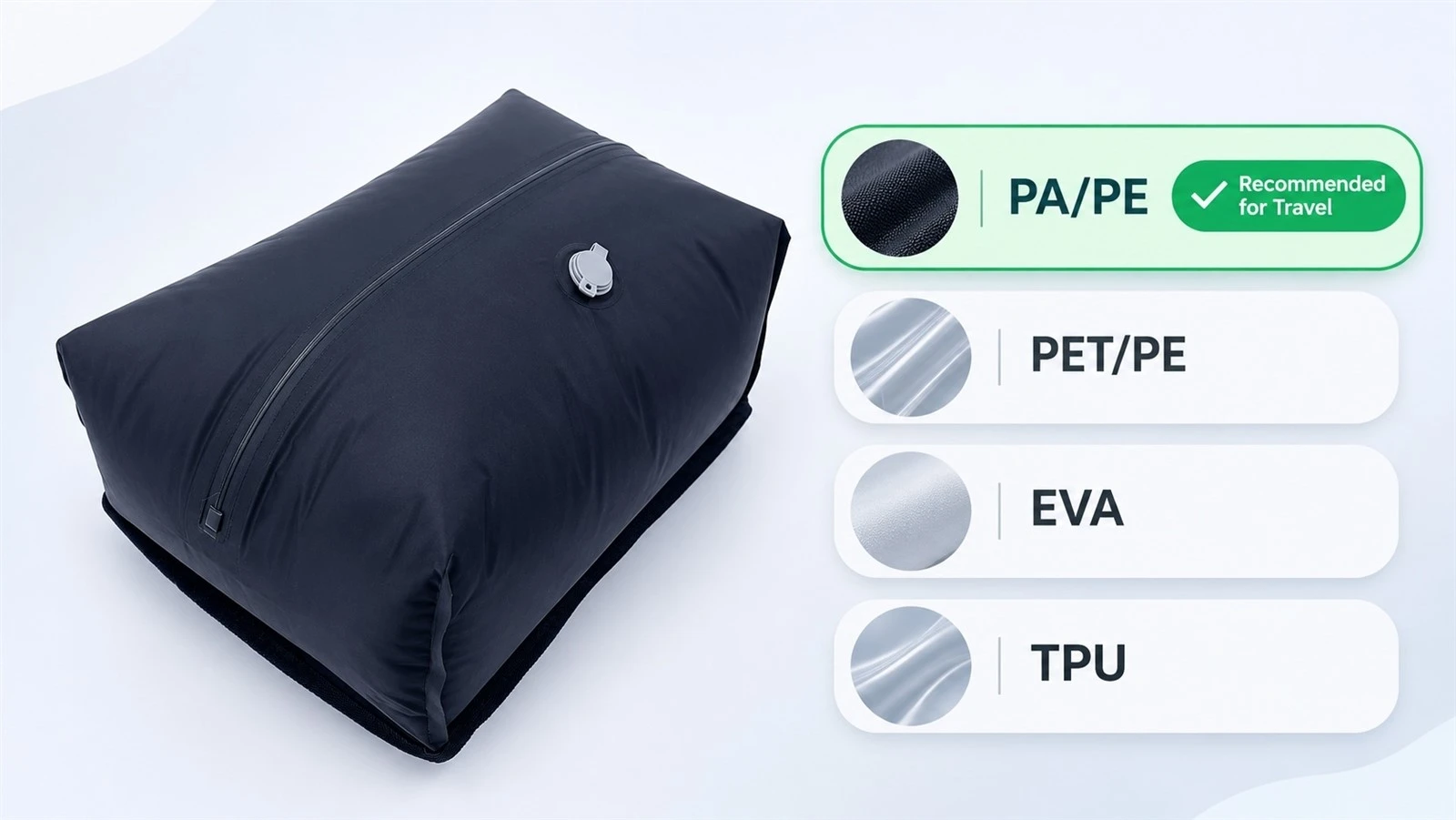
Why Is PA/PE the Best Material for Travel Vacuum Compression Bags?
The case for PA/PE co-extruded film rests on three properties that align directly with travel demands.
Puncture resistance under real packing conditions. Travel compression bags share luggage space with hard objects-buckles, tent pole segments, toiletry kits, electronics. The PA (nylon) layer's crystalline structure resists puncture forces that would perforate a single-layer PE or EVA film. Comparative testing referenced in multiple industry sources shows PA/PE films sustaining higher puncture loads than PET/PE equivalents, both before and after repeated flexing.
Sustained vacuum retention. A compression bag that slowly re-inflates defeats its purpose. PA/PE's low oxygen transmission rate-typically below 2 cm³/m²·24h·0.1 MPa for quality grades-means the bag holds its compressed state over the days or weeks of a trip. EVA and thin single-layer PE films cannot match this. One manufacturer's quality-grade PA/PE bag, tested over a 60-day period, showed an air leakage rate of approximately 1 percent-far better than the industry average for thinner or single-material alternatives.
Cold-weather resilience. Airlines do not heat cargo holds. Winter backpacking exposes gear to sub-zero temperatures. PET/PE film becomes rigid and crack-prone in these conditions. PA/PE remains flexible, so the bag survives being handled, repacked, and re-compressed in cold environments without developing micro-fractures along fold lines.
What Is the Best Thickness for Travel Vacuum Compression Bags?
A common misconception is that thicker film is always more durable. When evaluating vacuum compression bag material thickness, the relationship between thickness and durability is non-linear.
|
Thickness Range (single-side) |
Typical Behavior |
|
6–8 si (0.06–0.08 mm) |
Entry grade; may last one season of regular travel use |
|
9–12 si (0.09–0.12 mm) |
Balanced; good puncture resistance without excessive stiffness |
|
14–16 si (0.14–0.16 mm) |
Can become rigid; fold-line fatigue risk increases |
Beyond approximately 12 si (0.12 mm), added thickness makes the film harder to fold and seal cleanly, and the material's own rigidity can stress seal lines during compression. Some manufacturers misleadingly state combined double-wall thickness (for example, labeling a 9-si-per-side bag as "18 si"). Reputable products specify single-side thickness.
For travel bags, the sweet spot is typically 8 to 12 si (0.08–0.12 mm) in a PA/PE co-extruded structure. This range balances puncture resistance, flexibility, and pack weight.
Why Are Airtight Seals and Valves as Important as the Material?
Even the best film fails if the seal leaks. For airtight travel compression bags, two design elements are worth checking:
- Double-track zipper seals with a sliding clip create two parallel closure lines, providing redundancy if one track is compromised by dust or fabric fibers caught in the seal.
- One-way valve design determines how easily air can be removed and how reliably it stays out. Quality valves use a soft silicone flap that seals under back-pressure; cheaper designs rely on a simple plastic plug that can work loose during transit.
A PA/PE bag with a single-track seal and a plug valve will underperform a slightly thinner PA/PE bag with a double-track seal and a silicone-flap valve. Material and hardware must be evaluated together.
From a manufacturing perspective, reliable airtight performance depends on more than film specifications. Seam construction, sealing consistency, closure hardware, and appropriate air-leakage testing are also essential considerations when developing reusable vacuum compression bags.
Which Material and Thickness Should You Choose for Different Travel Needs?
Different travel scenarios place different demands on the bag. When selecting vacuum compression bags for luggage, backpacking, or outdoor gear storage, material and thickness should match the intended use. The table below maps common use cases to recommended material and thickness specifications.
Table 2. Material and Thickness Recommendations by Travel Scenario
|
Scenario |
Recommended Material |
Thickness (single-side) |
Key Requirement |
|
Airline checked luggage (clothing) |
PA/PE co-extruded |
8–10 si (0.08–0.10 mm) |
Volume reduction, cold-hold survival |
|
Backpacking / thru-hiking |
PA/PE co-extruded |
6–8 si (0.06–0.08 mm) |
Weight minimization, puncture resistance |
|
Winter gear transport (down jackets, sleeping bags) |
PA/PE co-extruded (7-layer) |
10–12 si (0.10–0.12 mm) |
Low-temp flexibility, sustained vacuum |
|
Long-term storage between trips |
PA/PE co-extruded |
10–12 si (0.10–0.12 mm) |
Multi-month vacuum retention |
|
Waterproof gear organization (no vacuum needed) |
EVA or TPU |
Varies |
Water exclusion, not compression |
Are Travel Vacuum Compression Bag Materials Safe and Recyclable?
PA/PE co-extruded films are free of adhesive solvents-the layers fuse during extrusion, so there is no residual solvent concern. Quality grades comply with food-contact safety standards such as FDA and EU regulations, which also covers the case where a traveler repurposes a compression bag for food storage on a backcountry trip.
On the end-of-life side, multilayer films are technically recyclable but practically difficult to separate into homogeneous polymer streams. Some manufacturers are exploring mono-material PE structures with EVOH (ethylene vinyl alcohol) barrier layers to improve recyclability while maintaining oxygen barrier performance. This is an emerging area, and the barrier properties of current mono-material alternatives do not yet match PA/PE composites at equivalent thickness.
For travelers and brands concerned about environmental footprint, the most impactful strategy is durability: a PA/PE bag that lasts 30–40 compression cycles replaces many single-use or short-life alternatives, reducing total material consumption over time.
FAQ
Is PA/PE Better Than TPU for Travel Vacuum Compression Bags?
For most lightweight travel vacuum compression bags, PA/PE co-extruded film offers a better balance of gas barrier performance, puncture resistance, flexibility, and cost.
TPU offers excellent abrasion resistance and flexibility, making it suitable for premium outdoor products that require additional durability. However, TPU's mechanical advantages do not automatically guarantee better vacuum retention. The final choice should depend on the bag's intended use, film structure, sealing system, and performance testing.
What Is the Best Thickness for Reusable Vacuum Compression Bags?
For reusable travel vacuum compression bags made from PA/PE co-extruded film, a single-side thickness of approximately 0.08–0.12 mm is generally a practical choice.
Thinner films reduce weight and packing volume, while thicker films can offer additional puncture resistance. However, excessive thickness may reduce flexibility and increase stress around folded areas and seals. Brands should evaluate thickness alongside material composition and expected reuse cycles.
Why Do Travel Vacuum Compression Bags Lose Their Vacuum?
Travel vacuum compression bags can gradually lose their compressed state because of punctures, damaged heat-sealed seams, improperly closed zipper tracks, or leaking one-way valves.
Even when the film has good gas barrier properties, weak seals or poorly designed valves can allow air to enter. This is why reliable vacuum retention depends on the complete airtight system rather than the material alone.
For brands developing custom airtight travel bags, testing the finished product is essential to identify potential leakage points before mass production.
Can Travel Vacuum Compression Bags Be Used for Airline Luggage and Backpacking?
Yes. Travel vacuum compression bags are commonly used to reduce the packed volume of clothing, jackets, and other compressible items in luggage and backpacks.
For airline checked luggage, PA/PE co-extruded film in the 0.08–0.10 mm range offers a practical balance of durability and space savings. For lightweight backpacking, thinner PA/PE films in the 0.06–0.08 mm range may help minimize weight.
However, travelers should protect compression bags from sharp equipment and remember that reducing clothing volume does not reduce its weight.
How Many Times Can a PA/PE Vacuum Compression Bag Be Reused?
Quality-grade PA/PE vacuum compression bags may withstand approximately 30–40 or more compression cycles, depending on material thickness, film construction, sealing quality, and usage conditions.
Repeated folding, overfilling, sharp objects, and improper valve handling can shorten their service life. For long-term performance, it is important to choose a durable multilayer film and a reliable sealing system.
Brands developing reusable vacuum compression bags should also evaluate repeated compression cycles, seam integrity, and vacuum retention during product testing.
Final Thoughts
The best material for travel vacuum compression bags is PA/PE co-extruded multilayer film, at a single-side thickness of 8 to 12 si (0.08–0.12 mm), paired with a double-track seal and a silicone-flap one-way valve. This combination delivers the puncture resistance, sustained vacuum retention, and cold-weather flexibility that travel demands-at a cost point that remains practical for both brands and consumers. PET/PE serves the budget home-storage segment. EVA belongs in waterproof pouches. TPU is excellent but overspecified for compression.
Ultimately, selecting the right material is only part of developing a reliable travel compression bag. Film construction, seam integrity, valve design, and appropriate product testing all contribute to long-term performance.
At FENGLINWAN, we specialize in OEM/ODM manufacturing of outdoor waterproof and functional bags, with experience in TPU/PVC materials, HF welding, airtight construction, and custom product development. If your brand is exploring custom travel vacuum compression bags or related airtight travel gear, contact FENGLINWAN to discuss your project requirements, material options, and product development needs.