

2026 Waterproof Bag Design Trends in Europe
Sep 16, 2026
Leave a message
European waterproof bag design in 2026 is becoming more refined, more adaptable, and more technically demanding. Outdoor-grade protection is moving into commuter, cycling, travel, and everyday products, while materials and silhouettes are taking on a cleaner urban character. Sustainability, ergonomic comfort, verified waterproof performance, and better moisture management are now shaping product development together. For brands planning their next collection, the strongest opportunities sit where technical construction and everyday usability meet.

1. What Is Shaping Waterproof Bag Design in Europe in 2026?
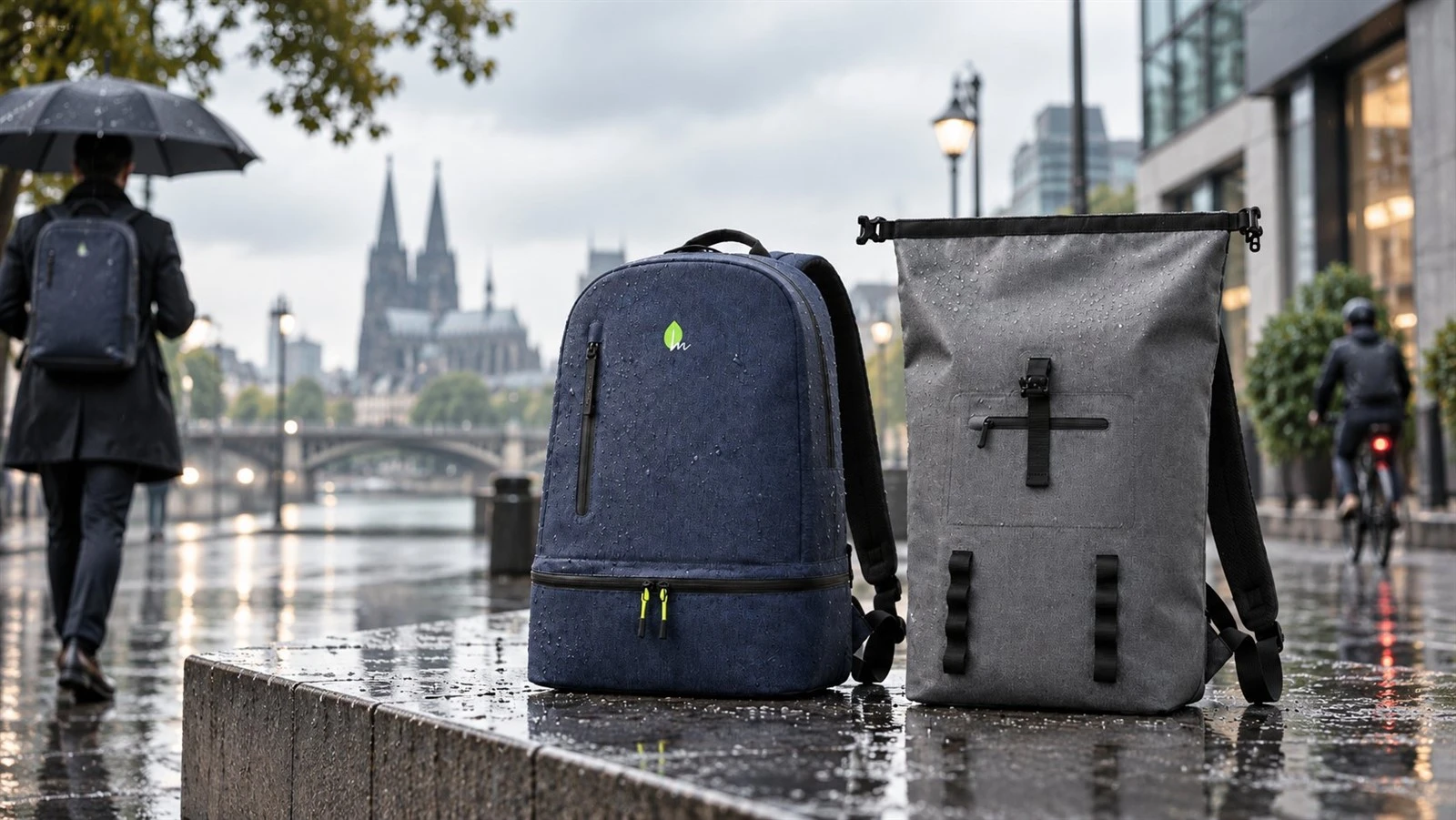
The defining shift in European waterproof bag trends is the rise of the urban-outdoor hybrid: a bag designed to move between daily commuting, cycling, travel, and outdoor use without looking like specialized expedition equipment.
This explains why many of the most relevant 2026 trends appear together. Matte surfaces work with office clothing. Welded construction keeps the technical credibility. Laptop protection and internal organization make the same bag useful on a weekday. A roll-top or water-protected zipper extends that use into cycling, hiking, or a wet weekend trip.
The categories themselves are becoming more fluid. Multi-scenario use is increasingly influencing the way European brands think about materials, capacity, organization, closures, and styling.
Four design directions are emerging
|
Segment |
Typical use |
Design priorities |
|
Urban commuter |
Office, cycling, public transport |
Clean silhouette, laptop storage, quick access, weather protection |
|
Outdoor-hybrid |
Hiking, weekend travel, bikepacking |
Lightweight construction, modular storage, flexible capacity |
|
Watersports / technical outdoor |
Kayaking, sailing, SUP, fishing |
Welded seams, secure closure, higher waterproof performance |
|
Professional / rescue |
Rescue, transport, expedition |
Airtight or watertight structure, durability, visibility, testable performance |
This segmentation matters. A muted commuter backpack and a fluorescent rescue dry bag can both be completely relevant in 2026. They are simply solving different problems.
2. Sustainable Materials Are Becoming an Engineering Decision
Sustainable waterproof bag materials are moving deeper into product development. Recycled content, fluorocarbon-free water-repellent treatments, bio-based inputs, material traceability, and product longevity now affect sourcing decisions much earlier in a project.
One 2026 trend analysis cited a 42% year-over-year increase in recycled PVC and ocean-bound plastics, alongside stronger interest in PFC-free water-repellent treatments. Other industry material discussions point toward recycled fabrics and bio-based inputs derived from sources including corn, mushroom-based materials, and pineapple by-products.
For waterproof bags, however, material sustainability has to work with manufacturing reality.
A new coating or bio-based formulation may behave differently during heat sealing or high-frequency welding. Welding temperature, dwell time, coating thickness, textile weight, and cooling behavior can all change. Material substitution therefore has to be validated through sampling and process adjustment before it reaches mass production. This becomes particularly important for airtight or heavily welded products.
TPU vs. matte PU/nylon vs. emerging bio-based materials
TPU waterproof material, or thermoplastic polyurethane, remains a strong choice for high-performance welded waterproof bags. It is flexible, suitable for HF welding, and commonly used where seam sealing and airtight construction are important. A lightweight waterproof TPU backpack is a good example of how this material direction can support lower weight while retaining technical waterproof construction.
Matte PU-coated nylon or polyester fits the urban waterproof backpack category well. It can produce a softer textile appearance, lower visual gloss, and a more fashion-oriented hand feel.
Recycled and bio-based alternatives will continue to expand, but performance testing is essential. Waterproofness, weldability, abrasion resistance, dimensional stability, and processing tolerance all matter.
The 2026 material trend is therefore diversification. European brands are choosing materials according to use case, appearance, environmental goals, and manufacturing method instead of relying on one universal waterproof fabric.
3. Minimalist "Quiet Utility" Is Shaping the New Waterproof Aesthetic
One of the strongest visual directions is quiet utility: a clean exterior with a highly functional internal system.
Visible webbing, oversized external attachments, and heavily tactical styling are being reduced in many urban products. In their place are concealed passport pockets, fleece-lined device sleeves, protected wet-item storage, hidden zippers, welded details, and subtler branding.
Waterproof materials are changing with the aesthetic. Smooth matte PU, engineered waterproof nylon, low-gloss coatings, and softer technical fabrics can make a bag feel much closer to a modern commuter or fashion accessory than a traditional dry bag.
That shift also affects silhouette.
Crescent shapes, compact pouches, slouchier under-arm bags, and elongated east-west profiles are influencing weather-resistant urban products. These shapes are especially relevant to lifestyle and commuter collections, where waterproof technology increasingly borrows visual language from European fashion.
Color follows the same direction. Chocolate brown, tobacco, burgundy, muted slate, olive, charcoal, and other earthy neutrals work well with understated urban styling.
High-visibility colors still have an important role in marine, rescue, cycling, and professional outdoor equipment. In those categories, orange, lime, yellow, and reflective details serve a functional purpose.
So the useful 2026 color strategy is increasingly use-case driven: restrained tones for urban integration, functional contrast where visibility matters.
4. Waterproof Performance Is Moving From Claims to Engineering
A waterproof bag is a system made up of its material, seams, closure, construction, and testing method.
That distinction is becoming more important as European buyers ask for clearer specifications and more transparent test information. The relationship between coated materials, welded seams, zipper interfaces, and final testing determines whether a design can achieve repeatable performance. Our guide to how waterproof bags are made explains these construction elements in more detail.
HF welding, or high-frequency welding, bonds compatible coated materials using electromagnetic energy rather than a conventional sewn seam. It is particularly useful where needle holes would create an unnecessary leakage risk. Thermal bonding and heat sealing are used for similar reasons in suitable constructions.
One B2B manufacturing reference reported roughly 40% higher structural integrity for its seamless welded construction compared with a traditional stitched-and-taped construction. The exact result depends heavily on material and test method, but the example illustrates why welded panel joints remain important in high-performance waterproof products.
Closure design deserves the same attention. Water-protected zippers, watertight zippers, storm flaps, roll-tops, and sealed zipper interfaces solve different levels of exposure.
Match the waterproof level to the use case
The distinction between waterproof, water-resistant, and moisture-proof becomes especially important when setting product specifications.
|
Protection level |
Typical application |
Common construction approach |
|
Water-resistant / weatherproof |
Daily commute, light rain |
Coated fabric, protected zipper, seam management |
|
Technical waterproof |
Cycling, travel, heavy rain, hiking |
Welded/sealed seams, stronger closure protection |
|
Watertight / submersible |
Watersports, marine, professional use |
Welded shell, watertight or airtight closure, controlled testing |
For IPX7, the commonly referenced condition is temporary immersion up to 1 metre for 30 minutes. IPX8 applies beyond the IPX7 immersion condition, but the actual depth and duration need to be specified by the manufacturer or test method. These classifications come from the IEC 60529 IP Code, so test conditions are just as important as the rating itself when a B2B buyer is comparing specifications.
Roll-top vs. waterproof zipper
A roll-top waterproof backpack remains highly relevant because the closure provides a simple sealing system, flexible capacity, and a recognizable technical identity. It works particularly well in watersports, bikepacking, and outdoor applications.
Waterproof or watertight zippers offer faster access and a cleaner structured opening. That makes them attractive for commuter bags, camera bags, professional gear, and premium urban products.
The two solutions are increasingly serving different design priorities rather than following a simple "old versus new" progression.
5. Multi-Scenario Design Is Changing Internal Organization
As waterproof bags move between office, travel, cycling, and outdoor use, internal architecture becomes more important.
A multi-scenario waterproof bag is designed around more than one use environment, with storage that can adapt without turning the product into an oversized organizer.
For many commuter and weekend products, a 20–30L capacity range has emerged as a useful reference point. This size can transition comfortably between laptop carry, cycling, short travel, and lighter outdoor use.
Capacity alone is less interesting than what happens inside it.
One of the more useful design ideas is compartment-level waterproofing. Instead of depending entirely on one outer shell, a product can use independently protected areas for electronics, documents, or wet equipment.
That solves problems that rain protection by itself does not address:
- condensation from cold bottles or changing temperatures;
- a wet umbrella or rain jacket placed inside the bag;
- perspiration entering through the back panel area;
- liquid leaking from an exterior bottle or coffee pocket;
- separation of wet outdoor equipment from electronics.
This points toward a broader design direction: moisture management.
For a modern waterproof commuter backpack, keeping rain outside is only part of the job. The internal movement of moisture matters too.
Modular pockets, removable organizers, adjustable dividers, expandable capacity, and detachable accessories can extend the same base product across more scenarios without adding unnecessary bulk.
6. Ergonomics Is Becoming Part of Waterproof Performance
A waterproof backpack used for cycling or all-day commuting also needs to manage heat, load, and movement.
Current design directions increasingly include 3D mesh back panels, air-cell shoulder structures, ventilation zones, and improved load distribution. Arc-shaped back structures and honeycomb ventilation, once associated mainly with load-bearing outdoor packs, are also moving into premium commuter products.
These features solve a particular problem for waterproof products. Coated fabrics and rain shells can trap heat against the body, especially when the user is already wearing waterproof outerwear.
Good ergonomic design therefore considers:
- shoulder strap geometry;
- ventilation between the bag and the back;
- stable load distribution during cycling or walking;
- reduced pressure points;
- actual load limits.
One professional-grade example uses an 18 kg load-capacity test. The figure should be treated as a product-specific benchmark rather than a universal requirement, but it shows how comfort claims can be connected to measurable product specifications.
AI-assisted fit and weight sensors are also being explored. For 2026, they remain more experimental than ventilated back structures and ergonomic load distribution.
7. Smart Features Are Becoming More Invisible
Smart waterproof bags are becoming more practical when the technology stays in the background.
Current product development includes RFID protection, GPS or Bluetooth tracking, wireless charging, weight sensing, and other integrated functions.
The most convincing applications are currently the least intrusive:
- an RFID-blocking compartment, which reduces unauthorized reading of compatible contactless cards or documents;
- a protected pocket for a Bluetooth or location tracker;
- concealed cable routing and power-bank organization;
- sealed housings for electronic modules in higher-end products.
Built-in wireless charging, load sensors, and AI-assisted fit have more complexity. Electronics create additional sealing points, affect repairability, and may introduce CE, electromagnetic compatibility, RoHS, battery, or other compliance considerations depending on the final product.
For a technical bag, the feature has to justify the engineering around it.
8. What These Trends Mean for Brands Developing Waterproof Bags
For a brand, the useful part of a trend is how easily it can be converted into a repeatable product specification.
A matte commuter backpack, a welded roll-top, and a submersible equipment bag may share visual language, yet their materials, zipper requirements, testing processes, and production methods can be very different.
A practical 2026 product-development checklist
- Define the use case. Decide whether the primary scenario is commuting, cycling, hiking, watersports, travel, or professional use.
- Set the waterproof target. Specify rain protection, technical waterproofing, watertight performance, or immersion requirements.
- Select the material system. Balance appearance, weight, welding or sewing requirements, abrasion resistance, and sustainability goals.
- Choose the closure and seam construction. Roll-top, protected zipper, watertight zipper, stitched seam, taped seam, or welded structure all create different outcomes.
- Plan internal moisture management. Consider laptop protection, wet/dry separation, condensation, and spill containment.
- Engineer carrying comfort. Define ventilation, strap geometry, back-panel structure, and realistic load capacity.
- Prototype and test. New materials and waterproof structures need physical validation before bulk production.
- Prepare documentation. European buyers increasingly value test reports, material traceability, REACH-related documentation, and applicable compliance records.
- Design for scalable production. Standardized shells, closure systems, and interchangeable organization modules can shorten development cycles and support multiple SKUs.
Rapid sampling, in some programs within seven days, and modular manufacturing platforms are also becoming useful responses to shorter seasonal development cycles.
This is where manufacturer capability becomes part of product design. A capable waterproof bag manufacturer needs to connect material selection, prototyping, seam construction, testing, and scalable production within the same development process.
FENGLINWAN's current manufacturing system covers traditional sewing, TPU/PVC waterproof materials, HF welding, heat-sealed construction, roll-top and airtight/watertight structures, along with air-leakage and water-leakage testing. Its development process also includes patterns, HF molds, sampling, BOM/specification setup, and quality control through mass production.
What Will Define a Successful Waterproof Bag in 2026?
The strongest waterproof bag designs in Europe in 2026 combine a cleaner visual language with credible technical performance. Matte and lower-impact materials are expanding, urban and outdoor categories are converging, internal moisture management is becoming more sophisticated, and brands are paying closer attention to ergonomics, testing, traceability, and manufacturing feasibility.
The result is a more mature category: products that look appropriate in the city, perform in wet conditions, and are engineered for the way people actually carry them.
FENGLINWAN develops OEM and ODM waterproof and functional bags for outdoor, sports, commuter, and specialist brands. If you are planning a new waterproof bag collection, contact us to discuss materials, construction, prototyping, waterproof testing, and production options for your project.