


How to Choose Buckles for Custom Bags: Plastic, Metal & Branded Options
Sep 16, 2026
Leave a message
A buckle affects far more than how a bag opens and closes. It influences weight, adjustment, load control, durability, appearance, and the way the product feels in daily use. For custom bags, buckle selection should happen alongside webbing, fabrics, construction, and target use-not after the main design is finished.
The right choice depends on what the buckle needs to do. Plastic, metal, branded, and fully customized options each suit different performance, cost, and branding requirements.
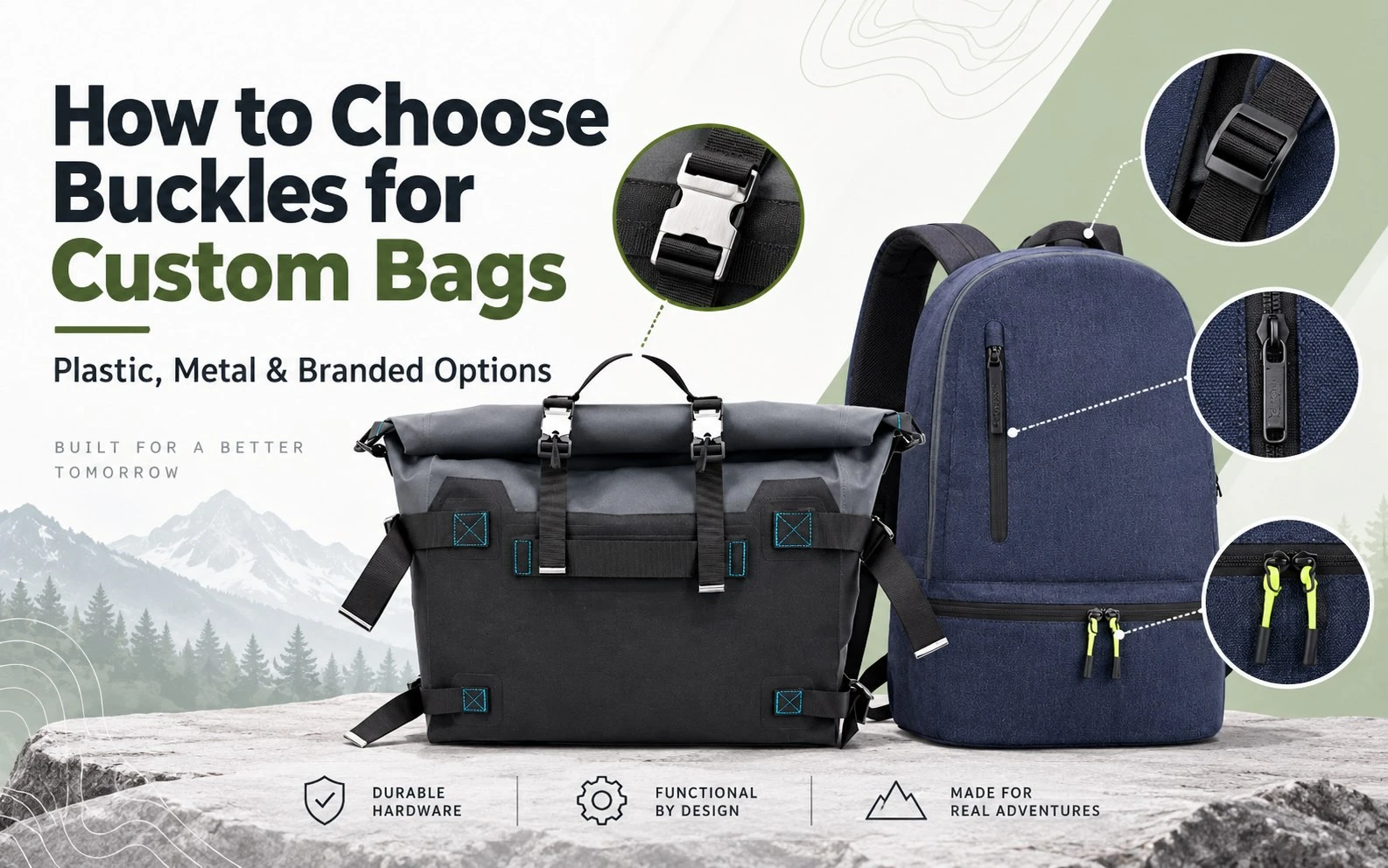
Why Buckle Selection Matters in Custom Bag Design
A bag buckle is a fastening or adjustment component used to connect, release, secure, or tension webbing and straps. Depending on its position, it may function as a roll-top closure, sternum-strap fastener, compression-strap adjuster, shoulder-strap hardware, or main opening mechanism.
That makes the buckle part of the bag's structural system rather than a purely decorative accessory.
Strong webbing does not automatically create a strong strap assembly. If the buckle deforms, releases unexpectedly, or allows the webbing to slip, it can become the limiting component. The opposite is also true: specifying an expensive high-strength buckle will not solve a weak stitching pattern or poorly designed attachment point.
The buckle also has a direct effect on user experience. A commuter may operate the same buckle several times every day. A roll-top waterproof backpack may require the user to release and reconnect the closure every time the bag is opened. Opening force, adjustment smoothness, tactile feedback, and buckle weight all become noticeable over time.
For this reason, buckles for custom bags should be selected as part of the complete webbing, hardware, and construction system.
Plastic vs. Metal Buckles: What Are the Real Differences?
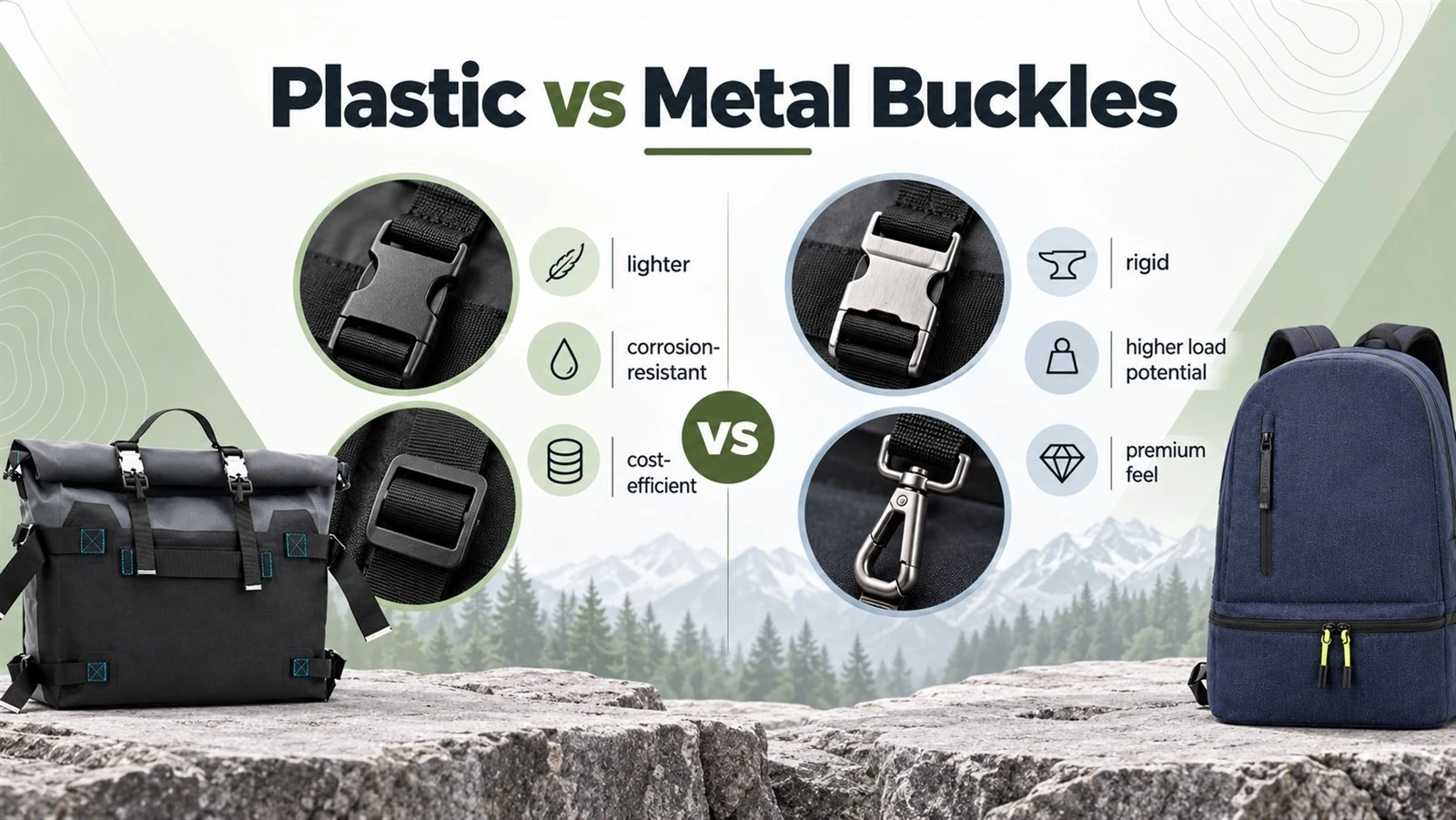
Plastic vs. metal buckles is the most common starting point, but material alone does not determine performance.
Plastic buckles are usually chosen when low weight, corrosion resistance, cost efficiency, and easy operation are priorities. Metal buckles generally provide greater rigidity, higher load potential, and a more substantial feel. They can also contribute strongly to the visual positioning of a premium or technical bag.
|
Factor |
Plastic Buckles |
Metal Buckles |
|
Weight |
Usually lighter |
Usually heavier |
|
Cost |
Generally lower |
Generally higher |
|
Rigidity |
Depends on resin and design |
Generally higher |
|
Load potential |
Suitable for many normal bag applications |
Better suited to many high-load applications |
|
Corrosion |
Does not rust |
Depends on alloy and surface treatment |
|
Color options |
Flexible through molding and material color |
Usually achieved through anodizing, plating, coating, or finishing |
|
User feel |
Lightweight and technical |
Solid and often more premium |
|
Typical applications |
Backpacks, outdoor bags, sports bags, everyday carry |
Premium bags, technical equipment, heavy-duty applications |
Some reference materials place standard plastic buckles in roughly the 10–25 kgf range and heavier-duty metal hardware at 50–100+ kgf. These are broad reference ranges rather than design limits. Actual load capacity depends on buckle size, geometry, material grade, locking mechanism, and the test method used.
A well-designed engineering-plastic buckle can outperform a poorly designed metal buckle in a specific bag application.
Common Plastic Buckle Materials: POM, Nylon and PP
"Plastic buckle" is not a complete material specification. Different polymers behave differently under load, impact, repeated cycling, and temperature changes.
|
Plastic Material |
Main Characteristics |
Typical Selection Reason |
|
POM / Acetal |
High stiffness, low friction, good dimensional stability |
Precise operation and consistent engagement |
|
Nylon / PA |
Good toughness, fatigue resistance, and impact performance |
Outdoor and technical applications requiring resilience |
|
Polypropylene / PP |
Economical, flexible, good chemical resistance |
Cost-sensitive and relatively light-duty products |
POM, or polyoxymethylene, is an engineering plastic suited to mechanisms that need stiffness and dimensional accuracy. These properties help explain why POM is commonly considered for components that need precise, repeatable movement. Technical information on POM / acetal material properties can also help buyers understand why material grade matters in mechanical hardware.
Nylon, including PA grades such as PA66, is generally selected when toughness and fatigue resistance matter. It can be a good option for technical backpacks and equipment exposed to repeated movement.
PP is more economical and flexible. It can make sense for promotional bags, basic daypacks, or products where cost matters more than demanding load performance.
Plastic does not rust, which is valuable for outdoor and waterproof bags. However, UV exposure, temperature extremes, resin grade, and long-term loading still need consideration. Some plastics become more brittle in very cold conditions, so products intended for demanding climates should be validated with the actual buckle specification.
Common Metal Buckle Materials: Aluminum, Stainless Steel, Zinc Alloy and Brass
Metal buckles also vary significantly by material.
Aluminum offers a useful strength-to-weight ratio and is especially attractive for premium outdoor and technical bags. Anodizing can provide durable color and a clean technical appearance without making the hardware unnecessarily heavy.
Stainless steel is selected when rigidity, durability, and corrosion resistance are important. It is especially relevant to wet, marine-oriented, or demanding outdoor applications, although the exact stainless grade still matters.
Zinc alloy, often used in die-cast hardware, allows more decorative shapes and detailed surface finishes at a relatively accessible cost. It is common where visual appearance matters as much as structural performance.
Brass has a warmer, traditional look and develops a distinctive patina. It is more relevant to heritage, leather, and lifestyle designs than to lightweight waterproof equipment.
The useful distinction is therefore not simply plastic versus metal. It is which material, in which buckle design, for which load and environment.
Common Bag Buckle Types and Where to Use Them
Material selection answers only part of the problem. The buckle mechanism must also match its function on the bag.
Quick-Release Closures
A side-release buckle uses flexible locking arms that engage with a receiving body and can be released by squeezing the sides. It is one of the most common backpack buckles because it is simple, fast, and suitable for repeated opening and closing.
Typical uses include roll-top closures, sternum straps, compression straps, and flap systems. On products such as a large roll top waterproof duffel bag, closure hardware needs to work smoothly while remaining compatible with the roll-top construction and webbing.
A magnetic quick-release buckle combines mechanical locking with magnetic assistance. Its main advantage is usually faster, more intuitive operation rather than simply higher strength. This makes it attractive for cycling bags, commuter products, and premium designs where one-handed operation matters.
Strap Adjustment Hardware
Ladder locks and webbing adjusters control strap length by routing the webbing through a shaped frame. Their performance depends heavily on the relationship between buckle geometry and the webbing itself.
For shoulder straps or compression systems, buyers should pay attention to adjustment force and webbing slippage. A buckle that is too loose may creep under load. One that grips too aggressively can make adjustment frustrating.
Cam buckles use a moving clamping element to lock the webbing. They are useful when fast adjustment and secure webbing retention are priorities.
Hooks and Specialty Hardware
G-hooks and hook-style buckles are common in technical, outdoor, and minimalist commuter bags. They can create a low-profile appearance and avoid the bulk of a conventional side-release buckle.
A single bag may use several buckle types. The main closure, shoulder adjustment, compression straps, and accessory attachment points do not have the same job, so they should not automatically use the same hardware.
Branded, Generic or Custom-Branded Buckles?
"Branded buckle" can mean two different things in custom bag development.
A supplier-branded buckle is a standard buckle produced by an established hardware manufacturer and specified by brand and model. A custom-branded buckle is hardware modified or developed to carry the bag brand's own logo, color, finish, or geometry.
Those options involve different levels of cost, risk, and differentiation.
Specified Branded Buckles
A customer may specify a particular buckle supplier because the mechanism, material, dimensions, or operating feel are already established in the product specification.
This approach can be useful when consistency matters across several products or production seasons. It can also reduce development uncertainty because the hardware already exists as a mature component.
The trade-off is that the buyer has less visual exclusivity and may be more exposed to supplier lead times or availability.
Custom Branding on Standard Buckles
A standard buckle can often be customized without redesigning the entire mechanism.
Common approaches include laser engraving, molded logos, embossed or debossed branding, pad printing, custom colors, and specialized finishes such as matte black, gunmetal, or brushed nickel.
This is often the most efficient choice for brands that want stronger product identity without assuming the cost and development risk of completely new hardware.
Hardware should also be considered as a visual system. Buckles, zipper pullers, D-rings, hooks, rivets, and logo plates should use compatible finishes. A premium bag can lose visual consistency quickly when every hardware component has a slightly different black, gloss level, or metal tone.
Fully Custom and Hybrid Buckle Development
A fully custom buckle uses new geometry, tooling, or even a proprietary mechanism. This gives the brand more control over product identity, but requires more investment in engineering, molds, prototypes, and validation.
Reference ranges for complex custom buckle programs can reach approximately US$3,000–15,000+ in tooling, with MOQs around 3,000–10,000 units and a possible 15–40% unit-cost premium over standard hardware. These figures are indicative rather than universal. Actual costs depend on material, complexity, supplier, and production volume.
Buckle customization should therefore be considered alongside other custom bag cost factors, especially when new tooling, custom finishes, or dedicated components are involved.
A hybrid approach reduces that commitment. A brand may keep a proven functional mechanism while customizing only the visible face, shackle, color, or surface treatment.
For many bag programs, that is the better commercial balance between reliability and differentiation.
How to Choose the Right Buckle for Different Bag Applications
The same buckle specification does not suit every product category. Application should narrow the options before appearance or supplier preference does.
Outdoor and Waterproof Bags
For waterproof bags, dry bags, cycling bags, and technical outdoor backpacks, moisture exposure is a major factor. Plastic hardware has a natural advantage because it does not rust. Aluminum can provide a more premium technical feel while keeping weight under control, while appropriately specified stainless steel may suit applications where metal hardware and stronger corrosion resistance are required.
Other conditions also matter: UV exposure, saltwater, mud, temperature changes, repeated opening, and impact.
A waterproof bag does not automatically require a plastic buckle. It requires a buckle whose material and construction fit the actual environment.
Travel, Commuter and Everyday Backpacks
These products usually place more emphasis on comfort, smooth adjustment, repeated use, appearance, and weight than on extreme load ratings.
Engineering-plastic side-release buckles and adjusters are therefore common solutions. A premium waterproof commuter backpack may use aluminum or other metal hardware to create a more substantial tactile experience even when the load requirement does not demand metal.
The best option is the one that fits how often the customer touches and adjusts the hardware.
Premium, Technical and Heavy-Duty Bags
For premium or heavy-duty products, hardware can become part of the product's identity.
Metal components may provide greater rigidity and a more deliberate mechanical feel. Custom finishes or branded components can reinforce the visual language of a technical or premium collection.
Where the buckle is genuinely load-bearing, static load alone is not enough. Dynamic shock loading, repeated cycles, and the strength of the attachment construction need to be considered as well.
Match the Buckle with Webbing-and Test the Complete System
A buckle specification is incomplete without the webbing.
The buckle's nominal size must match the webbing width, but width is only the first check. Webbing thickness, stiffness, surface texture, and weave can all affect adjustment force and slippage.
Two webbings with the same nominal width may behave differently in the same adjuster.
For performance-critical custom bags, testing should therefore focus on the assembled system rather than the buckle alone. Depending on the product, relevant checks can include tensile or pull strength, repeated opening and closing, webbing slippage, impact behavior, temperature exposure, UV resistance, abrasion, and corrosion or salt-spray resistance for metal components.
Physical samples also matter. Datasheets cannot fully communicate opening force, sound, hand feel, surface quality, or how smoothly the webbing runs through an adjuster.
The correct development sequence is to select a candidate buckle, pair it with the actual production webbing and attachment construction, then validate the assembly under conditions relevant to the finished bag.
What Should You Specify to Your Custom Bag Manufacturer?
Clear buckle specifications make sampling faster and reduce last-minute hardware changes.
A useful RFQ or development brief should identify:
- buckle type and position on the bag;
- intended function and expected load;
- webbing dimensions and construction;
- preferred plastic or metal material;
- operating environment, including moisture, UV, temperature, or salt exposure;
- color and surface finish;
- branded, non-branded, or custom-logo requirement;
- target order volume, MOQ limitations, and cost target;
- any required pull, cycle, corrosion, or other acceptance tests.
If the project is still at an early stage, reviewing the full custom bag project process can help clarify when hardware, fabrics, dimensions, samples, and testing should be confirmed.
For quoting, manufacturers also need more than a photo or a general concept. Providing complete information for an accurate custom bag quote helps prevent later price changes caused by unspecified buckles, webbing, finishes, or testing requirements.
The sample stage should then confirm appearance, opening and closing feel, color consistency, webbing compatibility, adjustment performance, and the way the hardware integrates with the finished bag.
This is especially important when switching from standard hardware to custom bag buckles. A small change in geometry, finish, or webbing can affect both function and production.
FAQ
Are Metal Buckles Stronger Than Plastic Buckles?
Metal buckles generally offer greater rigidity and higher load potential, but material alone does not determine strength. Buckle size, geometry, alloy or resin grade, locking mechanism, and test method all affect the result.
For normal backpacks and many outdoor bags, a properly specified engineering-plastic buckle can provide more than enough performance. Metal becomes more relevant when higher loads, rigidity, premium tactility, or a particular design language are required.
What Is the Best Plastic for Backpack Buckles?
There is no single best plastic for every backpack buckle.
POM is well suited to applications where stiffness, low friction, and dimensional stability are important. Nylon is attractive where toughness and fatigue resistance matter. PP is more appropriate for economical or lighter-duty products.
The application should determine the resin, not the other way around.
Are Plastic Buckles Suitable for Waterproof and Outdoor Bags?
Yes. Plastic buckles are widely suited to outdoor applications because they are lightweight and do not rust.
They still need to be selected for the actual environment. UV exposure, cold temperatures, impact, load, and repeated operation can affect long-term performance, so demanding applications should use an appropriate engineering resin and validated buckle design.
Should I Use a Branded Buckle for My Custom Bag?
A specified branded buckle makes sense when the product requires an established mechanism, consistent performance, a customer-mandated component, or continuity across a product range.
A good non-branded buckle can be appropriate when the required performance can be validated and cost control is more important than supplier branding.
For premium programs, the decision often depends on consistency, user feel, supply reliability, and product positioning rather than the logo on the buckle itself.
Can Buckles Be Customized with a Logo?
Yes. Common options include laser engraving, molded logos, embossing or debossing, printing, and custom colors or finishes.
A new mold is not always necessary. Many brands can achieve a distinctive result by customizing a standard buckle. Fully custom tooling makes more sense when unique geometry or a proprietary mechanism is part of the product strategy.
Choosing the Right Buckle for Your Custom Bag
Choosing buckles for custom bags comes down to matching the hardware to the product. Plastic is usually the practical choice for lightweight, corrosion-resistant, cost-efficient designs. Metal is better suited to applications that need greater rigidity, higher load potential, or a more substantial premium feel. Branded and custom options add another layer: consistency, differentiation, MOQ, tooling, and supply-chain planning.
The final decision should consider the buckle together with the webbing, attachment construction, environment, user experience, target cost, and production volume.
Dongguan Fenglinwan Leisure Products Co., Ltd. develops OEM/ODM outdoor waterproof and functional bags and supports customers through material and accessory selection, sampling, engineering, testing, and mass production. If you are looking for an experienced custom bag manufacturer to develop a backpack, waterproof bag, duffel, or other functional bag with plastic, metal, branded, or customized hardware, contact FENGLINWAN to discuss your product requirements and sample development.