


Laptop Sleeves vs. Laptop Cases: What’s the Difference?
Nov 03, 2026
Leave a message
If you have ever stood in the accessories aisle-or scrolled through an endless product catalog-trying to decide between a laptop sleeve and a laptop case, you are not alone. The two terms are sometimes used interchangeably across e-commerce listings, manufacturer specifications, and retail packaging, yet they generally describe different approaches to laptop protection and carrying.
Understanding the difference matters before you buy. It affects how your laptop is protected in transit, how much bulk you carry, how easily the product fits inside another bag, and whether you have enough room for chargers, cables, documents, and other accessories.
This guide explains the key differences in the laptop sleeve vs. laptop case comparison, looks at protection, portability, storage, and construction, and helps you decide which option better fits the way you actually carry your device.

What Is a Laptop Sleeve?
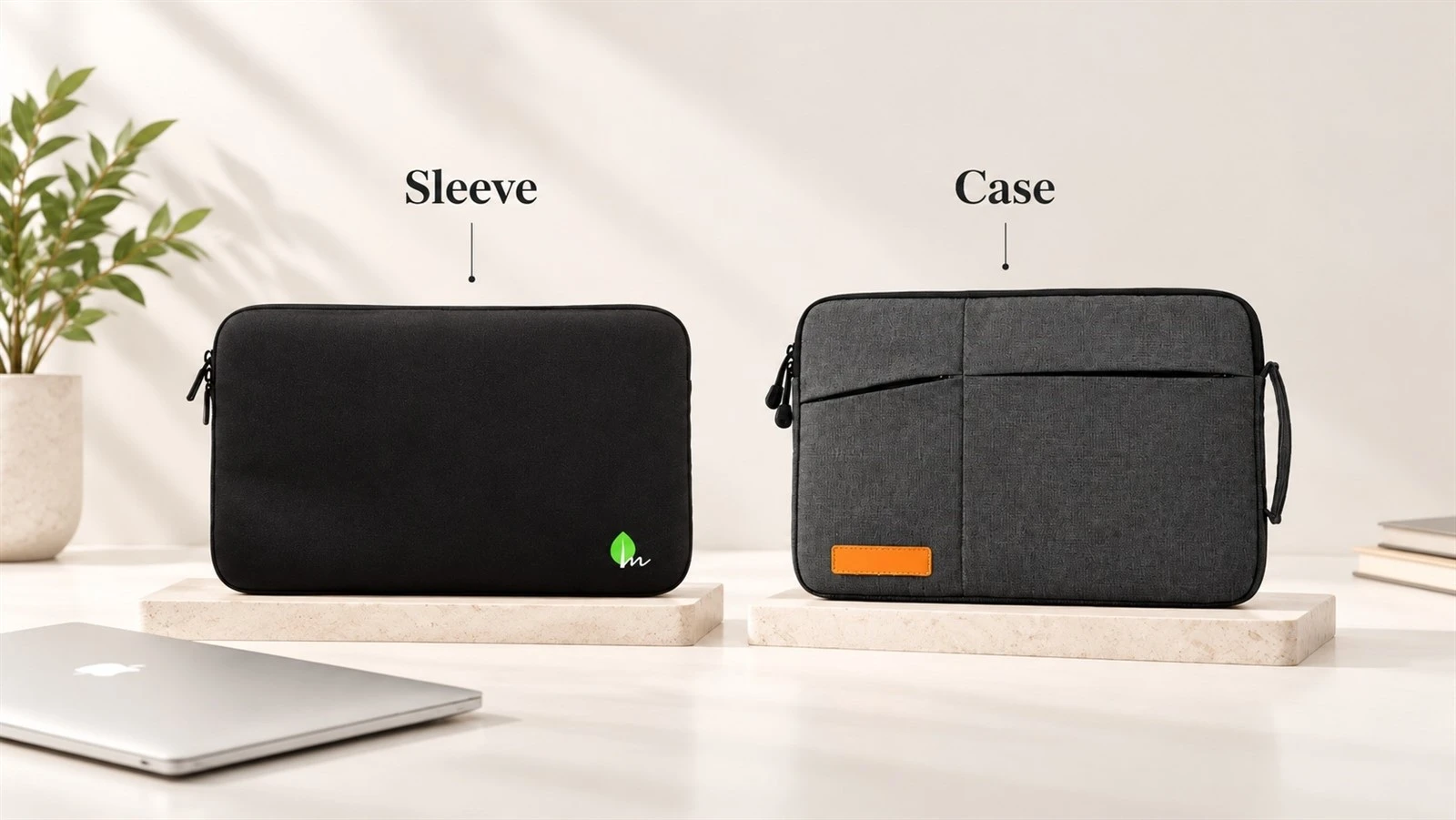
A laptop sleeve is a slim, form-fitting pouch designed to hold a laptop with relatively little unused space around the device. Think of it as a dedicated protective layer rather than a complete carrying system.
Most sleeves open along one edge in either a top-loading or side-loading configuration. Depending on the design, they may use a zipper, magnetic flap, hook-and-loop closure, or open-top construction. Interior space is usually focused on the laptop itself, with little or no room for a charger, mouse, documents, or other accessories.
|
Attribute |
Typical Laptop Sleeve |
|
Profile |
Slim and closely fitted to the device |
|
Closure |
Zipper, magnetic flap, or open-top |
|
Interior capacity |
Mainly the laptop, with minimal accessory space |
|
Carry method |
Handheld or placed inside another bag |
|
Primary purpose |
Scratch and light-impact protection |
The design priority of a padded laptop sleeve is minimal bulk combined with direct-contact protection. Depending on the product, manufacturers may use foam padding, soft microfiber or felt linings, polyester, nylon, PU materials, or other layered constructions to reduce scratches and cushion light bumps. These material choices can significantly affect protection, weight, appearance, and cost; our guide to the best materials for laptop sleeves explains these options in more detail.
More protective laptop sleeves can include reinforced corners, thicker padding, water-resistant outer materials, or soft interior linings for devices with aluminum, glass, or other easily marked surfaces. Some designs, such as a laptop sleeve with a handle, also add limited standalone carrying convenience while retaining a relatively slim profile.
Because laptop sleeves are intentionally compact, they are commonly used as an inner protective layer. You slide the laptop into the sleeve and then place the sleeve inside a backpack, tote, briefcase, or duffel bag. The outer bag carries the load and provides additional environmental protection, while the sleeve helps prevent direct contact, scratching, and minor impact.
What Is a Laptop Case?
A laptop case is generally a more structured and self-contained carrying solution. Rather than protecting only the laptop, it is often designed to carry the device together with the accessories and documents that accompany it, such as a charger, mouse, cables, notebooks, pens, or tablet.
A typical laptop carrying case also has its own carrying system, such as handles, a removable shoulder strap, or occasionally backpack straps. This allows it to function as a standalone bag rather than simply as an insert inside another bag.
|
Attribute |
Typical Laptop Case |
|
Profile |
More structured and often multi-compartment |
|
Closure |
Full-length zipper or dual-zipper opening |
|
Interior capacity |
Laptop plus accessories and documents |
|
Carry method |
Handle, shoulder strap, or backpack straps |
|
Primary purpose |
Protection, transport, and organization |
The design priority of a laptop case is usually organization and independent carry. Interior layouts may include a padded laptop compartment, tablet pocket, front organizer, cable storage, and additional sections for documents or personal items.
Some cases use heavier or more structured construction than sleeves, including denser foam, reinforced panels, EVA molded components, reinforced stitching, and heavier-duty zippers. A protective laptop case may therefore offer greater resistance to compression and impact, although the exact level of protection depends on its construction rather than the product name alone.
For example, a 16-inch laptop case with handle illustrates how a case can combine device protection with a dedicated carrying feature.
This distinction is important because "laptop case" is a broad market term. It can describe a soft carrying case, a semi-rigid EVA case, or in some markets a hard-shell laptop case. If you want to understand how molded structures differ from ordinary padded bags, our guide to EVA protective cases covers their materials, molding, and protective applications.
The label alone does not tell you how protective the product actually is.
Laptop Sleeve vs. Laptop Case: Side-by-Side Comparison
The easiest way to understand the difference between a laptop sleeve and a laptop case is to compare the features that directly affect everyday use.
|
Dimension |
Laptop Sleeve |
Laptop Case |
|
Form factor |
Slim pouch, fitted around the device |
More structured, often multi-compartment |
|
Protection level |
Scratch and light-impact protection |
Greater potential for impact and compression protection |
|
Accessory storage |
Minimal to none |
Dedicated storage compartments |
|
Standalone carry |
Usually limited |
Usually includes handles and/or a strap |
|
Bulk and weight |
Low |
Moderate to high |
|
Best used as |
Inner protective layer |
Primary carrying solution |
|
Typical price tier |
Lower |
Higher |
A useful way to understand the distinction is this:
A laptop sleeve is primarily a protective layer, while a laptop case is usually a protective carrying system.
There are exceptions, however. A heavily padded sleeve can provide better impact protection than a lightly constructed carrying case. Likewise, a larger case is not automatically more protective simply because it has more compartments.
From a product-development perspective, fit, cushioning, structural reinforcement, closure design, and environmental protection matter more than the category name itself.
How Laptop Sleeves and Cases Protect Your Laptop
Protection is where the laptop sleeve vs. laptop case comparison becomes more complicated. Both categories may be marketed with terms such as "shockproof," "water-resistant," or "protective," but those descriptions do not always represent the same construction or level of performance.
Laptop sleeves generally focus on direct-contact and surface protection. A padded lining can absorb energy from light bumps, such as a laptop moving against another object inside a backpack or contacting a desk edge. A soft interior also helps prevent scratches from keys, cables, zippers, and other items packed nearby.
The durability of the outer textile also matters. Standardized test methods such as those used for evaluating abrasion resistance of fabrics help illustrate why surface durability should be considered separately from cushioning or impact protection.
A thin sleeve, however, has limited ability to absorb the energy of a severe drop. When padding is only a few millimeters thick, there is less material available to slow the laptop before impact energy reaches the device.
Laptop cases can provide a broader protection envelope. Some use denser foam panels, including constructions with approximately 10 to 20 millimeters of padding, together with reinforced corners or rigid and semi-rigid structures. These features can help distribute compression and absorb more impact energy.
The most important point is that laptop protection is a system rather than a single material or feature.
A well-designed protective product may combine several layers:
- An outer material for abrasion resistance, appearance, and water resistance
- Padding or foam for impact absorption
- A soft lining for scratch protection
- EVA or reinforced panels for structural support
- A suitable closure system that does not create an obvious weak point
This is also why water protection and impact protection should be evaluated separately.
A water-resistant laptop sleeve may help protect against light rain or splashes but still provide only moderate impact protection. A semi-rigid EVA case may provide excellent structural protection while its zipper and seams remain vulnerable to water.
Likewise, a fabric product should not automatically be described as waterproof simply because the face material repels water. The fabric, seams, zipper, and overall construction all affect the finished product's water resistance. A purpose-designed waterproof laptop sleeve, for example, needs to consider the complete construction rather than only the outer fabric.
At FENGLINWAN, this distinction is especially relevant because different protection requirements call for different materials and manufacturing methods. Laptop and protective products may use materials such as polyester, nylon, PU, 600D fabric, felt, padding, or EVA structures, while genuinely higher-waterproof applications can require different solutions such as TPU or PVC materials, welded seams, and specialized water-resistant or watertight closures.
The right construction therefore depends on the actual risk you are designing for.
When to Choose a Laptop Sleeve
A laptop sleeve is usually the better choice when your laptop already travels inside a backpack, briefcase, tote, or travel bag that provides the main carrying structure, and you want an additional layer of scratch and bump protection without adding substantial bulk.
|
Scenario |
Why a Laptop Sleeve Fits |
|
Daily commute in a backpack |
Adds direct-contact protection without using much pack volume |
|
Moving between meeting rooms |
Lightweight for short-distance carrying |
|
Storing a laptop in a larger travel bag |
Reduces contact damage from other packed items |
|
Minimalist carrying preference |
Keeps the total setup slim and lightweight |
Sleeves are also useful for people who frequently switch between different outer bags. If you sometimes carry a backpack, sometimes a messenger bag, and sometimes a tote, the sleeve can remain with the laptop while your outer carrying system changes.
If your decision is more about choosing between different full-size carrying formats, our comparison of a laptop bag vs. laptop backpack looks at portability, storage, and commuting use in more detail.
Fit is especially important with a laptop sleeve.
A sleeve should generally be snug enough to keep the device from moving excessively but not so tight that inserting and removing the laptop becomes difficult. A poorly sized sleeve can reduce protection even if it uses good materials.
This is one reason screen-size labels should be treated only as a starting point. Two laptops marketed as the same screen size may still have different overall lengths, widths, thicknesses, and corner shapes. Our laptop sleeve size guide provides a more detailed explanation of how dimensions affect fit.
For brands developing custom laptop sleeves, actual device dimensions are therefore more useful than relying only on labels such as "13-inch" or "15-inch." In OEM/ODM development, the internal dimensions, padding thickness, material compression, zipper clearance, and intended fit all need to be considered together.
When to Choose a Laptop Case
A laptop case is usually the better option when the product itself needs to function as the primary carrying system.
Instead of placing the device inside another bag, you can carry the laptop, charger, mouse, cables, documents, and other daily essentials in one organized package.
|
Scenario |
Why a Laptop Case Fits |
|
Business travel with accessories |
One bag can hold the laptop, charger, mouse, and documents |
|
Airport travel |
Some designs open widely for easier device access |
|
Commuting without a backpack |
The case replaces the need for another bag |
|
Field or outdoor work |
Can provide more structured protection and weather resistance |
Laptop cases are particularly useful for users who travel frequently or need more organization. A wide-opening or clamshell design can make it easier to access the laptop and internal accessories, while dedicated compartments help keep chargers and hard objects away from the device surface.
For air travel, laptop owners should also check current TSA laptop screening guidance, since screening procedures can affect how easily a laptop needs to be accessed at security checkpoints.
For field work or demanding travel environments, additional structural protection may also become more important. Reinforced corners, EVA panels, thicker padding, stronger handles, and water-resistant materials can all contribute to a more durable laptop carrying case.
That does not mean every user needs the most heavily reinforced option. Added structure also means added size and weight. Some fully equipped cases can weigh two to three times as much as a basic sleeve when empty.
The better choice depends on where the laptop is going and what the carrying product is expected to do once it gets there.
Can You Use a Laptop Sleeve and Laptop Case Together?
Yes. For users who want an additional layer of device protection while maintaining accessory organization, a sleeve can be placed inside a laptop case or backpack.
In this setup, the sleeve handles direct-contact protection around the laptop, while the outer case or backpack carries the structural load and provides space for accessories.
The main issue is fit.
A laptop sleeve designed to fit a bare device snugly may make the overall package too large for a padded laptop compartment designed around the same nominal screen size.
If you plan to layer the two products, compare:
- The actual laptop dimensions
- The internal dimensions of the sleeve
- The exterior dimensions of the loaded sleeve
- The internal dimensions of the laptop compartment in the case or backpack
A small amount of usable clearance makes insertion and removal easier. A compartment that is too tight can place unnecessary pressure on the laptop and zipper, while excessive free space allows the device to shift during movement.
This illustrates a broader design principle: more layers do not automatically mean better protection if those layers do not fit together correctly.
Laptop Sleeve vs. Laptop Case: Which Should You Choose?
The laptop sleeve vs. laptop case decision is not about which category is universally better. It depends on how you carry your laptop, what else you carry with it, and the type of protection you actually need.
|
If You... |
Choose |
|
Already carry another bag and mainly want device protection |
A laptop sleeve |
|
Want one bag to carry the laptop and accessories |
A laptop case |
|
Prioritize minimal bulk and weight |
A laptop sleeve |
|
Need more structural impact protection |
A laptop case |
|
Switch frequently between different outer bags |
A laptop sleeve |
|
Regularly travel with chargers, documents, and accessories |
A laptop case |
A sleeve is usually the better choice for lightweight, layered protection. A case is usually the better option when you need protection, organization, and standalone carrying in the same product.
When comparing specific products, however, look beyond the label. Five factors provide a more useful picture of protection:
- Fit: Does the product match the actual device dimensions?
- Cushioning: Is there enough padding for the expected level of impact?
- Structure: Does the application require soft padding, reinforced panels, or an EVA shell?
- Closure: Does the zipper or opening protect the laptop without creating a pressure or exposure point?
- Environmental protection: Does the product need basic water resistance, rain protection, or a more specialized waterproof construction?
Those factors determine how well a laptop sleeve or case performs far more accurately than the product name alone.
FAQ
Is a laptop sleeve better than a laptop case?
Neither is automatically better. A laptop sleeve is usually better for lightweight protection inside another bag, while a laptop case is better when you need standalone carrying, accessory storage, and potentially more structural protection.
The better choice depends on your daily carrying environment and the level of protection you need.
Do laptop sleeves really protect laptops?
Yes, a well-designed laptop sleeve can protect against scratches, abrasion, light bumps, and contact with other items inside a bag.
However, most slim sleeves are not designed to protect a laptop from severe drops or heavy compression. Padding thickness, corner protection, fit, and material construction all affect actual performance.
Should a laptop sleeve fit tightly?
A laptop sleeve should fit snugly rather than excessively tightly.
The laptop should not move freely inside the sleeve, but there should still be enough clearance to insert and remove it without forcing the zipper or placing pressure on the device.
When selecting a sleeve, use the laptop's actual dimensions rather than relying only on its advertised screen size.
Is a laptop sleeve waterproof?
Not necessarily.
Some laptop sleeves use water-resistant exterior fabrics that can help with light rain and splashes, but water-resistant and waterproof are not the same thing. Seams, zipper construction, materials, and manufacturing methods all influence the final level of water protection.
A sleeve should only be treated as waterproof when the complete product construction has been designed and validated for that purpose.
Can I put a laptop sleeve inside a laptop case?
Yes, provided the sleeve fits comfortably inside the laptop compartment.
Using both can provide an additional direct-contact layer around the device, but you should check the exterior dimensions of the loaded sleeve against the internal dimensions of the case. Excessively tight layering can make the system harder to use and may place unwanted pressure on the laptop.
Conclusion
So, what is the difference between a laptop sleeve and a laptop case? A laptop sleeve is primarily a slim protective layer for the device, while a laptop case is generally a more complete carrying solution with additional structure, storage, and standalone carry features. Neither format is automatically more protective-the actual result depends on fit, padding, structural reinforcement, closure design, and environmental protection.
For brands developing custom laptop bags, sleeves, cases, or other protective carrying products, FENGLINWAN provides OEM/ODM support covering material selection, pattern development, sampling, protective structures, production, and quality control. Contact us to discuss your target device, use environment, and protection requirements for a custom project.