


When Does a Custom Waterproof Bag Need a New Mold?
Oct 29, 2026
Leave a message
Every custom waterproof bag project eventually reaches the same practical question: can an existing mold be reused, or does the design require new tooling?
The answer can affect tooling cost, sample lead time, production consistency, and how closely the finished bag can match the original design brief. Reusing a tool that no longer fits the product geometry can create unnecessary engineering compromises. Opening a completely new mold when the existing tooling can still do the job can add cost without adding meaningful value.
For an HF-welded waterproof bag, the decision is usually less about whether the product "looks different" and more about whether the change affects panel geometry, welding seams, sealing structures, component locations, or production repeatability.
A new custom waterproof bag mold is usually justified when existing tooling cannot reliably produce the required geometry, sealing structure, or functional specification-not simply because the appearance has changed.
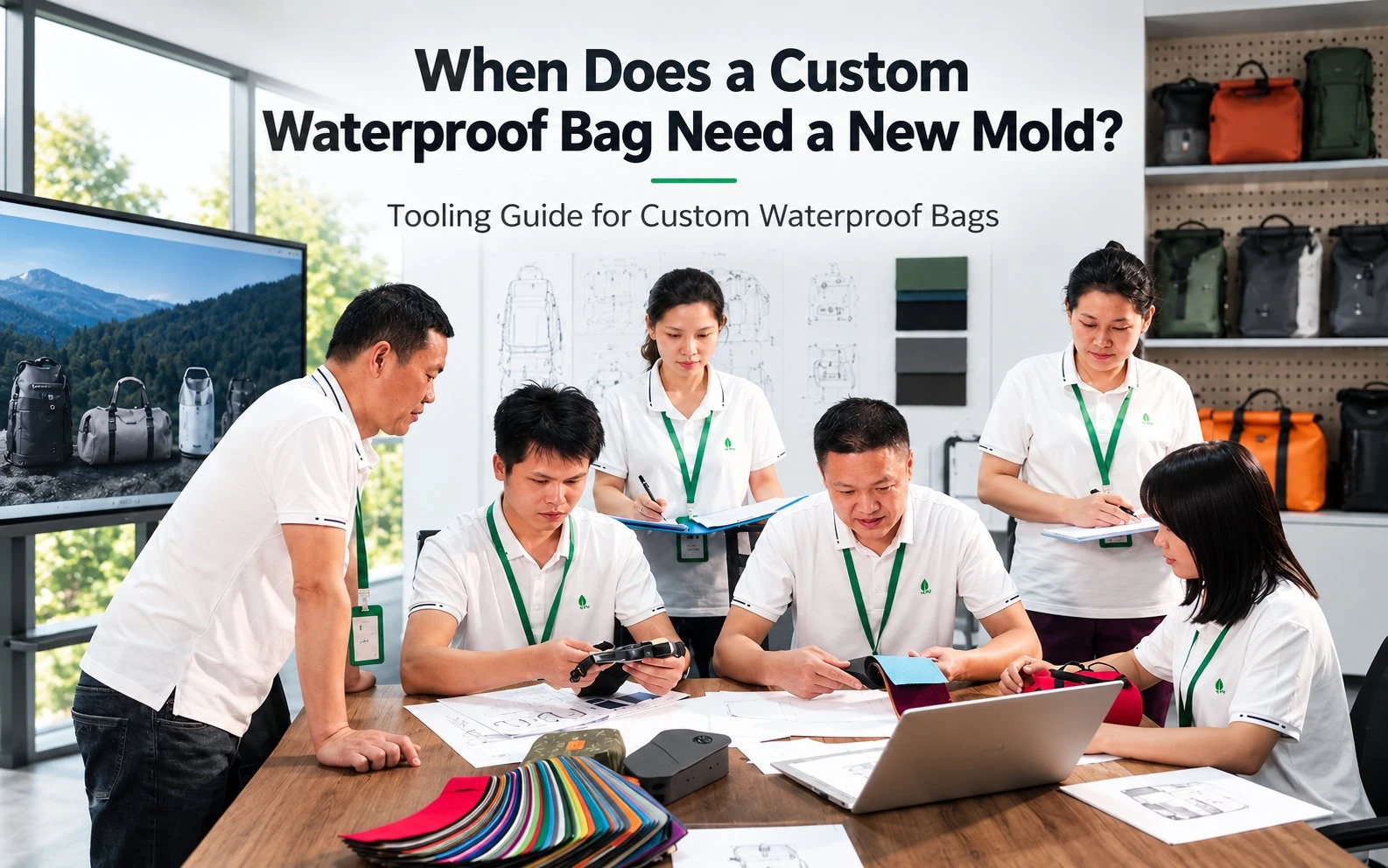
What "Mold" Means in Custom Waterproof Bag Manufacturing
Before deciding whether new tooling is necessary, it helps to clarify what "mold" means in waterproof bag manufacturing.
Depending on the product, several types of tooling may be involved:
|
Tooling Type |
What It Does |
Typical Trigger |
|
HF/RF welding die |
Seals compatible thermoplastic materials such as TPU or PVC along a defined seam profile |
New seam path, panel geometry, zipper welding area, pocket, reinforcement, or other welded structure |
|
Injection mold |
Produces custom rigid components such as buckles, valve bodies, handle parts, or proprietary fittings |
Custom hardware that cannot be sourced from standard components |
|
Cutting die or cutting template |
Defines the shape and dimensions of material panels |
New panel geometry or a size outside the usable range of existing tooling |
For most custom waterproof bag OEM projects, the tooling discussion centers on the HF or RF welding mold. If you want a deeper explanation of how this process works, see our guide to HF welding for waterproof bags.
At FENGLINWAN, waterproof product development begins with the product requirements, materials, dimensions, and structure. The engineering team develops the paper pattern, which can be laser cut for sample development, before HF welding tooling is produced for the relevant welded structures.
This sequence is part of a broader custom waterproof bag development process, because a custom waterproof bag mold should normally be developed only after the critical dimensions and welding geometry are reasonably stable.
When a Custom Waterproof Bag Needs a New Mold
These are the main conditions that should be reviewed during custom waterproof bag development. No single change automatically means that every tool must be replaced, but changes that affect welding geometry or tooling function are the strongest indicators that new tooling may be needed.
1. New Bag Geometry
The bag's three-dimensional shape-its panel layout, corner construction, base structure, and seam architecture-is one of the biggest drivers of waterproof bag tooling.
A roll-top dry bag, flat waterproof pouch, and three-dimensional waterproof duffel may use completely different panel and seam configurations. If a new design changes the actual welding path, the existing HF welding mold may no longer match the required geometry.
Even a change that looks small in a rendering can be significant in production.
For example, increasing the width of a bag may also move:
- side seams,
- bottom welds,
- zipper locations,
- reinforcing patches,
- handle attachment areas,
- or other welded components.
The important question is therefore not simply "How much did the bag change?" but "Did the change alter the geometry controlled by the tooling?"
For TPU products in particular, the relationship between panel layout, welded seam position, and sealing structure is critical. Our guide to TPU waterproof bag seam construction explains how welding and bonding choices affect the finished product.
2. Size or Capacity Changes That Alter the Welding Geometry
Capacity changes are not always cosmetic.
Moving from one size of waterproof bag to another may change panel dimensions, seam length, zipper dimensions, or structural proportions. If those changes move the welded areas outside the working geometry of the existing tool, a new mold may be required.
However, a different capacity does not automatically mean new tooling.
A smaller size adjustment may sometimes be handled through pattern or panel changes if the critical welded geometry remains compatible with existing tooling.
This is why a product should be reviewed from the paper pattern and seam layout, rather than assuming that every size requires a completely new mold.
3. New Material or Sealing Requirements
TPU and PVC are both commonly used for heat-sealed and HF-welded waterproof bags, but changing the material does not necessarily mean that the mold must automatically be replaced.
A material change can affect:
- welding energy,
- pressure,
- dwell time,
- material thickness,
- layer construction,
- and seal performance.
If the required seam geometry remains the same, engineering validation and process adjustment may be sufficient. If the new material or construction requires a different weld width, pressure profile, reinforcement layout, or seam design, tooling modification or a new HF welding mold may become necessary.
At FENGLINWAN, both TPU and PVC can be considered for heat-sealed waterproof products. Examples include a TPU waterproof backpack and a PVC/TPU waterproof duffel bag, with material selection evaluated together with the required structure and waterproof performance.
4. New Zippers, Valves, Pockets, or Custom Hardware
Adding a new functional component can have a greater impact on waterproof bag tooling than changing the external appearance.
Examples include:
- changing zipper length,
- moving the zipper position,
- adding an airtight or watertight zipper,
- adding a welded external pocket,
- adding an air valve,
- adding welded reinforcement,
- or introducing a proprietary hardware attachment.
For an HF-welded bag, these elements often create additional sealing areas or change existing ones.
A new component does not always require replacing the entire tooling set. In some cases, only the specific welding tool for the new zipper area, pocket, valve, or reinforcement needs to be developed.
That distinction matters because a custom waterproof bag can use multiple pieces of tooling rather than one single "mold."
5. Order Volume Justifies Dedicated Tooling
Tooling is also an economic decision.
A dedicated HF welding mold makes the most sense when the expected production quantity and product lifecycle justify the tooling investment. For very small pilot runs, brands may prefer to validate the design through existing tooling, modified patterns, or other prototype methods before committing to production-specific molds.
There is no universal MOQ at which a mold suddenly becomes worthwhile.
The decision depends on factors such as:
- tooling complexity,
- product unit value,
- expected repeat orders,
- manufacturing efficiency,
- and how much compromise would be required to reuse existing tooling.
The purpose of the decision should not be to avoid tooling at any cost. It should be to use new tooling only where it meaningfully improves manufacturability, consistency, or product performance.
If you are evaluating the commercial side of development, our article on custom bag cost factors explains how tooling fits alongside materials, accessories, construction, quantity, and other cost drivers.
6. Waterproof or Airtight Performance Requires Different Tooling Geometry
A more demanding waterproof specification can also trigger new tooling.
If the required performance calls for a different:
- seal width,
- seam profile,
- zipper integration,
- reinforcement structure,
- pressure distribution,
- or airtight construction,
the existing tool may no longer be suitable.
This becomes especially important for products designed around airtight or high-level waterproof structures. For example, an airtight waterproof expedition backpack may require tighter control of welded areas, zipper integration, and pressure retention than a simple splash-resistant design.
FENGLINWAN combines TPU-based structures, HF welding, airtight/watertight zippers, roll-top constructions, and other waterproof solutions depending on the product specification. Finished waterproof samples can then be checked through Air Leakage Testing and Water Leakage Testing rather than relying on appearance alone.
For airtight products, the company's documented process includes 100% airtight testing.
Where a project references an IP classification such as IPX8, it is useful to understand that IEC ingress protection ratings are a standardized enclosure-classification system. Any IP-related claim should therefore be tied to an appropriate test method and clearly defined product configuration.
7. A Proprietary Visual or Functional Detail Depends on the Tool
Not every new mold is driven by waterproof performance.
A brand may deliberately develop a proprietary:
- seam line,
- welded logo area,
- embossing detail,
- corner shape,
- welded panel layout,
- or other recognizable structural feature.
If that feature depends directly on the tooling geometry, dedicated tooling can become part of the product's differentiation rather than simply a manufacturing expense.
In this case, the mold decision becomes both an engineering decision and a product-positioning decision.
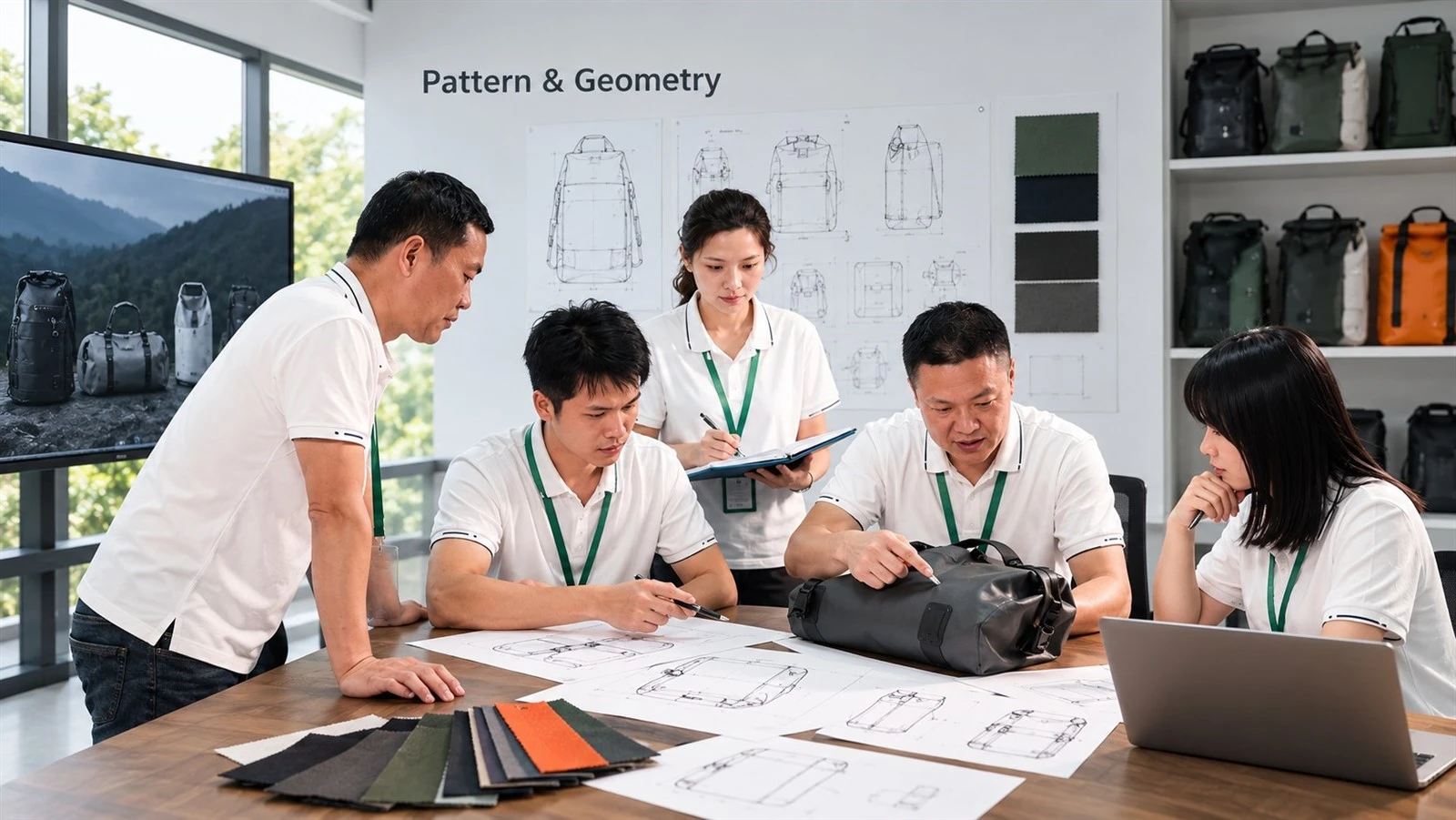
When You Do Not Need a New Mold
Knowing when not to open a new custom waterproof bag mold is equally important.
Many product changes can be made without replacing the main HF welding tooling.
A. Color, Print, or Branding Changes
Changing:
- material color,
- printed graphics,
- a logo,
- labels,
- hang tags,
- or packaging
usually does not affect the main welding geometry.
If the structural dimensions and welded areas remain unchanged, a visual update normally should not require a completely new body mold.
A welded or embossed logo that becomes part of the tooling itself is a different case and should be reviewed separately.
B. Minor Size Adjustments Within the Same Product Family
A relatively small dimensional change may be possible without replacing every existing tool.
The engineering team should first check whether:
- the seam path remains compatible,
- the existing welding area still fits,
- zipper and reinforcement positions remain usable,
- and the revised pattern can be manufactured consistently.
The percentage of the size change alone is not a reliable decision rule.
A small dimensional change can still require new tooling if it moves a critical welded feature, while a larger panel change may sometimes be possible without changing another independent welding tool.
C. Standard Hardware Changes
Switching between commercially available buckles, webbing, or similar accessories is usually a BOM and sourcing change rather than an injection-molding project.
FENGLINWAN's sourcing process supports different options for webbing, buckles, zippers, and other accessories as part of custom product development.
Dedicated injection tooling is more relevant when the project requires a proprietary component that standard hardware cannot provide.
D. Low-Volume or Pilot Development
During an early prototype or market-validation stage, it can make sense to avoid committing to all final production tooling too early.
A practical development sequence is to stabilize:
- product requirements,
- materials,
- paper pattern,
- critical dimensions,
- welding geometry,
- sample performance,
before finalizing the required HF welding molds.
This reduces the risk of paying for tooling and then changing the design immediately afterward.
How to Decide Whether New Waterproof Bag Tooling Is Needed
A practical engineering review should eliminate simpler options before recommending a completely new mold.
|
Step |
Question |
Practical Direction |
|
1 |
Can existing tooling produce the required welding geometry and dimensions? |
Reuse it where practical |
|
2 |
Can only the affected tooling component be modified or replaced? |
Avoid replacing unrelated tools |
|
3 |
Has the paper pattern and welded structure changed materially? |
Review the need for new HF tooling |
|
4 |
Does the design introduce new welded zippers, pockets, valves, or reinforcement areas? |
Evaluate additional tooling |
|
5 |
Does the waterproof or airtight specification require different seal geometry? |
Validate through sample development and testing |
|
6 |
Is the expected production volume sufficient to justify dedicated tooling? |
Include tooling in the commercial evaluation |
The key principle is simple:
The size of the visible design change does not determine whether a new mold is needed. The change to the manufacturing and welding geometry does.
At FENGLINWAN, tooling is part of a broader OEM/ODM development sequence rather than an isolated purchase. Product requirements are first translated into materials, patterns, sample structures, and engineering data before the product is prepared for stable mass production. You can also review the broader waterproof bag manufacturing process to see how materials, welding, construction, testing, and production preparation fit together.
What a New Waterproof Bag Mold Costs and What the Investment Covers
Tooling cost is one of the first questions buyers ask, but quoting one universal mold price would be misleading.
The cost depends on factors such as:
- mold dimensions,
- welding seam complexity,
- number of separate welded structures,
- tooling material,
- custom hardware requirements,
- product size,
- and whether several tools are required for one bag.
1. HF Welding Mold
For waterproof bags, the HF welding die is often the most relevant tooling investment.
The complexity can increase when a design contains:
- multiple contours,
- large welded panels,
- waterproof zipper integration,
- welded pockets,
- valves,
- reinforcement patches,
- or several independent sealing areas.
A custom bag that appears to require "one mold" may therefore need several individual pieces of HF welding tooling.
2. Injection Mold for Proprietary Hardware
Custom injection molds are a separate tooling category.
They may be considered where a product requires proprietary:
- buckles,
- fittings,
- valves,
- closure components,
- or other molded hardware.
When suitable standard components are available, they can often avoid the cost and development time associated with custom injection tooling.
The value of new tooling is not limited to the physical mold itself. Proper tooling can provide:
- repeatable dimensions,
- more consistent weld quality,
- more efficient mass production,
- lower dependence on manual adjustment,
- and the freedom to manufacture geometry that existing tools cannot reliably reproduce.
Typical HF Welding Mold Lead Time at FENGLINWAN
For FENGLINWAN's normal development process, a new HF welding mold typically takes approximately 7–10 days after the paper pattern and relevant sample or engineering requirements have been confirmed.
This refers to the normal tooling period rather than the entire product-development timeline.
A complete custom waterproof bag project may also require:
- material preparation,
- paper pattern development,
- sample making,
- product revisions,
- Air Leakage Testing,
- Water Leakage Testing,
- customer approval,
- engineering data setup,
- and production preparation.
Design changes after tooling begins may require rework, so stabilizing the critical geometry before opening the mold can save both time and cost.
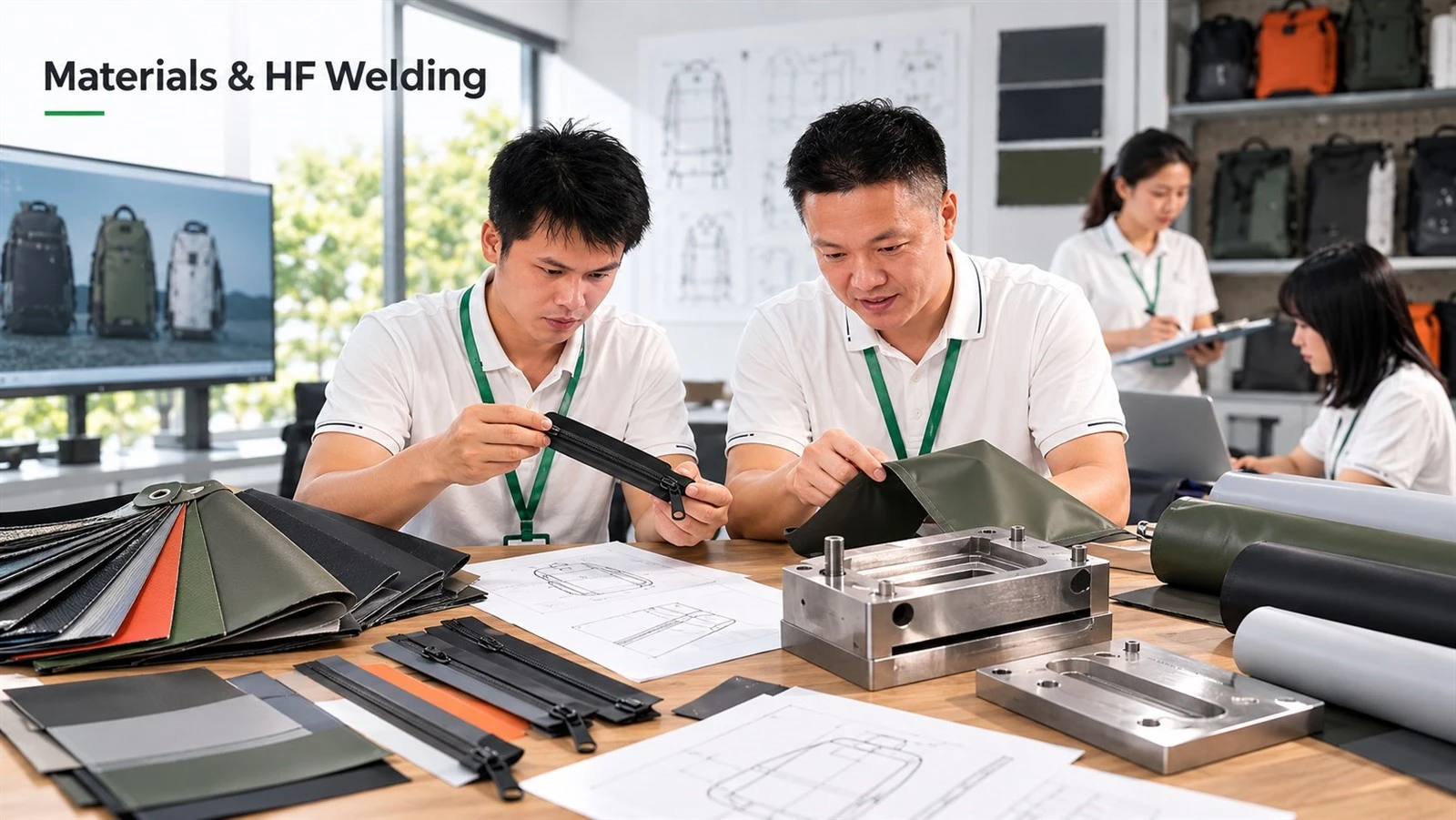
Mold Cost, Ownership, and Long-Term Tooling Planning
Tooling should be evaluated as part of the product's longer-term manufacturing plan rather than only as a first-order cost.
For example, brands should consider whether the same tooling can support:
- repeat production,
- future colorways,
- related product variants,
- seasonal collections,
- or additional orders using the same core geometry.
At the quotation stage, FENGLINWAN's project information can include the mold fee together with the product description, unit price, materials, MOQ, trade terms, and payment terms.
For any custom tooling project, buyers should also confirm commercial terms such as:
- tooling ownership,
- storage,
- maintenance,
- exclusivity,
- reuse rights,
- and what happens if the product is revised later.
These terms are best clarified in the quotation or project agreement rather than assumed.
Tooling life also depends on how the tool is used and maintained. Running the tool within the intended process and material specification helps preserve consistency across repeat production.
The most efficient product programs therefore treat a custom waterproof bag mold as a production asset that should support a realistic product roadmap-not simply as a one-time development expense.
FAQ
Does every new custom waterproof bag need a new mold?
No. A new design does not automatically require completely new tooling. Existing HF welding molds may still be usable if the critical seam geometry, dimensions, zipper areas, and welded structures remain compatible. The engineering team should review the paper pattern and welding layout before deciding.
Does changing from PVC to TPU require a new HF welding mold?
Not necessarily. Changing between PVC and TPU may require different welding parameters, material validation, and process settings, but a new mold is only necessary if the new material or construction also requires different tooling geometry or sealing conditions that the existing die cannot support.
Does changing the size of a waterproof bag require a new mold?
It depends on which dimensions change. If a size change alters the seam path, zipper length, welded pocket location, base geometry, or other tooling-controlled features, new tooling may be needed. If the relevant welding geometry remains compatible, some existing tools may still be reused.
How long does a new HF welding mold take?
At FENGLINWAN, the documented normal lead time for a new HF welding mold is approximately 7–10 days once the paper pattern and relevant sample requirements are confirmed. Sample making, testing, revisions, and customer approval are separate stages and can extend the complete custom waterproof bag development timeline.
Should I open a new mold for a small pilot order?
Not always. For an early pilot or market-test quantity, it may be more economical to validate the design before investing in all final production tooling. However, if the required geometry or waterproof structure cannot be produced reliably with existing tools, a new mold may still be necessary even for a smaller order.
Conclusion
A custom waterproof bag needs a new mold when the design change affects the welding geometry, sealing structure, tooling-controlled dimensions, or production consistency beyond what existing tooling can reliably deliver. Color changes, branding updates, standard hardware swaps, and some pattern adjustments usually do not justify replacing the main mold, while new seam paths, zipper structures, welded pockets, valves, major dimensional changes, or higher sealing requirements deserve an engineering review.
FENGLINWAN is an OEM/ODM manufacturer of outdoor waterproof and functional bags with capabilities in TPU/PVC development, HF welding, airtight/watertight structures, sample development, and leakage testing. If you are unsure whether your design can reuse existing tooling or needs a new custom waterproof bag mold, send us your drawings, reference sample, target dimensions, material requirements, and expected order volume to discuss the project.