


Nylon, PP or Polyester Webbing? What are the differences
Sep 16, 2026
Leave a message
Webbing is a narrow woven strap used to carry loads, reinforce structures, adjust fit, and connect buckles or hardware. In outdoor bags, the three most common synthetic options are nylon, polyester, and polypropylene (PP). Nylon stands out for toughness and abrasion resistance, polyester for low stretch and outdoor stability, and PP for low weight, very low moisture absorption, and cost efficiency.
The right choice depends on where the webbing is used and what that part of the bag needs to do.
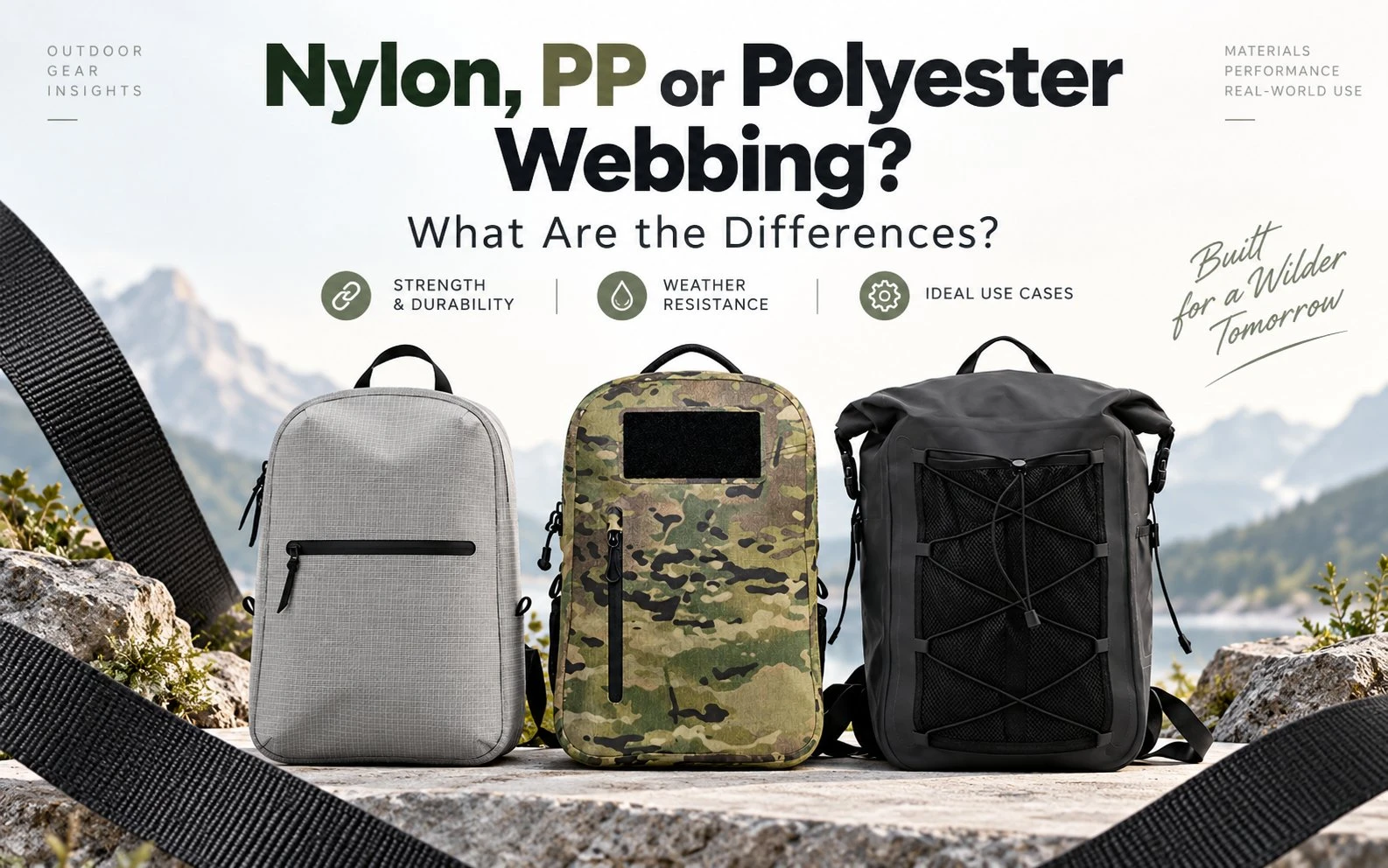
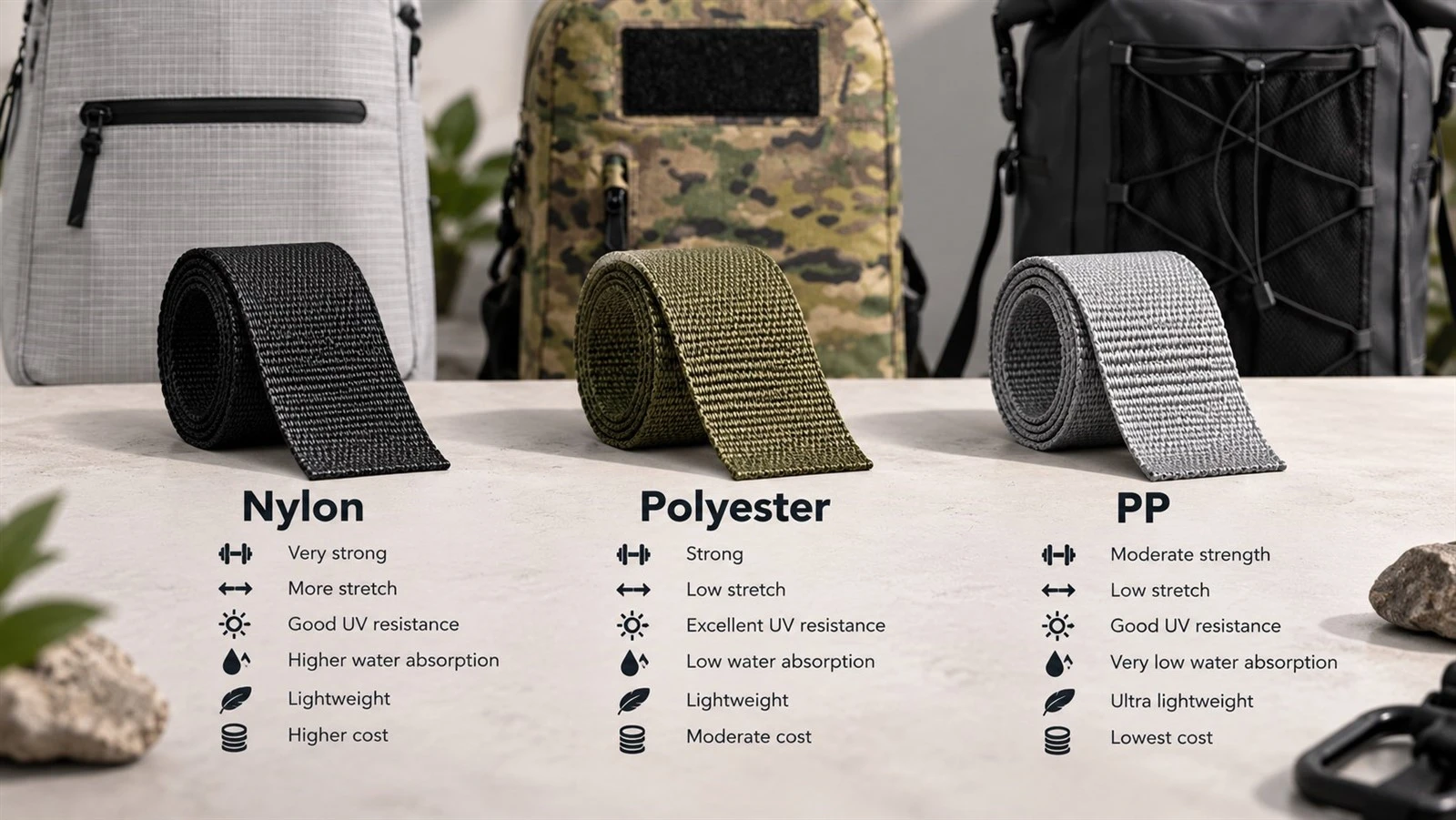
Nylon vs Polyester vs Polypropylene Webbing: Quick Comparison
The three materials can all be made into durable bag webbing, but their behavior changes significantly under load, moisture, sunlight, and repeated abrasion.
|
Property |
Nylon Webbing |
Polyester Webbing |
PP Webbing |
|
Strength potential |
High |
High |
Moderate |
|
Abrasion resistance |
Excellent |
Very good to excellent |
Moderate |
|
Stretch |
Higher |
Low |
Low to moderate |
|
Moisture absorption |
Highest, around 4–4.5% |
Low, around 0.4% |
Extremely low |
|
UV/weather resistance |
Moderate |
Excellent |
Depends strongly on UV stabilization |
|
Approx. material density |
~1.14 g/cm³ |
~1.38 g/cm³ |
~0.91 g/cm³ |
|
Floats in water |
No |
No |
Yes |
|
Chemical resistance |
Good |
Good |
Very good against many chemicals |
|
Color performance |
Excellent dyeability |
Excellent colorfastness |
Good, depends on coloring method |
|
Relative cost |
Higher |
Medium |
Lower |
|
Main reason to choose |
Toughness and abrasion resistance |
Low stretch and outdoor stability |
Low weight, water exposure and cost |
Those ratings describe material tendencies. The actual performance of finished webbing also depends on width, thickness, yarn, weave, density, finishing, and manufacturing quality.
That distinction matters when comparing webbing strength.
Nylon Webbing: Tough, Abrasion-Resistant and Flexible
Nylon webbing is widely used where repeated loading and friction are expected. It combines high strength potential with excellent abrasion resistance and a degree of elasticity that can be useful in dynamic applications.
That elasticity is one of nylon's defining characteristics. A shoulder strap or load-bearing connection does not behave like a rigid tie-down. Some flexibility can help the assembly accommodate movement and short-duration shock loads while remaining comfortable in use.
For outdoor bags, nylon is commonly considered for shoulder-strap structures, waist belts, carry handles, tactical-style attachment systems, and other areas exposed to repeated rubbing.
Its main limitation is moisture response. Nylon absorbs substantially more moisture than polyester or PP. Typical moisture uptake is around 4–4.5%, and wet nylon becomes more extensible. Its dimensions and mechanical behavior therefore change more noticeably in damp conditions. For a closer look at how this affects finished bags, see our guide to nylon backpacks and waterproof performance.
Nylon also performs less consistently than polyester under prolonged UV exposure unless the finished webbing has been designed for outdoor weathering.
Commercial nylon webbing covers a very wide strength range. Reference products can range from hundreds to several thousand pounds of breaking strength, while other finished constructions may be specified around 1,000–2,600 N. Those figures show why a material name is never enough to specify a load-bearing strap. Two nylon webbings with the same width can perform very differently.
For heavy-duty bag components, the actual breaking-strength specification should be checked.
Polyester Webbing: Low Stretch and Reliable Outdoor Stability
Polyester webbing is usually the strongest all-round choice for straps that need to hold their dimensions outdoors.
Its moisture absorption is low, around 0.4%, and it stretches much less than nylon under normal loading. That gives polyester excellent dimensional stability. Compression straps remain more consistent in length, buckle settings stay more predictable, and repeated exposure to rain or humidity has less effect on the strap.
This is one reason polyester is widely used for outdoor gear, backpacks, luggage straps, tie-downs, and marine-related products. The same material behavior is also relevant to polyester backpacks and water resistance.
Its other major advantage is weather resistance. Polyester generally handles long-term sunlight better than nylon and retains color well. For a product exposed repeatedly to sun, rain, and humidity, polyester is often the safest default webbing material.
Polyester also works well when appearance matters. It has good colorfastness, and polyester webbing can be produced with sublimated patterns or other branded surface treatments. That makes it useful for outdoor brands that want functional straps to remain visually consistent over a long product life.
Its low elongation does mean that polyester feels less elastic than nylon. In an adjustable compression strap, that is an advantage. In a component where additional flexibility is desirable, nylon may feel better.
The useful way to view polyester is as a combination of strength, low stretch, and environmental stability.
Polypropylene (PP) Webbing: Light, Water-Friendly and Economical
Polypropylene, usually shortened to PP, is the lightest of the three materials.
Its density is approximately 0.91 g/cm³, below the density of water. That is why PP webbing can float. It also absorbs extremely little moisture, making it particularly useful for wet environments, water-sports equipment, lightweight straps, and products that need to dry quickly.
Some references place PP webbing at roughly 20% lighter than comparable nylon constructions, although finished strap weight still depends on weave and thickness.
PP also has very good resistance to many acids, alkalis, oils, and other chemicals. Combined with its relatively low price, this makes it useful in general-purpose straps, marine products, recreational bags, and cost-sensitive designs.
The trade-offs are equally clear.
PP normally offers lower strength and abrasion resistance than high-grade nylon or polyester webbing. Reference tensile ratings can range from roughly 200 to 3,000 lb depending on construction. It also has lower heat resistance, with polypropylene melting in roughly the 160–170°C range.
UV performance deserves special attention. Standard PP can degrade under prolonged sunlight, while outdoor grades containing UV stabilizers, pigments, and antioxidants can perform much better. A PP webbing described simply as "UV resistant" should therefore be supported by a relevant outdoor-aging specification when long service life is important.
PP is a strong option when low weight, moisture resistance, buoyancy, or price matters more than maximum abrasion life.
Strength, Stretch, Water and UV: What Changes in Real Use?
Material comparisons become more useful when each property is connected to the way a strap actually behaves on a finished bag.
Strength and Abrasion Resistance
Both nylon and polyester can be manufactured into high-strength webbing.
Nylon is especially good at handling abrasion, repeated flexing, and dynamic loading. Polyester combines high strength potential with lower elongation and more stable dimensions. PP is suitable for many normal bag applications but is less commonly selected for the most demanding load-bearing structures.
Breaking strength should therefore be specified for the finished webbing. Width, thickness, weave, yarn construction, and finishing all affect the result.
Abrasion is equally important. A strap repeatedly sliding through a buckle can wear out long before a laboratory tensile value becomes relevant.
Stretch and Wet Performance
Nylon absorbs more moisture and becomes noticeably more extensible when wet.
Polyester absorbs much less water and retains its shape well, which makes it well suited to straps that need to stay adjusted. PP absorbs almost no moisture and dries quickly after surface water is removed.
For a compression strap, low stretch is usually desirable. For a shoulder system exposed to movement and repeated bending, some flexibility can be useful.
The function of the strap decides whether stretch is an advantage or a limitation.
UV and Long-Term Outdoor Exposure
For long-term sun exposure, polyester is usually the most dependable of the three.
Nylon can be used outdoors successfully, but extended UV exposure generally affects it more than polyester. PP varies much more by formulation. UV-stabilized PP can perform well, while unstabilized PP is much more vulnerable to weathering.
"Outdoor use" therefore covers several different requirements. A highly abrasive load-bearing component may favor nylon. A strap exposed continuously to rain and sunlight may favor polyester. A lightweight water-sports accessory may favor PP.
Which Webbing Material Is Best for Different Parts of a Backpack?
A waterproof backpack does not need to use the same webbing everywhere. Each component has a different job.
Shoulder Straps and Carry Handles
Shoulder-strap assemblies and carry handles usually require good strength, abrasion resistance, repeated-flex durability, and a secure stitched connection.
Nylon is well suited to these applications because of its toughness and flexibility. High-strength polyester is also a good option, particularly where low moisture absorption or dimensional stability is important.
For critical handles, the finished assembly should be evaluated as a system. Webbing strength, stitching, thread, and the base fabric all influence the final load capacity.
A product such as a travel duffel bag with backpack straps illustrates why these components need to be considered together: shoulder straps, carry handles, attachment points, and the main bag structure all experience different loading patterns.
Compression Straps, Buckle Straps and Roll-Top Closures
These parts benefit from low stretch.
Polyester is often the strongest choice because it maintains strap length well and performs consistently in wet outdoor conditions. It also works well with adjustable buckles where stable thickness and dimensional behavior improve adjustment.
PP can work for lighter-duty roll-top or accessory straps, especially on products where weight and repeated water exposure are major priorities.
MOLLE, Accessory Loops and Lightweight Straps
MOLLE-style and other modular attachment structures need consistent dimensions as well as abrasion resistance. Nylon remains common in demanding applications, while properly specified polyester can also perform well.
For lightweight accessory loops carrying modest loads, PP can reduce both weight and material cost.
A mixed-material design is often practical. A lightweight waterproof TPU backpack, for example, may use one webbing specification for its primary load-bearing straps and another for lighter accessory points, depending on the product design.
Material selection can be component-specific.
Is PP or Polyester Better for Waterproof and Water-Sports Bags?
For waterproof bags, PP and polyester solve different problems.
PP is attractive when buoyancy, very low moisture absorption, quick drying, and low weight are priorities. It is particularly useful on water-sports accessories or light-duty components that may spend a lot of time wet. For products designed around flotation and water exposure, floating waterproof dry bags are a useful example of the broader design context in which these material choices are made.
Polyester is usually preferable when the same product also requires low stretch, stronger dimensional stability, good UV resistance, and sustained outdoor durability.
Nylon can still be appropriate on high-wear or heavily loaded parts.
The webbing itself does not determine whether a bag is waterproof. Waterproof performance depends mainly on the shell material, seams, zipper or closure, and the way those elements are assembled. If you are comparing those base materials as well, our guide to the best waterproof fabrics for bags covers the main fabric options and their performance differences.
For example, a welded waterproof bag may use TPU or PVC-coated material, HF welding, watertight or airtight zippers, and a roll-top closure. Webbing is then selected according to the mechanical requirement of each strap. An outdoor waterproof backpack may therefore combine waterproof shell construction with a completely different set of requirements for its adjustment straps, handles, and accessory attachment points.
How to Specify Webbing for a Custom Bag Project
A useful webbing specification goes further than "25 mm black polyester."
For production, buyers and product developers should usually define:
- Fiber material: nylon, polyester, PP, or another specified material
- Width and dimensional tolerance
- Thickness and weight per meter
- Weave or construction
- Required breaking strength
- Elongation requirement
- Abrasion requirement
- UV stabilization or outdoor-aging requirement
- Color or Pantone reference
- Colorfastness requirements
- Buckle compatibility
- Logo, jacquard, sublimation, or other decoration
- Recycled-content or sustainability requirements where applicable
Two additional checks deserve attention.
First, the strength of the finished strap assembly is determined by more than the webbing. Stitch pattern, thread, seam position, reinforcement, and the strength of the fabric it is sewn to can become the limiting factors.
Second, buckle slippage can matter as much as tensile strength. A strong webbing that slowly slips through a ladder lock under load may still perform poorly in a backpack adjustment system. Thickness, surface texture, stiffness, weave, and buckle geometry all affect holding performance.
For OEM and ODM bag development, these details should be confirmed during material selection and sampling, before the product moves into bulk production. A capable custom bag manufacturer should evaluate the webbing together with the buckle, stitching method, body material, and intended load instead of treating it as an isolated component.
FAQ
Which Is Stronger, Nylon or Polyester Webbing?
Both can be manufactured into very high-strength webbing.
Nylon is especially valued for toughness, abrasion resistance, and elasticity. Polyester offers high strength with lower stretch and better dimensional stability.
For a load-critical application, compare the breaking-strength test value of the actual finished webbing.
Which Webbing Is Best for Outdoor Use?
For long-term sunlight, rain, and low-stretch requirements, polyester is usually the best general-purpose choice.
Nylon is a strong option where abrasion, repeated flexing, and dynamic loads matter most. PP is useful for water exposure, low weight, buoyancy, and cost-sensitive designs.
Does Polypropylene Webbing Float?
Yes. Polypropylene has a density of approximately 0.91 g/cm³, which is lower than water.
A complete strap assembly or bag may still sink if heavier materials and hardware increase its total density.
Does Nylon Webbing Stretch When Wet?
Yes. Nylon absorbs considerably more moisture than polyester and PP, and its elongation increases when wet.
For straps that must hold a precise adjustment in wet conditions, polyester is usually easier to control.
What Is the Best Webbing for a Waterproof Backpack?
For many structural and adjustment straps, polyester is a strong choice because of its low stretch and outdoor stability.
PP is useful where low weight, buoyancy, or minimal moisture absorption matters. Nylon remains valuable in areas exposed to heavy abrasion or repeated dynamic loading.
The final selection should be made by component.
Which Webbing Should You Choose?
Nylon, polyester, and PP each solve a different set of design requirements. Nylon is strongest where toughness, abrasion resistance, and flexibility matter. Polyester is the most balanced choice for low stretch, UV exposure, moisture, and dimensional stability. PP makes sense when light weight, water exposure, buoyancy, chemical resistance, or cost takes priority.
For a serious outdoor bag project, the fiber name is only the starting point. The finished webbing specification, buckle interaction, stitching, load, and environment determine whether the strap will perform as intended.
Dongguan Fenglinwan Leisure Products Co., Ltd. develops and manufactures custom waterproof and functional bags for outdoor brands, with support covering material selection, sampling, testing, and mass production. If you are deciding between nylon, polyester, PP, or a mixed webbing solution for a new bag, contact us to discuss the product structure and intended use.