


PEVA Lunch Bag Liners: Uses, Benefits & Why to Choose
Sep 16, 2026
Leave a message
PEVA is one of the most common liner materials used in reusable lunch bags, insulated totes, picnic bags, and everyday soft coolers. It provides a smooth, flexible interior that resists moisture and is easy to wipe clean after food or drink spills.
But PEVA is only one part of an insulated bag. The insulation foam, seam construction, zipper, outer fabric, and overall design also determine how well the finished product controls temperature, contains liquids, and withstands repeated use.
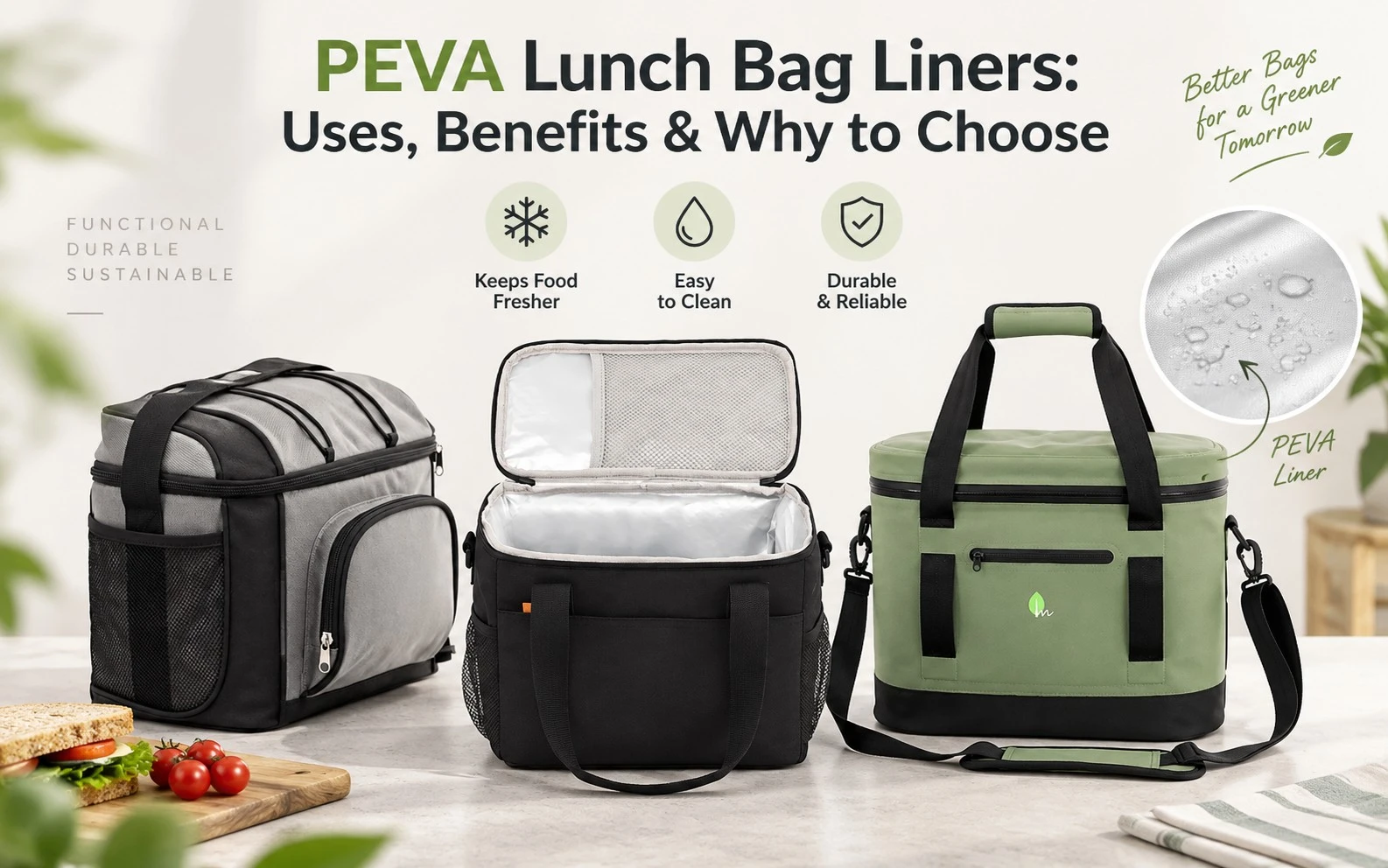
What Is a PEVA Lunch Bag Liner?
PEVA, commonly referred to as polyethylene vinyl acetate, is a flexible polymer material widely used as the inner lining of lunch bags and other insulated soft bags.
In a typical insulated lunch bag, PEVA is not the main insulating layer. The construction usually looks more like this:
Outer fabric → Insulation foam → PEVA inner liner
Each layer has a different job.
The outer shell provides structure, abrasion resistance, and the visible appearance of the bag. Materials such as polyester or 600D fabric are commonly used here.
The insulation foam creates most of the resistance to heat transfer. Depending on the product, manufacturers may use EPE, NBR, or another foam structure. For a broader look at how shells, insulation, and liners work together, see our guide to the best materials for lunch bags.
The PEVA liner forms the interior surface that users see and touch. Its main functions are to provide a cleanable surface, help isolate moisture from the insulation, and create a flexible interior suitable for food containers, beverages, and reusable ice packs.
This distinction matters because a product labeled simply as a "PEVA insulated lunch bag" does not tell buyers how much insulation it contains or how long it will maintain temperature. Thermal performance depends on the complete construction.
PEVA is best understood as a functional lunch bag lining material, not as a replacement for insulation foam.
What Does PEVA Actually Do Inside a Lunch Bag?
A PEVA lunch bag liner handles several practical problems that occur during daily use.
The first is moisture. Cold drinks, chilled meal containers, and ice packs can produce condensation. Sauces and beverages may also leak during transport. A PEVA surface helps separate this moisture from the foam and outer textile layers.
The second is cleaning.
Lunch bags regularly come into contact with food residue, oil, salad dressing, juice, coffee, and other spills. PEVA usually has a relatively smooth, non-absorbent surface, so these messes can often be wiped away before they reach deeper layers of the bag.
PEVA also works well in soft bag construction because it is flexible. It can conform to corners and folded structures without adding the stiffness associated with some heavier coated materials.
Durability still depends on specification. Thin PEVA film can be punctured by sharp food-container corners, bottle caps, metal utensils, or repeated abrasion. Thickness, backing material, seam design, and the type of items carried all affect service life.
PEVA therefore contributes most strongly to cleanability, moisture management, flexibility, and interior durability. It helps make an insulated lunch bag practical to live with, but it does not independently determine cold-retention time.
Key Benefits of PEVA Lunch Bag Liners
For everyday lunch bags, PEVA offers a useful combination of performance, manufacturing flexibility, and cost.
It is easy to clean. A smooth PEVA liner is well suited to bags that carry food every day. Spilled sauces, condensation, and drink residue can usually be wiped from the surface more easily than from highly textured or creased liner materials.
It resists moisture. PEVA provides a useful barrier between the contents of the bag and the insulation structure. This is especially important when chilled containers or reusable ice packs create condensation.
It is flexible and lightweight. PEVA works well in soft lunch totes, school lunch bags, foldable products, and compact meal-prep carriers where a rigid liner would make the product awkward.
It suits reusable products. Lunch bags are opened, compressed, carried, cleaned, and stored repeatedly. A correctly specified PEVA liner can handle this type of routine use without making the bag unnecessarily heavy.
It gives brands a PVC-free liner option. PEVA is frequently chosen when a brand wants to develop a lunch bag without PVC in the inner liner. That does not automatically make the finished product "eco-friendly," but it is a clear material-selection advantage for projects with a PVC-free policy.
It can be customized. Manufacturers can source PEVA in different thicknesses, colors, finishes, and surface textures. That makes the liner part of the product design rather than a hidden commodity. Matte, glossy, smooth, or embossed options may be available depending on the supplier and order volume.
These advantages explain why PEVA is widely used in reusable lunch bags rather than only in low-cost disposable thermal products.
Where Are PEVA Liners Commonly Used?
PEVA is especially useful in soft insulated products where users need a cleanable interior and moderate moisture protection.
|
Product type |
Why PEVA works well |
|
School lunch bags |
Easy to wipe after food and drink spills |
|
Commuter lunch totes |
Lightweight, flexible, and suitable for compact designs |
|
Meal-prep bags |
Handles repeated contact with containers, condensation, and sauces |
|
Picnic bags |
Practical for packaged food, drinks, and reusable ice packs |
|
Grocery coolers |
Smooth interior and flexible sewn construction |
|
Backpack cooler compartments |
Can be integrated into a soft multi-layer bag structure |
School and Kids' Lunch Bags
School lunch bags are exposed to frequent spills and daily cleaning. PEVA is useful here because the liner can be wiped without removing the insulation layer or washing the entire bag.
A PEVA lunch bag with strap, for example, shows how this liner can be combined with a portable everyday format.
The material choice alone does not establish compliance for children's products, so brands should still verify the exact production material against the requirements of the destination market.
Commuter and Meal-Prep Lunch Bags
Office lunch bags and meal-prep carriers often need to look more refined than a basic cooler.
PEVA can support that design goal because the liner can be specified in different colors and surface finishes. At the same time, it handles the practical side of carrying food containers, beverages, dressings, and chilled meals. Compact formats such as a small insulated lunch bag are a typical example of this use case.
Picnic, Outdoor, and Everyday Insulated Bags
PEVA is also common in picnic bags, grocery coolers, camping lunch bags, and insulated backpack compartments. It is particularly practical when the contents are mainly packaged foods, bottles, cans, and reusable ice packs.
For larger casual food-carrying applications, an insulated cooler tote bag is another common format. More outdoor-oriented applications can also be found across broader cooler bag designs.
For these applications, PEVA gives manufacturers a versatile interior surface without requiring the heavier construction used in premium welded soft coolers.
Is a PEVA Lunch Bag Waterproof or Leakproof?
PEVA itself has good water and moisture resistance.
That does not mean every PEVA-lined lunch bag is leakproof.
This is an important distinction. In a conventional sewn lunch bag, the needle passes through the liner and creates small holes. Liquid can also escape through seam intersections, corners, zipper ends, or other attachment points. A water-resistant liner material cannot compensate for poorly controlled seams.
The finished construction matters more than the material name.
- conventionally sewn;
- sewn with additional seam treatment;
- heat sealed where the material structure allows it;
- assembled using another compatible sealing method.
When compatible PEVA structures are sealed rather than simply stitched through the liquid-holding area, leak resistance can improve significantly. Some manufacturers use welded or sealed liner constructions specifically to reduce needle-hole leakage. Our guide to how soft cooler bags are made explains how liner, foam, outer shell, and seam construction work together in the finished product.
Even then, the correct approach is to test the finished bag.
A useful leakage test should define the amount of water, test duration, bag position, whether the zipper is included, and what counts as a pass or failure. A short standing-water test may find obvious defects, but it does not prove long-term waterproof performance.
For this reason, ordinary sewn PEVA lunch bags are usually better suited to reusable ice packs than to large quantities of loose ice and meltwater unless the finished construction has been designed and tested for that purpose.
PEVA provides the moisture-resistant surface. The seams and complete bag design determine whether that surface becomes part of a truly leak-resistant system.
PEVA vs. Other Lunch Bag Liner Materials
PEVA is not the only material used inside insulated bags. Aluminum foil laminates, PVC, and TPU all have valid applications, but they are suited to different product types.
|
Liner material |
Typical application |
Main strength |
Main limitation |
|
PEVA |
Reusable sewn lunch bags |
Easy to clean, flexible, moisture resistant |
Thin film can puncture; sewn seams may leak |
|
Aluminum foil laminate |
Promotional and budget thermal bags |
Lightweight and reflective |
Can crease, tear, or delaminate |
|
PVC film/coated fabric |
Sewn or welded cooler products |
Wide range of constructions; weldable grades available |
Performance depends heavily on formulation |
|
TPU-laminated fabric |
Premium welded soft coolers |
Durable, flexible, suited to welded waterproof construction |
Higher material and production cost |
PEVA vs. Aluminum Foil
Aluminum foil laminates are common in promotional coolers and low-cost thermal bags because they are light, economical, and reflective.
PEVA is generally better suited to products that need frequent cleaning and a smoother everyday user experience.
A reflective foil surface can reduce radiant heat transfer under suitable conditions, but it does not replace the insulation foam. One factory comparison cited in the reference material tested two identical 20 L bags at 85°F and reported that the foil-lined version retained about 10% more solid ice after 12 hours and was roughly 2°F cooler during the later part of the test. The same comparison also found much poorer liquid containment at the stitched foil seams.
That test illustrates an important design point: thermal reflection and leak containment are different performance requirements.
PEVA vs. PVC
PVC can be used as flexible film in sewn bags or as coated fabric in welded cooler constructions. It should not automatically be treated as a low-quality material.
PEVA becomes attractive when a brand specifically wants a PVC-free lunch bag liner while retaining a soft, wipeable interior.
The actual choice should account for formulation, intended use, cost, seam method, and target-market requirements rather than relying on broad claims that one polymer is always better than another.
When Does TPU Make More Sense?
TPU-laminated fabric is more common in premium RF-welded waterproof soft coolers than in ordinary lunch bags.
It is useful where brands require a tougher laminated structure, repeated outdoor use, welded seams, or reliable containment of loose ice and meltwater. It also costs more and requires tighter control of lamination and welding conditions.
For a conventional reusable lunch bag, PEVA is usually the more practical starting point. TPU becomes more relevant when the product moves into premium welded-cooler territory.

How Should Brands Choose and Specify a PEVA Liner?
A sourcing request that says only "PEVA lining" is incomplete.
Two PEVA films can differ substantially in thickness, flexibility, backing, surface finish, puncture resistance, and compatibility with sealing processes. A better specification connects the liner to the way the finished bag will actually be used.
Thickness, Color, and Surface Finish
PEVA lunch bag liners are available in different thicknesses. The reference material identifies approximately 0.10–0.30 mm as a useful development range for lunch-bag applications, while another source recommends around 0.15 mm or above as a practical starting point when improved puncture resistance is needed.
These figures should be treated as design references, not fixed rules.
The appropriate specification depends on:
- PEVA grade;
- backing or laminate structure;
- expected contents;
- folding frequency;
- target product weight;
- cost target;
- seam construction.
Color and surface texture also matter. White PEVA is common because dirt and residue are easy to see during cleaning, but other colors and embossed finishes can support a brand's visual identity.
Insulation and Seam Construction
The liner should be specified together with the rest of the thermal system.
Important decisions include:
- insulation foam type and thickness;
- outer fabric construction;
- sewn, sealed, or welded liner;
- seam treatment;
- zipper and closure design;
- use of ice packs or loose ice;
- expected cleaning method.
One reference suggests 5–8 mm EPE foam as a practical range for certain cooler constructions, but foam thickness should always be selected according to the target bag size and required thermal performance rather than copied as a universal specification. Our guide to insulation materials for custom cooler bags covers the main options in more detail.
Compliance and Finished-Sample Testing
"PEVA" is a material category, not a compliance certificate.
A finished liner may also contain pigments, surface treatments, backing materials, adhesives, or other components. Buyers should therefore verify the exact production material against the intended use and target-market requirements.
For U.S. projects, the FDA's guidance on food-contact substances is a useful reference for understanding how intended use and material identity affect food-contact assessment. For European projects, buyers may also need to check applicable REACH restricted substances.
Depending on the project, useful documentation may include:
- material specifications;
- applicable food-contact documentation;
- restricted-substance test results;
- tested color and thickness;
- production-material traceability;
- retailer-specific requirements.
Finished prototypes should also be evaluated for cleaning, leakage, puncture risk, repeated folding, and seam quality.
Approve the finished prototype, not only the PEVA material swatch.
That single step catches problems that a flat material sample cannot reveal at corners, zipper ends, seams, and attachment points.
FAQ
Does PEVA Keep Food Cold?
PEVA contributes to the functional inner structure of an insulated lunch bag, but it is not the main source of thermal resistance.
Most insulation comes from the foam layer and the overall construction, including closure design, seam gaps, internal volume, and the amount of chilled contents or ice packs.
Is PEVA Better Than Aluminum Foil?
For reusable everyday lunch bags, PEVA is often the more practical choice because it is flexible, easy to wipe, and well suited to food and drink spills.
Aluminum foil laminates remain useful for lightweight promotional products and applications where a reflective interior is desired. Neither material is universally better.
Is PEVA Safe for Lunch Bags?
PEVA is widely used in lunch bag liners, but the material name alone does not prove food-contact compliance.
Brands should verify the exact PEVA formulation and production material against the intended use and applicable requirements in the destination market. General claims such as "all PEVA is FDA approved" should be avoided.
Can You Put Loose Ice in a PEVA Lunch Bag?
Only if the finished bag has been designed and tested for that use.
A conventional sewn PEVA liner may leak through needle holes or seam intersections. Lunch bags intended for loose ice require a more carefully controlled liquid-containment structure.
How Do You Clean a PEVA Lunch Bag Liner?
Wipe spills promptly with an appropriate mild cleaning method, remove food residue, and allow the interior to dry fully before storing the bag closed.
Avoid letting sharp utensils or rough container edges repeatedly scrape the liner, since even a good PEVA film can eventually be punctured or abraded.
Choosing PEVA for Your Next Lunch Bag
PEVA is a strong choice for reusable lunch bags when the product needs a flexible, moisture-resistant, easy-to-clean, and PVC-free inner liner. It works especially well in school lunch bags, commuter totes, meal-prep bags, picnic products, and other everyday insulated soft bags.
The liner should never be specified in isolation. PEVA thickness, insulation foam, seam construction, closure design, intended contents, and finished-product testing all determine how the bag performs in real use.
Dongguan Fenglinwan Leisure Products Co., Ltd. develops insulated and functional bags using structures that include 600D fabric with PEVA lining, along with material selection, sampling, structural development, quality control, and OEM/ODM production support. If you are developing a custom PEVA lunch bag or insulated product, contact our custom bag manufacturing team to discuss the liner specification, insulation structure, prototype, and production requirements.