


Lunch Bag vs. Cooler Bag: What’s the Difference and Which One Do You Need?
Aug 27, 2026
Leave a message
Lunch bags and cooler bags both use insulation to help keep food and drinks at a stable temperature, but they are designed around different priorities. A lunch bag is usually smaller, lighter, and intended for one person's meal during work, school, or a daily commute. A cooler bag typically uses thicker insulation, offers more capacity, and is better suited to longer outdoor use.
The categories do overlap. Some insulated lunch bags perform much like compact soft coolers, so choosing the right bag means looking beyond the product name.
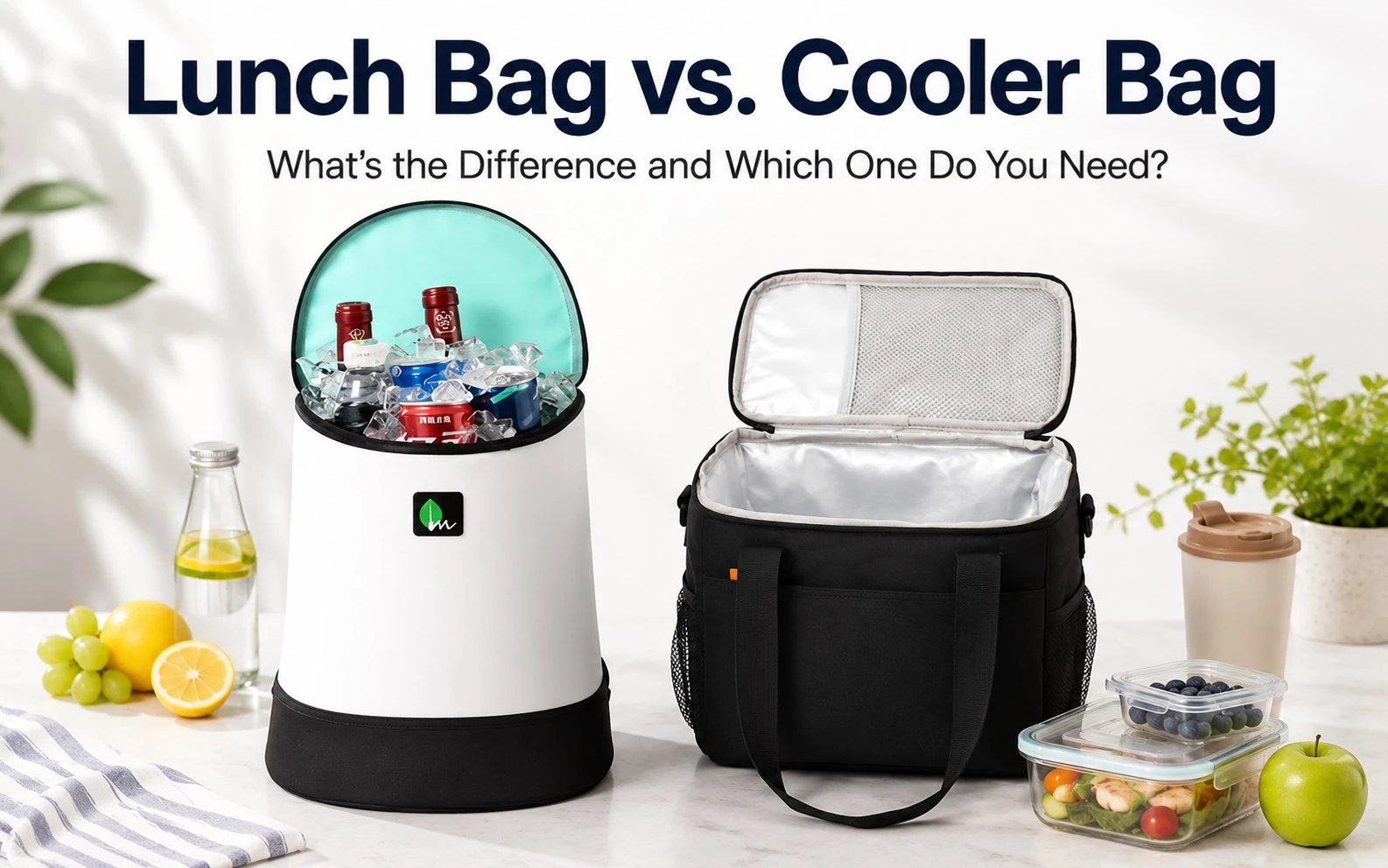
Lunch Bag vs. Cooler Bag: What's the Main Difference?
The main difference between a lunch bag and a cooler bag is the balance between portability and temperature control.
A lunch bag is an insulated food carrier designed mainly for a personal meal. It usually holds a lunch box or sandwich, snacks, utensils, and one small drink. Its compact size makes it easy to carry inside a backpack, tote, locker, or work bag.
A cooler bag, sometimes called a soft cooler, is an insulated bag designed to carry larger quantities of food and drinks while limiting heat transfer for a longer period. It normally has thicker insulation, a more substantial body, and greater capacity for ice packs, beverages, and multiple meals.
That makes lunch bags a natural choice for offices, schools, and short commutes. Cooler bags are usually better for camping, beaches, picnics, road trips, sports, construction sites, and other situations where refrigeration may not be available.
However, these are not strict industry definitions.
Products sold as insulated lunch bags, lunch coolers, and small soft cooler bags often sit somewhere between the two categories. A heavy-duty lunch cooler may offer more insulation than a basic lunch bag while remaining compact enough for one person.
The product label is useful, but the construction and intended use matter more.
Lunch Bag vs. Cooler Bag: Key Differences at a Glance
The following comparison shows the typical differences between a lunch bag and a cooler bag.
|
Feature |
Lunch Bag |
Cooler Bag |
|
Main purpose |
Daily personal meals |
Longer trips and larger food or drink loads |
|
Typical capacity |
One meal, snacks, and a drink |
Multiple meals, several drinks, or food for a group |
|
Insulation |
Usually lighter and thinner |
Usually thicker and more substantial |
|
Cold-retention goal |
A few hours |
Longer-duration cooling |
|
Portability |
High |
Depends on capacity |
|
Weight |
Usually lighter |
Usually heavier |
|
Storage |
Often compact or foldable |
Usually bulkier |
|
Ice packs |
Common |
Common |
|
Loose ice |
Depends on liner and seam construction |
More commonly supported on suitable designs |
|
Leak resistance |
Varies widely |
Often a more important design requirement |
|
Typical use |
Work, school, commuting |
Camping, beach, picnic, sports, road trips |
|
Refrigeration access |
Often available at destination |
Often limited or unavailable |
The biggest mistake is treating these differences as fixed rules. A premium insulated lunch bag may outperform a lightweight promotional cooler, while a compact cooler may be small enough for a normal work lunch.
Think of lunch bags and cooler bags as products on the same spectrum rather than two completely separate categories.

Why Do Cooler Bags Usually Stay Cold Longer?
An insulated bag does not create cold. Its job is to slow the movement of heat from the outside environment into the bag.
Cold food, frozen gel packs, ice, or frozen bottles provide the cooling energy. The construction of the bag determines how quickly that cold is lost.
Several parts of the design have a direct effect on performance. If you want a deeper look at how the layers and manufacturing processes fit together, see our guide to how soft cooler bags are made.
Insulation Thickness and Density
The insulation layer sits between the outer material and the inner liner. It reduces heat transfer and helps the inside temperature change more slowly.
Basic lunch bags tend to use relatively light insulation because portability is a major design priority. Thicker insulation adds volume and weight, which can make a bag less convenient to carry every day.
Cooler bags usually accept that trade-off. They are often designed with thicker or denser insulating materials because longer cold retention matters more than compact storage.
Materials such as NBR foam and other closed-cell insulation systems can be used depending on the required product performance. Different foam structures, thicknesses, and densities can produce very different results, which is why choosing the right insulation material for a custom cooler bag should start with the intended use rather than a single preferred material.
More insulation generally improves thermal resistance, but more is not automatically better. The right construction depends on how long the bag needs to perform and how portable it needs to remain.
Inner Liner and Outer Material
Most insulated bags can be understood as a three-layer system:
Outer shell → insulation layer → inner liner
The outer shell provides structure, abrasion resistance, and protection from the environment. Common options include polyester, nylon, coated fabrics, and waterproof materials such as TPU.
The middle layer provides insulation.
The inner liner creates the food-storage surface and should be easy to wipe clean. PEVA is commonly used in insulated lunch and cooler bags. Other waterproof constructions may use TPU depending on the product design.
For example, an insulated cooler can be developed with a 600D outer fabric, insulation, and PEVA liner for conventional sewn construction. A more waterproof product may use TPU material with an NBR insulation structure.
The correct material combination depends on whether the priority is low weight, easy cleaning, waterproofing, abrasion resistance, flexibility, or longer temperature control.
Zippers, Seams, and Closures
Insulation is only part of the system.
Heat can also enter around the opening, zipper, seams, and other structural joints. A thick insulated wall offers limited benefit if the bag has a large opening that is frequently left unsealed.
Seam construction also affects leak resistance. Traditional sewn seams are widely used for lunch bags and soft coolers, but products requiring stronger water containment can use bonded or welded structures.
HF welding, heat sealing, and other seam-sealing methods can reduce needle holes and create a more integrated waterproof structure when compatible materials are used.
This is why two cooler bags with a similar outer size can perform very differently. Thickness, materials, closure design, seams, and cold-source capacity all work together.
Capacity and Portability: How Much Do You Really Need to Carry?
Capacity is one of the easiest ways to decide between a lunch bag and a cooler bag.
A typical lunch bag is built around one person's daily meal. It may need to hold:
- A lunch box or sandwich
- Fruit or snacks
- One bottle or can
- Utensils
- One or two slim ice packs
That size is usually enough for a normal office or school day. It also keeps the bag easy to carry on public transportation or place inside another backpack.
A cooler bag serves a different load.
It may carry several bottles or cans, multiple meals, picnic food, ingredients for a road trip, or supplies for several people. Larger internal volume also gives users more room for ice packs or ice.
That extra capacity has a cost. A larger cooler requires more material and insulation, and once filled with drinks and ice, it can become heavy.
This is why the largest bag is rarely the best choice for everyone.
If you carry one lunch and have access to a refrigerator shortly after arriving at work, a compact lunch bag is usually more practical. If you are carrying food for several people or staying outdoors for most of the day, the added capacity of a cooler bag is worth the extra bulk.
How Long Do Lunch Bags and Cooler Bags Stay Cold?
Cold-retention time is one of the most important differences, but it should not be treated as a fixed specification for an entire product category.
A basic lightweight lunch bag may be designed around roughly 2 to 3 hours of temperature control. With better insulation and properly frozen ice packs, 2 to 6 hours is a useful general reference range for many insulated lunch bag applications.
Cooler bags are normally designed for longer use. Six hours or more is a reasonable starting point for this type of product, while thicker, heavy-duty cooler bags used with sufficient ice or frozen packs may be designed for 12 to 24 hours or longer.
Those numbers are reference ranges, not guarantees. Our detailed guide to how long a cooler bag stays cold explains the variables behind these differences in greater detail.
Actual performance changes significantly depending on:
- Insulation thickness and density
- The number and size of ice packs
- Whether loose ice is used
- Starting temperature of the food and drinks
- Outdoor temperature
- Direct sunlight
- How full the bag is
- How often the bag is opened
- Zipper and closure design
- Seam construction
A half-empty cooler opened every 15 minutes on a hot beach will not perform like the same cooler packed tightly with pre-chilled drinks and ice and kept in the shade.
For the same reason, an insulated lunch bag cannot make warm food cold. For items that need refrigeration, start with chilled food and use adequate frozen cold sources.
The useful comparison is therefore not simply "2 hours versus 24 hours." Lunch bags are generally optimized for shorter daily use, while cooler bags are designed to support longer cooling periods under more demanding conditions.
Which One Do You Need? Choose by Use Case
The best way to choose between a lunch bag and cooler bag is to look at where the bag will be used, how long the contents need to stay cold, and whether refrigeration will be available.
For Work, School, and Daily Commuting
A lunch bag is usually the better option for normal daily routines.
Choose one when you:
- Carry food for one person
- Have a relatively short commute
- Can place the food in a refrigerator after arriving
- Need the bag to fit inside a backpack, locker, or desk
- Prefer something lightweight and easy to store
For this type of use, carrying a thick soft cooler every day often adds unnecessary size and weight.
A compact design such as a lunch bag with a shoulder strap illustrates why this format works well for everyday carrying. A well-designed insulated lunch bag with cold packs provides a practical balance of convenience and temperature control.
For Construction Sites and Remote Work
This situation needs a different approach.
A worker may still carry only one lunch, but if that meal has to remain in a vehicle, outdoor work area, or remote site for several hours without refrigeration, a basic lightweight lunch bag may not be enough.
A small cooler bag or heavy-duty insulated lunch cooler is often the better choice.
The additional insulation becomes more important when:
- The working day is long
- Outdoor temperatures are high
- There is no refrigerator
- The bag remains in a vehicle or exposed environment
- Larger ice packs are needed
This shows why capacity alone cannot determine which product is right. One person with no access to refrigeration may need a more capable cooler than a family member carrying a short-distance office lunch.
For Picnics, Camping, Beaches, and Road Trips
A cooler bag is the clear choice for most outdoor leisure activities.
These situations usually involve more food, more drinks, longer storage periods, and more exposure to warm outdoor conditions.
A cooler bag also provides space for larger ice packs or loose ice when the liner and seams are designed to contain meltwater.
Durability matters more here as well. Handles, shoulder straps, zippers, outer materials, and bottom reinforcement may all need to support heavier loads than a standard lunch bag.
For a family picnic, weekend campsite, beach trip, or long drive, larger cooler bags provide the capacity and insulation that these applications normally require.
When an Insulated Lunch Bag May Be Enough
Not every user fits neatly into either category.
A heavy-duty insulated lunch bag can provide a useful middle ground for people who want lunch-bag portability with cooler-like construction.
Products in this category may be marketed as:
- Insulated lunch bags
- Lunch coolers
- Work lunch coolers
- Compact soft coolers
An insulated cooler tote bag, for example, represents this crossover approach by combining an everyday carrying format with insulated storage.
These products are useful for commuters who spend longer periods without refrigeration but do not need the capacity of a full-size cooler.
When comparing them, ignore the marketing label for a moment and look at insulation, dimensions, liner construction, cold-pack space, and carrying comfort.
Waterproof, Leakproof, and Food-Safe: What Should You Look For?
Terms such as waterproof, water-resistant, and leakproof are often used interchangeably in product listings, but they describe different characteristics.
Waterproof vs. Water-Resistant vs. Leak-Resistant
A water-resistant outer material can resist light rain or splashes, but water may still enter through zippers and stitched seams.
A waterproof material can prevent water from passing through the fabric itself. That does not automatically make the complete bag waterproof.
A leak-resistant or leakproof liner refers mainly to whether liquid inside the bag can escape through the liner, seams, corners, or openings.
This distinction becomes important when using loose ice.
A lunch bag with PEVA lining may be easy to clean and suitable for frozen gel packs, but if the liner has stitched seams, melted ice may eventually escape through those seams.
A cooler specifically designed to hold loose ice may use a more thoroughly sealed liner or welded construction.
Always evaluate the complete structure rather than assuming that a waterproof fabric makes the whole bag leakproof.
Ice Packs, Loose Ice, and Food Safety
Ice packs are suitable for most lunch bags because they provide a contained cold source without creating large amounts of meltwater.
For packed perishable lunches, the USDA recommends using at least two cold sources, such as two frozen gel packs or a gel pack combined with a frozen bottle or juice box.
Frozen bottles can therefore serve a similar purpose.
Loose ice places more demands on the bag. Before filling any insulated bag with ice, check whether the liner, seams, and closure are designed to contain the resulting water. If loose ice is part of your intended use, our guide on whether you can put ice in a cooler bag explains the construction factors to check first.
For perishable food, insulation alone is not enough. The bag needs an adequate cold source, and the contents should already be cold before packing. The U.S. Food and Drug Administration recommends keeping cold food at 40°F (4°C) or below and using ice or frozen gel packs when transporting it in a cooler.
A better-insulated bag slows warming, but correct packing still determines whether the food stays cold enough for the intended period.
Lunch Bag vs. Cooler Bag for Brands and Bulk Buyers
For brands developing a custom insulated bag, choosing the product name should come after defining the functional requirements.
A better starting point is to establish:
- Target user
- Typical usage environment
- Required cooling duration
- Capacity
- Insulation type and thickness
- Inner liner
- Outer material
- Sewn, bonded, or welded construction
- Leak-resistance requirements
- Zipper or closure system
- Carrying method
- Branding and logo requirements
- Packaging requirements
A compact corporate lunch bag, for example, may prioritize low weight, a clean appearance, easy storage, and logo placement.
A cooler developed for construction workers, fishing, camping, or field operations may require thicker insulation, heavier load capacity, reinforced straps, stronger outer materials, and more attention to leak-resistant construction.
There is also growing room between these traditional categories. Brands can develop compact lunch coolers that combine everyday portability with more substantial insulation, or choose between backpack and traditional soft-cooler formats based on the intended market. Our comparison of cooler backpacks vs. soft cooler bags covers these design trade-offs in more detail.
For custom product development, the specification should define the bag-not the category name.
Lunch Bag vs. Cooler Bag FAQs
Is a Lunch Bag the Same as a Cooler Bag?
No, although the categories overlap.
A lunch bag usually focuses on compact daily meal storage and easy carrying. A cooler bag normally provides greater capacity and more substantial insulation for longer use.
An insulated lunch cooler can sit between the two.
Can I Use a Cooler Bag as a Lunch Bag?
Yes.
A small cooler bag can work very well as a lunch bag, especially when food needs to stay cold for several hours without access to a refrigerator.
The main disadvantage is that it may be heavier and bulkier than necessary for a normal office commute.
Can You Put Ice in a Lunch Bag?
Only if the bag is designed for it.
The outer material may be waterproof while the internal stitched seams are not fully leakproof. Melted ice can then leak through corners or seams.
For most lunch bags, frozen gel packs are the simpler option. Use loose ice only when the manufacturer confirms that the liner and construction can contain meltwater.
Does a Lunch Bag Need an Ice Pack?
For food that needs to remain refrigerated, an ice pack or another frozen cold source is generally necessary.
The insulation in a lunch bag slows heat transfer. It does not actively cool the contents.
Starting with pre-chilled food and properly frozen cold packs will provide much better results than placing room-temperature food in an insulated bag.
Is a Thicker Cooler Bag Always Better?
No.
Thicker insulation can improve cold-retention potential, but it also increases weight and bulk. A highly insulated cooler may be unnecessary for a short office commute.
The better choice is the lightest and most practical construction that can reliably meet your required capacity and cooling time.

Which Should You Choose: Lunch Bag or Cooler Bag?
Choose a lunch bag when you mainly carry one meal, value low weight and compact storage, and only need food kept cool for part of the day or until refrigeration becomes available.
Choose a cooler bag when you need more capacity, longer cold retention, larger cold packs or ice, or reliable performance during camping, road trips, outdoor work, beach trips, and other situations without refrigeration.
If your requirements fall between those two categories, a heavy-duty insulated lunch bag or compact soft cooler may be the better fit.
What matters most is not the name on the product. Look at the capacity, insulation, liner, seam construction, closure, cold source, and actual use environment.
FENGLINWAN develops and manufactures custom lunch bags, cooler bags, and other insulated bag solutions for OEM/ODM projects. If you are developing a new insulated product and need support with materials, structure, samples, waterproof construction, or mass production, contact us to discuss your requirements.