


Best Materials for Lunch Bags: Fabric, Insulation & Lining Guide
Aug 27, 2026
Leave a message
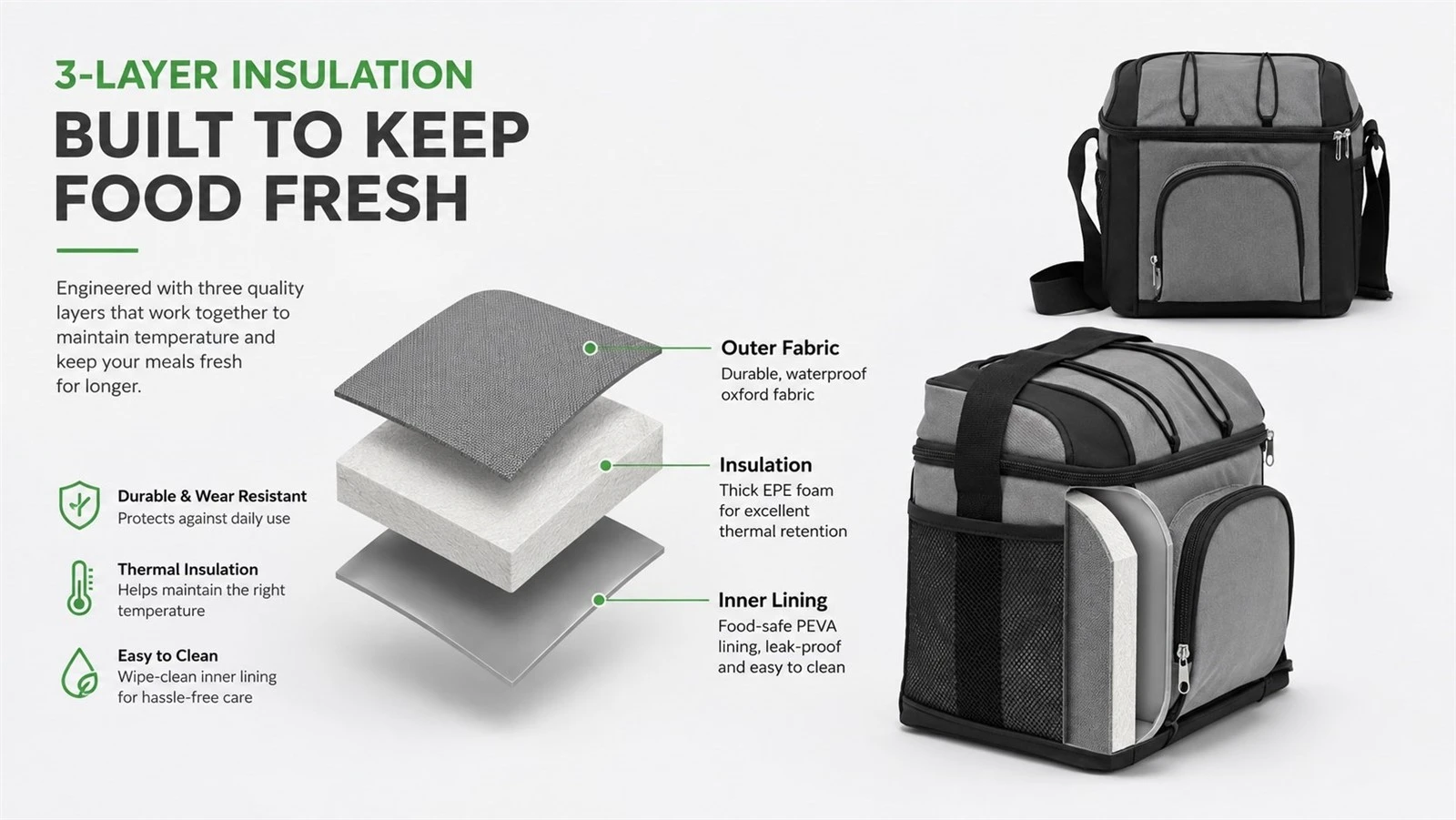
The best lunch bag materials work as a system. Most insulated lunch bags combine a durable outer fabric, a thermal insulation layer, and a moisture-resistant inner lining. Polyester and Oxford fabrics are common outer shells, EPE, EVA, and NBR are practical insulation options, while PEVA, aluminum film, and TPU are widely used lining choices.
The right combination depends on how the bag will be used, how much structure it needs, the target cost, and the required level of insulation and leak resistance.
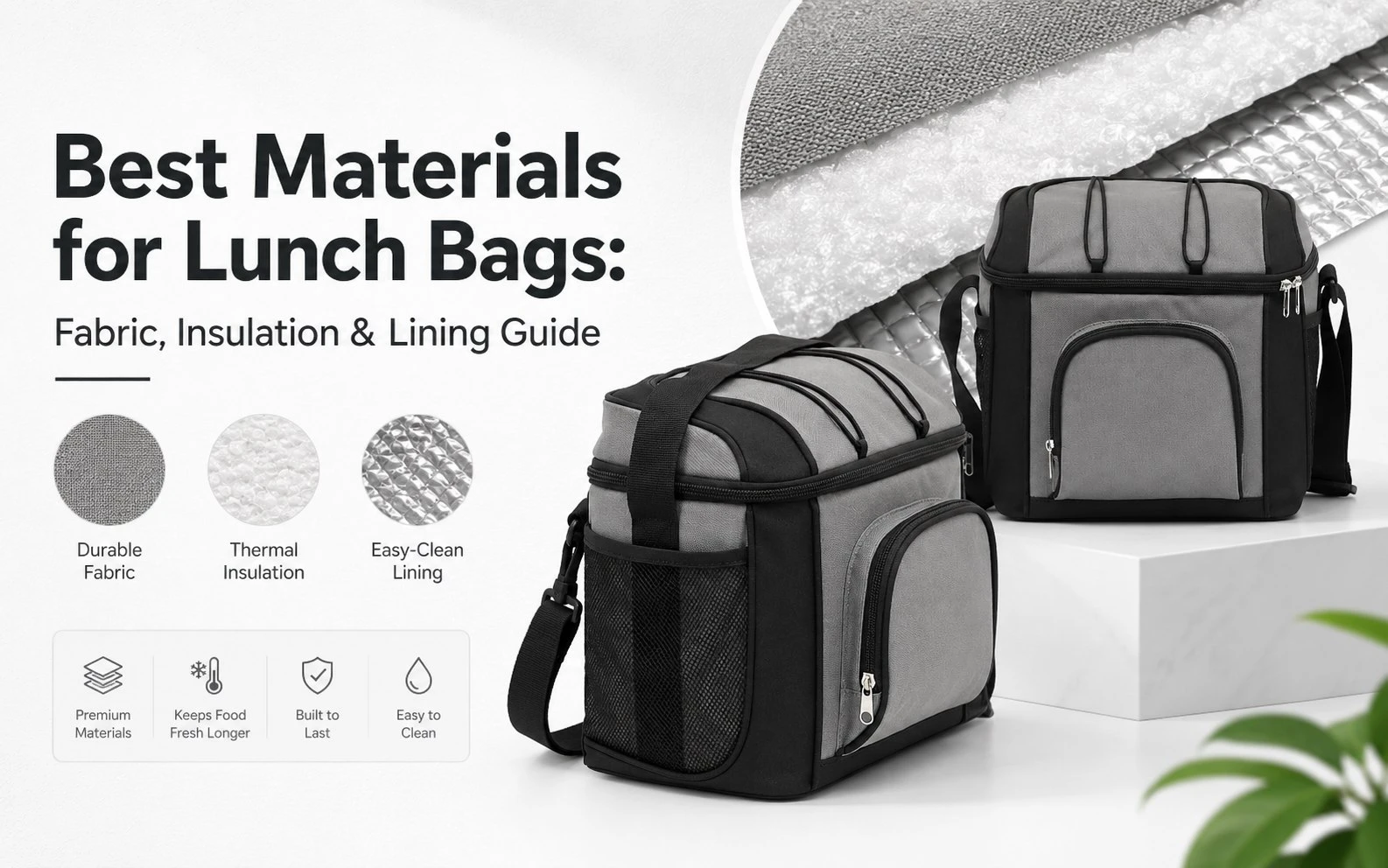
What Are Lunch Bags Made Of?
An insulated lunch bag normally uses three functional material layers:
- Outer fabric protects the bag from abrasion, daily handling, and light moisture while defining its appearance.
- Insulation slows heat transfer between the food and the surrounding environment.
- Inner lining creates the interior surface that handles moisture, spills, cleaning, and sometimes thermal reflection.
A finished lunch bag also includes components such as zippers or other closures, handles, webbing, pockets, and seams. These parts matter because materials alone do not determine finished performance.
|
Layer |
Main Function |
Common Materials |
|
Outer fabric |
Durability, appearance, external protection |
Polyester, Oxford fabric, nylon, canvas, neoprene, recycled polyester |
|
Insulation |
Slows heat transfer and adds cushioning |
EPE/PE foam, EVA foam, NBR foam |
|
Inner lining |
Moisture control, cleaning, leak resistance, thermal reflection |
PEVA, aluminum/metallized film, TPU |
For material selection, it is better to think in terms of a complete construction rather than choosing one "best" fabric.
Best Outer Fabrics for Lunch Bags
The outer fabric has little value as insulation by itself, but it has a major effect on durability, weight, appearance, water resistance, branding, and product cost. For a broader comparison of coatings and technical shell materials, see this guide to waterproof fabrics for bags.
Polyester and 600D Oxford Fabric
Polyester is one of the most practical lunch bag fabrics for everyday products. It is lightweight, cost-effective, holds color well, and works across a wide range of school, office, promotional, and retail lunch bags.
600D Oxford fabric is commonly selected when the product needs a tougher and more structured exterior. It handles daily abrasion well and is frequently used for cooler-style lunch bags, outdoor lunch bags, and products that need a stronger feel.
For most mainstream insulated lunch bags, polyester or Oxford fabric is the safest starting point. They offer a good balance between durability, weight, appearance, and cost.
Water resistance still depends on the exact fabric construction and any backing, coating, or lamination. A polyester or Oxford shell should not automatically be described as making the complete lunch bag waterproof.
Nylon and Ripstop Nylon
Nylon is useful when low weight and tear resistance are priorities. Ripstop versions are particularly suitable for lightweight outdoor or premium products where the buyer wants a less bulky exterior.
Nylon can also be supplied with water-resistant or waterproof treatments, but the finished performance depends on the material treatment and bag construction.
This distinction matters. A water-resistant outer fabric does not prevent leakage through sewn seams or an ordinary zipper.
Canvas, Neoprene and Recycled Fabrics
Cotton canvas gives a lunch bag a softer, more natural retail appearance. It works well for lifestyle totes and casual lunch bags, but it usually needs a laminated or water-resistant backing if the product must handle condensation and spills.
Neoprene is soft, flexible, and cushioned. It can contribute thermal resistance and is useful for form-fitting lunch totes, bottle holders, and other flexible insulated designs. It is less suitable when a buyer wants a rigid, box-shaped product.
Recycled polyester, including RPET options, is useful for programs built around recycled-content positioning. Buyers should verify the actual material specification and supporting documentation rather than relying only on an environmental marketing claim.
|
Outer Material |
Main Strength |
Main Limitation |
Typical Use |
|
Polyester |
Lightweight, economical, versatile |
Performance depends on finish and construction |
Everyday and promotional bags |
|
600D Oxford |
Tough, abrasion resistant, structured |
Heavier than lightweight fabrics |
School, office and outdoor lunch bags |
|
Nylon / Ripstop |
Lightweight and tear resistant |
Often higher cost |
Premium lightweight products |
|
Canvas |
Natural retail appearance |
Needs added moisture protection |
Lifestyle lunch totes |
|
Neoprene |
Soft, flexible, cushioned |
Less structural support |
Flexible lunch bags and bottle holders |
|
RPET |
Recycled-content positioning |
Claims need material documentation |
Sustainability-focused programs |
For a broad commercial product range, polyester and Oxford fabric remain the most versatile choices. Nylon, canvas, neoprene, and RPET make more sense when a specific weight, appearance, flexibility, or branding goal justifies them.
Best Insulation Materials for Lunch Bags
Lunch bag insulation is the material between the outer shell and inner lining that slows heat transfer. It does not actively cool or heat food. In thermal science, heat moves through conduction, convection, and radiation; insulation is used to reduce that transfer rather than generate cold or heat. The U.S. Department of Energy's explanation of heat flow provides useful background on these mechanisms.
For cold contents, insulation slows heat entering the bag. For warm contents, it slows heat escaping. Foam materials do this partly through their cellular structure, which contains small pockets of air that resist heat transfer.
For a deeper comparison focused on soft coolers, see how to choose insulation materials for custom cooler bags.
EPE / PE Foam
Expanded polyethylene, commonly called EPE foam, is one of the most practical insulation materials for mainstream insulated lunch bags.
Its main advantages are:
- Lightweight construction
- Good thermal resistance for its cost
- Flexibility
- Cushioning
- Suitability for high-volume commercial production
EPE works particularly well in school lunch bags, office lunch bags, promotional products, and general cooler-style bags where cost and performance need to remain balanced.
For many standard programs, EPE is the default insulation option worth evaluating first.
EVA Foam
EVA foam is generally denser and firmer than typical PE foam constructions. That makes it useful when insulation also needs to help maintain the shape of the bag.
EVA can provide:
- Better structural support
- Good cushioning
- Greater firmness
- A more substantial product feel
It is often more appropriate for structured lunch boxes or premium insulated bags than for highly compressible designs.
EVA should not automatically be described as insulating better than EPE in every application. Finished thermal performance depends on the material thickness, density, bag size, closures, seams, and complete construction.
NBR Foam
NBR foam is another useful closed-cell insulation material for higher-performance insulated products. It combines flexibility, cushioning, and thermal resistance and can work well in cooler bags and outdoor insulated constructions.
FENGLINWAN's existing product and material system includes insulated constructions such as TPU + NBR, with NBR used as an insulation layer or internal support in cooler products.
NBR is particularly worth considering when a project needs more than a basic lightweight lunch bag and the design calls for a flexible but substantial insulation layer.
Reflective Layers: Aluminum Film and Mylar
Aluminum film, metallized film, and Mylar-type materials work differently from foam.
Foam primarily slows heat transfer through its insulating structure. A reflective thermal layer helps manage radiant heat by reflecting thermal energy. This is why reflective films are often combined with foam rather than used as a complete replacement for it.
That layered approach is more useful than treating aluminum film as the entire insulation system.
|
Insulation |
Main Characteristic |
Structure |
Best Fit |
|
EPE / PE foam |
Lightweight and economical |
Soft to moderately structured |
Mainstream lunch bags |
|
EVA foam |
Denser and firmer |
More structured |
Premium or box-style lunch bags |
|
NBR foam |
Flexible with substantial insulation |
Flexible, supportive |
Outdoor and higher-performance insulated bags |
|
Reflective film |
Reflects radiant heat |
Very thin |
Supplemental thermal layer |
There is no universal winner. EPE suits a wide range of standard lunch bags, EVA is useful when structure matters, and NBR is attractive for more demanding insulated constructions.
Best Lining Materials: PEVA vs Aluminum Film vs TPU
The inner lining is the surface exposed to condensation, spills, food containers, ice packs, and repeated cleaning. A good lunch bag lining should therefore be selected for moisture resistance, durability, cleanability, and the intended construction method.
PEVA Lining
PEVA lining is one of the most common options for everyday insulated lunch bags. It is flexible, moisture resistant, and easy to wipe clean, which makes it practical for school, office, and general retail products.
PEVA is often used with polyester or Oxford outer fabrics and foam insulation.
One point requires care: the name PEVA alone does not prove that every formulation automatically meets a particular food-contact or chemical compliance requirement. For projects that require direct food-contact compliance, buyers should check the exact material formulation, intended use, and supporting documentation against applicable FDA food-contact substance and packaging requirements.
Aluminum or Metallized Film
Aluminum or metallized film is light, wipeable, and reflective. It is frequently used in insulated lunch bags where the interior surface is also expected to contribute to thermal management.
Its main weakness is physical durability. Very thin film can be more vulnerable to puncture, tearing, or damage from sharp utensils and hard-edged containers.
The quality of the laminate and the finished construction therefore matter as much as the reflective appearance.
TPU Lining
Thermoplastic polyurethane, or TPU, is a durable waterproof material option for premium or heavy-duty insulated bags. It is flexible and can be compatible with welded constructions, which makes it useful where stronger leak resistance is required.
TPU typically costs more than a conventional PEVA lining, but it can be the better choice for outdoor coolers and products designed for repeated exposure to water, melting ice, or demanding use. Buyers comparing TPU specifications can review this guide to TPU waterproof material.
|
Lining |
Main Strength |
Main Limitation |
Best Application |
|
PEVA |
Flexible, moisture resistant, easy to clean |
Compliance depends on exact specification |
Everyday lunch bags |
|
Aluminum / metallized film |
Lightweight and reflective |
Thin films can puncture or tear |
General insulated bags |
|
TPU |
Durable, waterproof potential, weldable |
Higher cost |
Premium and heavy-duty bags |
PEVA remains a strong general-purpose choice. TPU becomes more attractive when durability and welded waterproof construction are more important than minimum material cost.
What Actually Determines Lunch Bag Insulation Performance?
The insulation material is important, but it is only one part of the finished thermal system.
Actual performance is affected by:
- Insulation material
- Foam thickness
- Foam density
- Bag volume
- Lining construction
- Seam design
- Zipper or closure
- Opening frequency
- Ambient temperature
- Quantity and temperature of the contents
- Use of ice packs or other temperature sources
This is why a statement such as "5 mm foam keeps food cold for a fixed number of hours" is too simple for product development. A small, tightly closed bag and a large bag with the same insulation thickness can perform very differently. For more detail on the variables behind real-world retention, see how long a cooler bag stays cold.
Thicker foam can improve thermal resistance, but thickness alone does not define retention time.
For perishable food, insulation also does not replace a cold source. USDA food-safety guidance recommends using an insulated lunch bag together with appropriate cold sources for foods that need to remain chilled; see the USDA FSIS guidance on keeping bag lunches safe.
Construction also changes leak and water performance. A fabric may itself resist water, but conventional sewing creates needle holes. Ordinary zippers and unsealed seams can also become leakage paths.
Higher-performance bags may therefore use seam sealing, heat sealing, or HF welding instead of relying only on stitched construction. These construction choices are explained in more detail in how soft cooler bags are made.
A waterproof material does not automatically make a waterproof lunch bag.
Finished-product testing is more meaningful than judging thermal or waterproof performance from one material name.
Which Lunch Bag Material Is Best for Different Uses?
A useful material recommendation starts with the application.
Everyday School and Office Lunch Bags
For most daily-use products, a practical construction is:
Polyester or Oxford fabric + EPE foam + PEVA lining
This combination offers good durability, manageable weight, easy cleaning, and a reasonable production cost. It works well for lunch boxes, soft lunch totes, and standard insulated bags. A typical small lunch bag is a useful reference for this compact daily-use format.
Premium or Structured Lunch Bags
Products that need a firmer shape can move toward:
Oxford or nylon outer fabric + EVA or denser foam + PEVA or reflective lining
The denser insulation supports the structure and gives the bag a more substantial feel. This approach is useful for premium office bags and box-style retail products.
Outdoor and Heavy-Duty Insulated Bags
For products that will face more water, abrasion, ice, or rough handling, consider:
TPU-coated or heavy-duty outer construction + NBR or suitable closed-cell foam + TPU or compatible waterproof lining
Welded seam construction can further improve leak resistance when the material system is compatible with the manufacturing process.
This type of construction makes more sense for outdoor insulated bags and soft coolers than for a low-cost promotional lunch tote. An insulated cooler tote bag is one example of a larger insulated format where structure, carrying style, and thermal materials need to be considered together.
Lifestyle, Promotional and Sustainability-Focused Bags
A lifestyle lunch tote may use canvas or another soft textile to create a specific retail look. The inner insulation and lining still need to handle condensation and cleaning.
For promotional programs, polyester with economical foam and PEVA is usually easier to justify because the cost target matters more.
A sustainability-focused program can use RPET or another verified recycled textile for the exterior. The buyer should still evaluate the insulation, lining, coatings, durability, and supporting material documentation rather than judging the whole product from one recycled component.
|
Use Case |
Suggested Outer Material |
Insulation |
Lining |
|
School / office |
Polyester or 600D Oxford |
EPE |
PEVA |
|
Premium structured |
Oxford or nylon |
EVA / denser foam |
PEVA or reflective lining |
|
Outdoor / heavy-duty |
TPU-coated or durable technical fabric |
NBR / closed-cell foam |
TPU |
|
Lifestyle tote |
Canvas or soft textile |
EPE / suitable foam |
PEVA |
|
Promotional |
Polyester |
Economical EPE/PE foam |
PEVA |
|
Recycled-content program |
RPET |
Application-specific foam |
PEVA or specified lining |
The best lunch bag material is therefore a material combination chosen for a specific product, not a universal material ranking.
How to Choose Materials for a Custom Lunch Bag
For a custom lunch bag, material selection should happen before sampling, not after the first sample has already been made.
Start with the intended product and market. An inexpensive promotional lunch bag, a children's school bag, and a premium outdoor cooler require very different material decisions.
Before sampling, confirm:
- Product dimensions or target capacity
- Outer fabric
- Insulation type and thickness
- Inner lining
- Zipper or closure
- Seam construction
- Handles and pockets
- Logo method
- Color requirements
- Testing or compliance requirements
- Packaging
- Order quantity
- Destination market
Outer material also affects branding. Texture, surface finish, flexibility, and construction can influence which logo method is practical and how the finished product looks at retail.
Once these choices are made, the final structure should be recorded in the product specification and carried into sample development. For OEM and private-label projects, this reduces the risk of comparing samples that use different materials or constructions.
Material selection is therefore a product-development decision, not simply a purchasing decision.
FAQ
What is the best material for a lunch bag?
For most everyday insulated lunch bags, polyester or Oxford fabric + closed-cell foam + PEVA lining provides a practical balance of durability, insulation, weight, cleanability, and cost.
More demanding products may use EVA or NBR insulation and TPU-based waterproof constructions.
Is PEVA or aluminum foil better for lunch bags?
Neither is automatically better.
PEVA is flexible, moisture resistant, and easy to clean. Aluminum or metallized film provides a reflective interior surface that can contribute to thermal management. The right choice depends on the rest of the insulation system, durability requirements, and target cost.
What insulation is used in lunch bags?
Common lunch bag insulation materials include EPE/PE foam, EVA foam, and NBR foam. Reflective materials such as aluminum film or Mylar may also be added as supplemental thermal layers.
Some designs use neoprene or fiber-based insulation where flexibility or a specific product style is more important.
How thick should lunch bag insulation be?
There is no single correct thickness.
The required foam thickness depends on bag size, foam density, target performance, structural requirements, weight, and cost. Finished-bag testing is the best way to validate thermal performance.
Are lunch bags waterproof?
Some lunch bag fabrics and linings can be waterproof, but the finished bag is only as waterproof as its seams, zipper, closure, and overall construction.
A sewn lunch bag made from waterproof fabric may still leak through needle holes or an ordinary zipper. Welded or sealed constructions are more appropriate when higher leak resistance is required.
What should buyers confirm before sampling a custom lunch bag?
At minimum, confirm the outer fabric, insulation, lining, dimensions, zipper or closure, handles, pockets, logo, packaging, testing requirements, quantity, and destination market.
These choices should be documented before the sample is approved for production.
The best materials for lunch bags are the ones that work together. Polyester and Oxford are dependable outer fabrics, EPE, EVA, and NBR cover different insulation needs, while PEVA, reflective film, and TPU provide useful lining options. The final choice should match the required thermal performance, durability, structure, cost, and end-use environment.
Dongguan Fenglinwan Leisure Products Co., Ltd. develops and manufactures custom lunch bags, cooler bags, and other insulated products with OEM/ODM support from material selection and sampling through testing and production. If you are developing a new insulated bag, contact our custom bag manufacturing team to discuss the most suitable fabric, insulation, lining, and construction for your project.