


NBR Insulation in Cooler Bags: What Buyers Need to Know
Sep 16, 2026
Leave a message
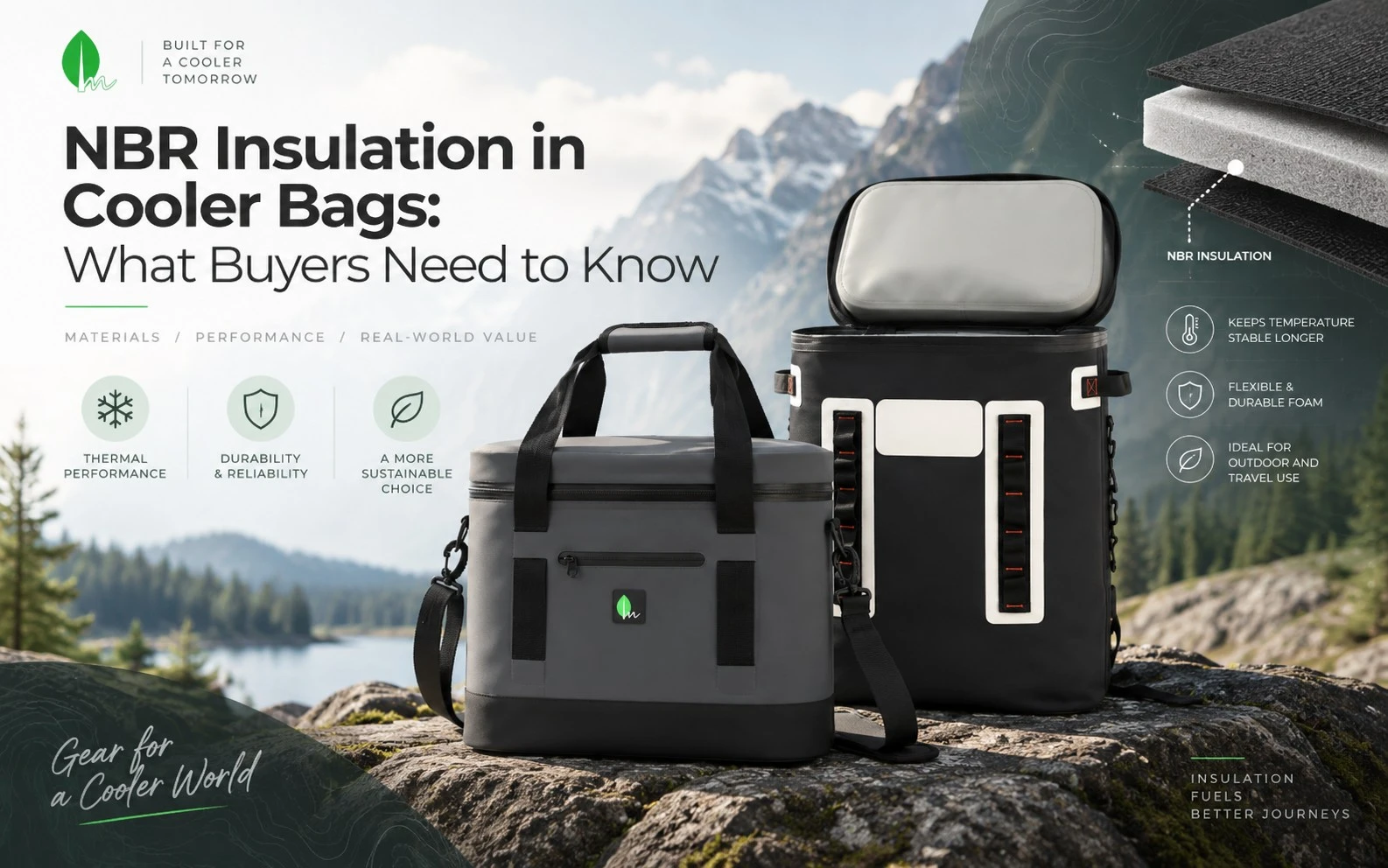
NBR insulation is widely used in performance-oriented soft cooler bags because it combines thermal resistance, flexibility, cushioning, and low moisture absorption in one closed-cell foam layer. For buyers, though, "NBR" is only the starting point. Thickness, density, the outer shell, liner, seams, zipper, and finished-product testing all affect how a cooler performs. A well-specified NBR cooler can work very well for outdoor, commuter, sports, and other demanding applications, but the material needs to be selected as part of the complete cooler construction.
What Is NBR Insulation in a Cooler Bag?
NBR stands for Nitrile Butadiene Rubber, a synthetic rubber made from acrylonitrile and butadiene. In cooler bags, it is generally used in a foamed, closed-cell form. Flexible cellular rubber materials such as these are covered by test and classification frameworks including the ASTM D1056 flexible cellular materials standard.
A closed-cell foam contains many small, isolated cells filled with gas. This cellular structure slows heat transfer through the insulation layer. It also helps the foam resist moisture uptake better than an open-cell material.
In a typical soft cooler, the NBR sits between the exterior and interior layers:
|
Layer |
Typical Materials |
Main Function |
|
Outer shell |
TPU, Oxford fabric, nylon, technical coated fabric |
Abrasion resistance, appearance, external protection |
|
Insulation |
NBR closed-cell foam |
Slows heat transfer, adds cushioning and structure |
|
Inner liner |
TPU, PEVA, reflective or other compatible liner |
Moisture control, cleanability, leak resistance |
Simply put, the NBR is the thermal core. It does not actively cool the contents. It slows the movement of heat between the inside of the cooler and the surrounding environment.
That distinction matters when evaluating supplier claims. The insulation layer contributes heavily to performance, but it operates together with the rest of the bag.
Why Is NBR Used in Premium Soft Coolers?
NBR is especially useful when the product needs more than basic lightweight insulation.
Its first advantage is thermal resistance. Closed-cell NBR foam creates a substantial insulation layer without requiring the rigid construction associated with many hard coolers. This makes it suitable for soft cooler backpacks, insulated totes, fishing bags, golf cooler bags, and other products that still need to flex during use. A double shoulder insulated bag, for example, needs insulation that can work with a wearable, flexible structure.
The second advantage is its rubber-like feel. NBR provides cushioning and can recover from repeated compression better than many low-cost lightweight foams. That affects more than durability. It also changes how the finished bag feels, how well it holds its shape, and how easily it can be carried or folded.
Moisture resistance is another practical benefit. Closed-cell NBR has low water absorption, which is useful in products exposed to condensation, melting ice, rain, or splash. The insulation is normally protected by an inner liner, but lower moisture uptake gives the material an additional margin of durability.
NBR also has useful resistance to oils and some chemicals. In a cooler bag, this is usually a secondary property because the liner is the first surface exposed to spills. It can still matter in catering, industrial, outdoor, and other demanding applications.
For a performance-oriented soft cooler, NBR makes the most sense when thermal insulation, flexibility, cushioning, and moisture resistance need to work together in the same layer.
How Thick Should NBR Insulation Be?
NBR insulation thickness directly affects the thermal resistance of the cooler, but increasing thickness also changes the product's weight, internal capacity, stiffness, and cost.
There is no single correct thickness for every cooler. In product development, the following ranges are useful starting points.
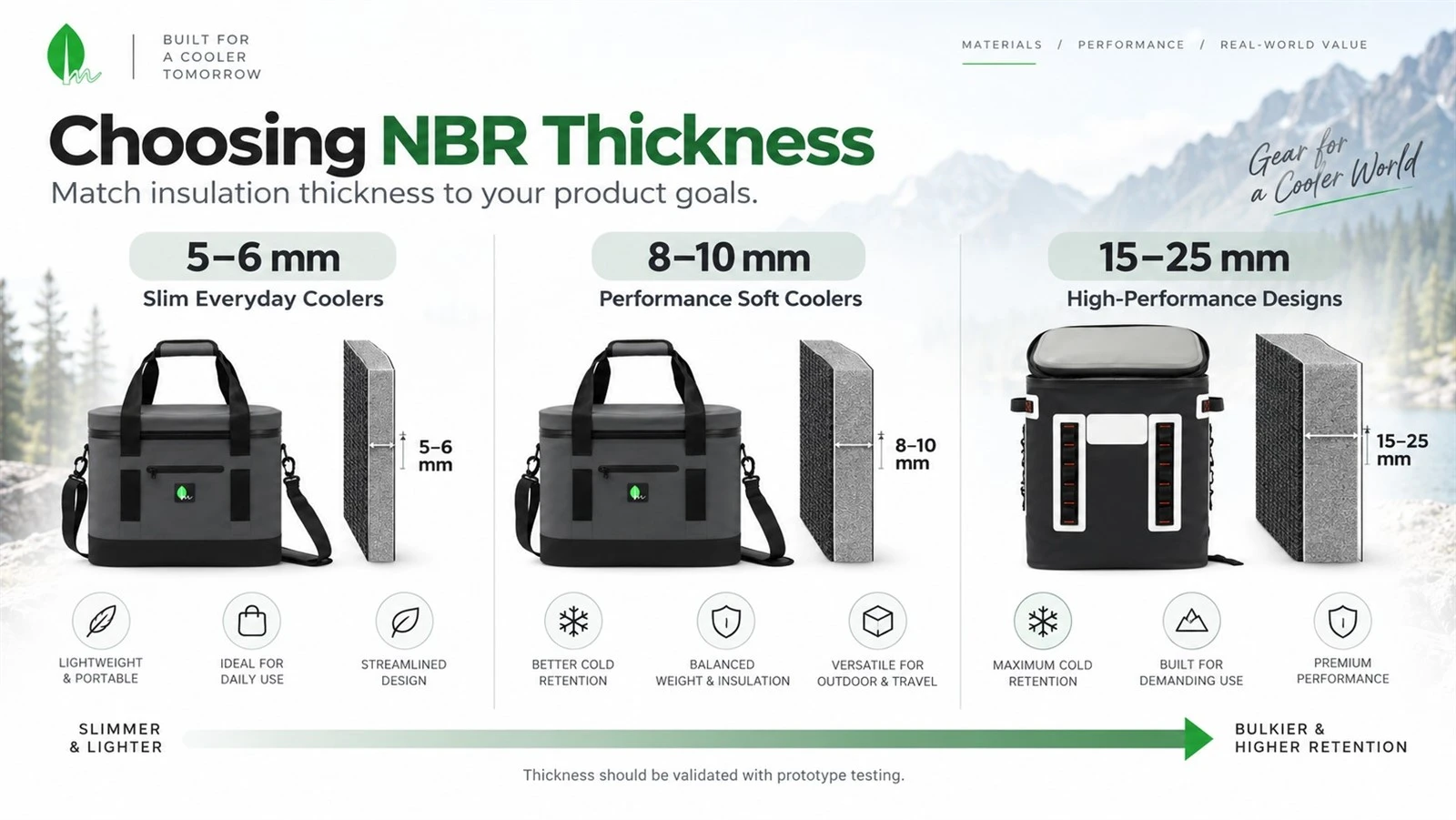
5–6 mm: Slim Everyday and Commuter Coolers
A 5–6 mm NBR layer works well as a starting point for compact lunch coolers, commuter backpacks, and products where a slim appearance matters.
This thickness keeps the construction relatively light and leaves more usable interior space. It is appropriate when the cooler is designed for several hours of everyday use rather than extended outdoor retention. Buyers developing smaller insulated formats can also compare the broader material choices used in insulated lunch bags.
8–10 mm: Performance-Oriented Soft Coolers
For many premium soft coolers, 8–10 mm is a practical middle range.
It provides a more substantial insulation layer while keeping the bag portable. This range is commonly suitable for cooler backpacks, outdoor day-trip bags, fishing coolers, and weekend-use products. A 24 can backpack cooler is the type of format where capacity, insulation thickness, carrying comfort, and exterior dimensions all need to be balanced.
In well-designed products, 8–10 mm NBR can support 12–24-hour cooling targets, depending on ambient temperature, cooler size, ice-to-content ratio, opening frequency, and the rest of the construction.
The important word here is product. A 10 mm NBR sheet does not carry a fixed "24-hour" rating on its own.
15–25 mm: High-Performance and Specialized Designs
When longer retention is required, designers may move toward approximately 15 mm or more, with 15–25 mm used in some demanding outdoor or specialized constructions.
The trade-offs become much more noticeable at this point. Thicker insulation reduces usable interior dimensions, adds material cost and weight, and can make the cooler less collapsible.
|
NBR Thickness |
Typical Design Direction |
Main Trade-Off |
|
5–6 mm |
Daily use, commuter, compact cooler |
Lower maximum thermal resistance |
|
8–10 mm |
Premium soft cooler, outdoor day use |
More bulk than lightweight designs |
|
Around 15 mm |
Higher-retention outdoor cooler |
Reduced internal capacity and increased weight |
|
15–25 mm |
Specialized high-performance applications |
Significant bulk, cost, and structural impact |
More insulation can increase thermal resistance, but the thickness should be tied to a defined performance target and validated with a finished prototype.
NBR vs EPE, EVA and PU Foam
NBR is one of several insulation options used in soft cooler development. The right choice depends on the target price, structure, weight, durability, and thermal performance. For a broader sourcing comparison, see this guide to cooler bag insulation materials.
|
Material |
Typical Strength |
Structural Feel |
Cost Position |
Common Fit |
|
EPE / PE foam |
Lightweight, economical |
Soft to moderately structured |
Lower |
Promotional, lunch and mainstream cooler bags |
|
EVA foam |
Firm, supportive, good cushioning |
More structured |
Medium |
Box-style and structured insulated bags |
|
NBR foam |
Flexible, substantial insulation, good recovery |
Flexible and supportive |
Medium to higher |
Premium, outdoor and performance-oriented soft coolers |
|
PU foam |
Strong thermal performance; formulation varies |
Can be more rigid depending on type |
Varies |
Structured or higher-performance insulated products |
NBR vs EPE Foam
EPE is widely used because it is light, inexpensive, and suitable for large-volume commercial production. It is a sensible choice for school lunch bags, promotional coolers, and mainstream products where cost is a major constraint.
NBR is more attractive when the product needs better cushioning, stronger recovery after compression, and a more substantial insulation layer. It usually comes with a higher material cost, so the decision should match the intended retail positioning.
NBR vs EVA Foam
EVA is generally firmer and is useful when the insulation layer also needs to help maintain the shape of the bag. It works well in structured lunch boxes and products that need a more solid feel.
NBR is more flexible and better suited to soft cooler designs that must bend, fold, or conform to the body while still providing a substantial insulation layer.
NBR vs PU Foam
PU foam covers a wide range of formulations and constructions. In soft cooler development, PU may provide strong insulation and structural support, while NBR is often preferred when flexibility and repeated compression are important.
Material names should therefore be treated as starting points. Buyers should compare the exact foam grade, density, thickness, and finished cooler design.
Why NBR Does Not Determine Ice Retention by Itself
A cooler is a complete thermal system.
NBR thickness and density matter, but actual ice or temperature retention is also influenced by cooler volume, the outer shell, liner construction, seams, zipper, thermal bridges, quantity of ice, starting temperature, ambient temperature, and how often the bag is opened. These variables are discussed in more detail in our guide to how long a cooler bag stays cold.
This is why two coolers using the same 10 mm NBR foam can produce very different test results.
A typical high-performance construction might use:
TPU outer shell → NBR insulation → waterproof or compatible inner liner → sealed or welded compatible seams → performance-oriented closure
This type of structure is especially relevant for waterproof or heavy-duty soft coolers. TPU protects the exterior and can support welded construction where the material system is compatible. Buyers who want to understand the shell material in more detail can review how TPU waterproof material is used in technical bags, while the full manufacturing sequence is covered in our guide to how soft cooler bags are made.
A product such as a waterproof insulated cooler pack illustrates why insulation, exterior material, closures, and construction method need to be considered together.
The closure deserves particular attention. A thick foam body cannot compensate for a poorly designed lid, conventional zipper, or large leakage path around the opening. The same applies to seams. A waterproof fabric does not automatically make the finished cooler waterproof.
A 10 mm NBR specification is a material specification, not a finished-cooler performance guarantee.
What NBR Specifications Should Buyers Confirm Before Ordering?
"NBR, 10 mm" is too vague for a production specification.
A serious RFQ or tech pack should define the material closely enough that suppliers are quoting and sampling the same construction.
Foam Specification
At minimum, buyers should confirm:
- NBR grade or material specification
- thickness and thickness tolerance
- density
- thermal conductivity
- water absorption
- compression set or recovery
- service-temperature range
- odor requirement
Density deserves special attention. Two NBR foams with the same thickness can feel very different and may vary in weight, firmness, recovery, and thermal behavior.
Thermal conductivity should also be compared under the same or clearly stated test conditions. A number without a test temperature or method has limited value.
Odor, Chemical and Market Requirements
Odor is easy to overlook during sourcing and very obvious once the product reaches the customer. Low-grade rubber foam can produce a strong smell, which is particularly undesirable in food and beverage products.
For EU programs, buyers may need documentation relating to REACH and the Candidate List of substances of very high concern (SVHC). Other chemical, VOC, or food-contact requirements depend on the destination market and on which material layer is actually exposed to the user or contents.
Request the relevant test reports for the specific material being supplied. Generic statements such as "global compliant" are not detailed enough for a technical approval.
Bonding and Layer Integration
NBR must also integrate properly with the shell and liner.
Poor bonding can result in bubbling, delamination, uneven panels, or premature failure. The correct process may involve compatible adhesives, lamination, sewing, or other assembly methods.
HF welding can be used on compatible thermoplastic parts of a cooler construction, such as certain TPU layers. It should not be assumed that the NBR foam itself is directly HF welded without confirming the actual laminate and process.
How Should Buyers Test an NBR Cooler Before Mass Production?
Finished-product testing is the most useful way to validate a cooler design.
For a meaningful comparison between prototypes, keep the main test conditions consistent: cooler capacity, ambient temperature, starting internal temperature, ice or ice-pack quantity, loading ratio, opening frequency, test duration, and temperature measurement location.
It also helps to define exactly what the performance claim means.
Ice retention measures how long some solid ice remains.
Temperature retention measures how long the interior stays below a defined temperature.
"Keeps cold for 24 hours" is much less useful unless the test condition and temperature threshold are clearly stated.
For example, if a brand is developing an outdoor cooler backpack, the test specification could define a certain ambient temperature, a fixed load of ice and contents, limited opening intervals, and an internal temperature threshold. Once those conditions are fixed, 6 mm, 10 mm, and 15 mm prototypes can be compared on equal terms.
This also makes thickness decisions easier. If 10 mm already meets the target, moving to 15 mm may only reduce capacity and increase cost. If 10 mm fails, the next step might involve thicker insulation, improved closure design, better seam treatment, or a combination of changes.
Approve the complete cooler before approving mass production.
FAQ
Is NBR a good insulation material for cooler bags?
Yes. NBR is well suited to premium and outdoor soft coolers because it combines thermal resistance, flexibility, cushioning, compression recovery, and low moisture absorption.
Its value is strongest when the product needs a substantial but still flexible insulation layer.
Is NBR better than EPE foam?
For many higher-performance soft cooler designs, NBR offers advantages in cushioning, recovery, and overall material feel. EPE remains a very practical option for lightweight and cost-sensitive products.
The choice should follow the product requirement and target price rather than the material name alone.
How thick should NBR insulation be?
As a practical development guide, 5–6 mm suits slimmer everyday designs, 8–10 mm works well for many performance-oriented soft coolers, and 15 mm or more may be used for higher-retention applications.
These ranges should still be validated through prototype testing.
Can 10 mm NBR keep a cooler cold for 24 hours?
It can support that type of performance target in a well-designed cooler, and 8–10 mm NBR is commonly considered for approximately 12–24-hour use cases.
Actual performance depends on ambient temperature, cooler volume, ice load, liner, seams, closure, and opening frequency. A 10 mm thickness by itself does not guarantee 24 hours.
Is NBR waterproof?
Closed-cell NBR has low water absorption and good moisture resistance.
The waterproofness of the finished cooler is a separate issue. It depends mainly on the shell, liner, seams, zipper or closure, and the way those components are assembled.
What should buyers ask a supplier before ordering an NBR cooler?
Confirm the NBR grade, thickness, tolerance, density, thermal conductivity, water absorption, compression characteristics, odor requirement, relevant compliance documents, bonding method, complete layer structure, and finished-cooler test conditions.
For buyers developing premium soft coolers, NBR is a strong choice when the product needs reliable insulation without giving up flexibility, cushioning, or a refined soft-sided construction. The best results come from specifying the foam properly, engineering the complete cooler around it, and validating performance before bulk production.
FENGLINWAN develops custom cooler bags and other insulated products with OEM/ODM support covering material selection, prototyping, waterproof construction, testing, and mass production. If you are evaluating NBR thicknesses or developing a new insulated product, contact our custom bag manufacturing team to discuss the material structure and performance target for your project.